Saturday, May 30, 2009
Smithsonian Tours Seattle Glass
(about $2,500 per person)
"On the Cutting Edge: Glass Art in Seattle"
"Seattle has become a vibrant center for Pacific Northwest glass artists whose inventive works have drawn accolades worldwide. Art historian Margery Aronson examines this exciting artform and accompanies you on exclusive tours to studios, galleries, museums, and private collections."
August 5— Welcome Reception in Seattle
Arrive individually at the hotel and then gather with fellow travelers in the hotel lobby to depart for the Ballard neighborhood for a welcome reception and opening lecture on Seattle’s glass art scene by your Study Leader followed by dinner at one of the city's culinary hotspots. (R,D)
August 6— Seattle's Cultural Legacies
Begin the morning with a driving tour of downtown Seattle, including Pioneer Square, Pike Place market, the Space Needle and the Experience Music Project, designed by Frank Gehry. Enjoy an extensive visit at the new Olympic Sculpture Park. Tour Seattle City Center, where you can see the work of some of the region's most distinguished glass artists; Benaroya Hall, home of Dale Chihuly’s grand chandeliers, Foster/White Gallery, and the critically acclaimed Seattle Public Library designed by Rem Koolhaas. After lunch on your own at the museum cafe, tour the Seattle Art Museum. The day concludes with a reception at the William Traver Gallery, where the work of Dale Chihuly and other internationally acclaimed glass artists are on exhibit; Return to the hotel for an evening at leisure. (B,R)
August 7— Museum of Glass and Tacoma Museum of Art
Enjoy an exclusive visit to the Dale Chihuly Ballard Studio, where Chihuly's large-scale architectural installations are composed. Experience the studio's private gallery that includes a unique Chihuly Sealife Aquarium. Continue to nearby Tacoma and tour the fascinating Museum of Glass: International Center for Contemporary Art. View works by prominent and emerging glass artists, including Chihuly's 500-foot pedestrian Bridge of Glass, connecting the museum with the cultural center. Enjoy a "hot" lunch while watching glassblowing demonstrations in the Hot Shop Amphitheater where visitors learn about the creative challenges of working with molten glass. Return to Seattle and visit the home of a prominent glass collecting couple. (B,L)
August 8— Pilchuck Glass School
Depart the hotel by motorcoach for an excursion via ferry to the picturesque Whidbey Island. The Pacific Northwest has become synonymous with glass art, so it's no surprise that many of them have gravitated to the islands. Whidbey Island, often referred to as the "Isle of Murano" of Puget Sound, is particularly known for its glass artists. Enjoy a scenic day of touring the studios of a number of well-known Whidbey Island glass artists, including glassblowing demonstrations. Return to Seattle via the quaint seaside town of Mukilteo. Enjoy a festive farewell dinner at local celebrity chef Tom Douglas's Dahlia Lounge, which put Northwest cuisine on the map by embracing the region's bounty of fresh ingredients and incorporating them with global flavors and styles. (B,L,D)
August 9 — Depart
Individual departures from the hotel. (B)
Largest musical instrument in world is made of glass bells
April 26, 2009. Youtube user hhoorn: "Zingende toren" http://www.youtube.com/watch?v=McULjYnQ7W0
The Glass Tower in Utrecht!
From the Prague Daily Monitor: "Prague, April 29 (CTK) - Eight tonnes of Czech glass were used to make the monumental Glass Tower, a unique musical instrument decorating a newly built residential area of the Dutch town of Utrecht, Dalibor Kotek, the author of the project, told ČTK Wednesday.
The Glass Tower designed by Dutch glass artist Bernard Heesen is made from metal and glass balls which were produced at the Czech glass works Ajeto in Lindava, north Bohemia, and is allegedly the largest musical instrument in the world.
A total of 800 decorative glass balls that are 40 to 50 cm in diameter and have various shades of cobalt blue and more than 100 bells made from lead crystal glass were used to make the tower.
The glass balls were made by Czech glass artists in Lindava who worked about six months on them. Glass bells were produced in the Royal Leerdam Glass works in the Dutch town of Leerdam.
The balls were fixed in a stainless steel fitting with a special glue. They were installed in the tower construction with the use of a crane and fork-lift platforms.
One ball weighs about ten kilos and the whole metal structure bears the load of 8000 kilos of Czech glass.
According to the authors, the tower is not only a visual but also a unique musical artefact. They say it is the largest musical instrument in the world.
More than one hundred crystal bells of various sizes and tones creating a classic keyboard are fitted in the tower.
The pianist sits directly beneath the tower and the music is transferred from the piano directly to the town with the help of a complex computer and mechanical system.
The project started to be realised in 2006. Its installation was preceded by many tests, including the testing of the materials used in its construction and the development of the keyboard.
The Ajeto glass works specialises in the small-series production of complex and exclusive hand blown arts glass pieces.
Renowned Czech designer and architect Borek Sipek is the company's artistic director. The annual sales of the company employing 55 people is about 45 million crowns."
"Tonnes of Czech glass music heard in Neatherlands." Prague Daily Monitor. May 30, 2009. http://launch.praguemonitor.com/2009/04/30/tonnes-czech-glass-music-heard-netherlands
Thursday, May 28, 2009
1999
1999 Frances Anderton:
"
WHEN Tom Wolfe wrote about this gambling oasis in the early 1960's, he reeled: ''Such colors! All the electrochemical pastels of the Florida littoral.'' Today he would be struck dumb by . . . such details! Las Vegas on the cusp of a new millennium is decked out with all the frills of the Renaissance.
As the garish neon signs of old give way to theme-park evocations of the Old World, Las Vegas is reveling in a grand new cityscape of aged walls, fake frescoes and acrylic ''marble.'' The casino owners here are America's new Medici, proud patrons of the flowering of a modern variant on old ornamental crafts.
To ceiling painters, ''Vegas is the Vatican of the 90's,'' said Karen Kristin, who owns Sky Art, an Englewood, Colo., company that painted the ersatz St. Mark's Square at the Venetian casino resort and the celestial vault that spans a canal there.
The casinos are drawing talent from all over the globe in crafts both old and new to make fake statuary (more than 10,000 pieces for the ''landmarks'' on the facade of the Paris casino complex), distress walls and concoct fancy plasterwork and ironwork. Like itinerant painters, sculptors and woodcarvers plying their trade in the courts of Europe, crafts workers have packed up their bags. All roads lead to Las Vegas.
''We had people calling from all over the world,'' said Dave Suder, the president of the West Coast division of KHS&S contractors, which oversaw the exterior decoration of the Paris. ''They didn't quite understand the project. They thought we were going to take real stone and carve real stone statues.'' Instead, the ones at the Paris are carved from Styrofoam or cast in molds.
The New York New York casino -- which opened in 1997 and is themed from the top of its one-third-size Chrysler Building to the tips of the distressed fake-copper toes on its Statue of Liberty -- set a benchmark for authenticity, but it was soon upstaged by the Euro-style competition: the Bellagio, the Paris and the Venetian. After New York New York opened, Sheldon Adelson, the owner of the Venetian, dismissed it as a fake. ''We are not going to build a faux Venice,'' he said. ''We are going to build what is essentially the real Venice.''
Val Thornton, of Bergman, Walls & Youngblood, the project architect on the Paris, said in a recent interview: ''You don't fool around with Paris. You do Paris, or you leave it alone.''
A slight overstatement, considering that what is being built is taking months rather than centuries, and is mostly decorative effect rather than art. But what is real is the level of talent that the casino owners are enlisting -- artists who have to contend with modern necessities in the way that no master of the Renaissance ever imagined: stringent fire regulations and code restrictions, steel substructures, and mechanical and electrical systems. And it must be remembered that Las Vegas, unlike ancient Rome, puts up its buildings not for posterity but until the next marketing gimmick.
''A lot of the projects have been pretty fun, but there're downsides to it as well,'' said Daniel Miller, a sculptor on several Las Vegas projects who said he had invented a machine to spray clay onto foam. ''Las Vegas in general is so hurried, you have to compromise on your artistic vision. It's about the art of compromise more than the art of sculpture.''
Karen Kristin has been painting cloud-dappled skies in Las Vegas since she created the heavens in the Cleopatra suite of Caesars Palace in 1988. ''I think they are like the new Catholics in a way,'' she said, referring to the casino owners who, like the popes of old in their zeal to top each other with each new extravagance, are raising the caliber and budget of theming.
Bill Mensching, the vice president of EverGreene Painting Studios of New York, does not quite concur with the Las Vegas-as-nouveau-Vatican analogy. ''Being Catholic, I'd have trouble saying that,'' he said. But he agreed that ''the casinos right now seem to be the major benefactors for studios like us.''
In the new casinos, noble materials are used in just a few places. The Bellagio, the Paris and the Venetian feature real marble in prominent public areas, and not all the interior plants are silk. The balconies and gates inside the Paris shopping mall are wrought iron. But for the most part, Las Vegas is a magnet for specialists in decorative effects, often using materials that are light, cheap and synthetic.
''We take foam, plastic, fiberglass, cast stone or glass-reinforced concrete and turn that into emotion,'' said Robert Hlusak, the executive design manager at Treadway Industries of Las Vegas, which made all the statuary, tracery and capitals of the fake Doges' Palace and other landmarks at the Venetian casino complex.
Such ornamentation is hardly high art. ''It's the equivalent of a set of showgirls molded in foam,'' said John Chase, author of the forthcoming ''Glitter Stucco and Dumpster Diving,'' a collection of essays on vernacular architecture. ''It's entertainment.''
As Robert Venturi, the architect and an author of ''Learning From Las Vegas,'' a 1972 celebration of the commercial Strip, put it, ''Historians aren't going to come back and put fragments in a high art museum, but they would put it in a craft museum.''
The casino crafting does have its defenders. Terry Dougall, a designer in Pasadena, Calif., whose Caesars Forum Shops mall is widely credited with raising the quality of theming, said, ''People may make fun of the faux marble in Las Vegas, but I can take you through Renaissance palaces and show you miles of faux marble.''
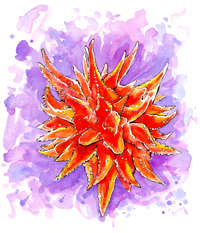
But what kind of art is it when even Robert Walker, a leading faux-finisher, calls the Las Vegas crafts boom ''not really creative''? With a few notable exceptions, like Dale Chihuly's glorious glass sculpture, ''Fiori di Como,'' in the lobby of the Bellagio -- which looks a bit like hundreds of multicolored sea anemones clinging to the ceiling -- most of the artwork is imitative rather than innovative.
EverGreene has created versions of paintings by Tiepolo and Veronese on the ceilings of the basilica-size hallways in the Venetian. This is not school of velvet art, however, or paint by numbers. The process is both complicated and alluring, involving layouts designed mainly on computer, transferred to canvases and then hand-painted in New York with acrylics. (Visually richer oil paint cannot be used, because all materials have to be fire-retardant.)
Sky Art, on the other hand, paints ceilings with spray guns and brushes. William Weidner, the president of Las Vegas Sands, which owns the Venetian, described his fascination at watching Karen Kristin, armed with walkie-talkie and laser pointer, shouting instructions to artisans perched on high movable platforms: ''I want wispy over there, lumpy over here. Deepen the sunset!''
Such a concentration of artists, Mr. Weidner declared with the ebullience typical of casino owners, just proves that these Las Vegas resorts are ''the W.P.A.'s of the 90's and the next century -- only this time, they are W.P.A.'s created by the private sector.''
There has been so much work in Las Vegas that it has even lured artisans like Erwin Antonitsch of European Design Iron. He left his native Austria with a journeyman's certificate in wrought-iron work, and eventually settled in Reno, Nev., where he forged the balconies and gates for the Paris casino. Another artist setting up shop in Las Vegas was Joan Morency of Color Alive, an ''aged wall'' specialist from Boston who made her local debut doing what she called ''10 days of cloud work'' at Caesars Magical Empire in 1996.
Mr. Venturi argues that one does not have to be original to be an artist. ''Michelangelo didn't invent new forms,'' he said. ''He just did them better. What visitors see in Las Vegas now is scenography that you walk through, a la Disneyland.'' It does involve ''a kind of artistry using iconography that maybe did not exist in the recent past,'' he added, ''but it is the art of stagecraft.''
It comes as no surprise, then, that many of the crafts specialists now working in Las Vegas acquired their skills in Hollywood and Disneyland. Mr. Dougall said he started working on the Caesars Forum Shops in the early 1990's, ''at the time Hollywood was in slump -- scenic artists started knocking on our doors.''
They have continued to come. But others arrive on the Strip equipped with degrees in fine art and find themselves awe-struck and energized, in spite of themselves. Marilyn Phillips, a sculptor, had never used Styrofoam until she came to Las Vegas but is now keen on it.
''It feels great,'' Ms. Phillips said as she put the finishing touches on a part-foam, part-clay column capital in the hangerlike studio of Treadway Industries. ''It's so fast, it's wonderful.''
The Treadway design manager, Mr. Hlusak, said that finding the right artist or artisan for the right job is not always easy. ''You can't go to a university and say, 'Give me your three best foam sculptors,' '' he said. ''What you find is your three best sculptors in clay. There's a two-week-to-a-month learning curve, but if they have an eye, they become trained in a new medium, and you are training a new genre of artisans.''
Budgets for theme decor have been expanding in the 1990's. Mr. Weidner of Las Vegas Sands said that $100 million had been spent on ornamentation at the Venetian. Charles Silverman, the president of Yates-Silverman, a Las Vegas design company that did the interiors of the public spaces at the Paris and all the interiors at New York New York, said his company put in ''40,000 design hours on Paris, and 25,000 on the entire New York New York, including guest rooms.''
But can this continue? Can Las Vegas, Our Lady of the Slot Machines, nurture a new generation of crafts workers?
Mr. Dougall, who said that the market for theming may be leveling off, sees plenty of opportunities for top artisans in theme parks, shopping malls and the casinos now being built around the world.
Las Vegas's artisans have found work in private residences, too. One firm, Projex, is custom-decorating a $5 million Roman-style home in Miami. The owner called after seeing the firm's statuary in Caesars Forum Shops. Moonlights Molds of Southern California, which made bas-relief panels for Bellagio and Paris, is ornamenting a $30 million house in the Bel Air section of Los Angeles. (The company also sells from a catalogue of rosettes, capitals and moldings in cast plaster, composites and fiberglass.)
And Karen Kristin recently finished painting a sky on the ceiling of the conference room in a private jet.
Casino chic: It may be coming to a home near you."
Anderton, F. "Put it on the ceiling and call it high art." The New York Times. October 14, 1999. acc. November 2, 2009. http://www.nytimes.com/1999/10/14/garden/design-notebook-put-it-on-the-ceiling-and-call-it-high-art.html?pagewanted=all
“Within the craft traditions, glass is particularly fruitful area for examining the relationship of old and new, the artistic strategies that might be described as adoptive and adaptive. Glass has a history dating back five thousand years, yet artists have been using it for purely personal aesthetic purposes only since the early 1960s (with a few isolated earlier instances). Today’s glass artists are nearly all art-school trained, not products of the apprenticeship system that dates to the beginning of the craft. They know the history of both the fine arts and the decorative arts. They have mastered their material, learning by experimentation as well as by studying with the great European masters who keep alive the traditions of the craft. This exhibition [Clearly Inspired, Tampa Museum of Art] aims to examine how contemporary artists working within the glassmaking craft traditions are reinterpreting them, carrying on the time-honored practice of adoption and adaption that has defined art throughout the millennia. These glass artists have been inspired and influenced by the past. Sometimes they have been challenged by it, as Barry Sautner was when he set out to duplicate and then surpass the achievements of the Roman cage cup makers. Or they have appropriated the old techniques and appearance, as Dale Chihuly has used the Venetian style for his own personal expression.”
Chambers, K.S. "Introduction: Revival and Revolution" in Clearly Inspired: Contemporary Glass and Its Origins. Tampa Musuem of Art, Pomegranate, San Fransisco. 1999
1999 Eric Scigliano:
"The New Northwest's distinguishing feature isn't rain or money or coffee. It's Chihuly. Not "Dale Chihuly." Not "glass art by Dale Chihuly." Chihuly is all you need to say, whether you're talking about a particular glass piece ("a Chihuly") or evoking the movement, the institution, the aesthetic, and the regional identity epitomized by the Northwest's (and the glass world's) most famous artist. Not since Bernini decked Rome with fountains, or at least not since the Wyeths became Maine's official art family, has an artist so exemplified the spirit of a city or region--and it took three generations of Wyeths. Chihuly's work doesn't say anything outright about us, but he's the best mirror we've got for divining what we've come to today.
A little background, with apologies to anyone who lives here and already knows it all. Dale Chihuly is the artist/celebrity who gets most of the credit for elevating glass blowing from one more craft to a bona fide--and wildly popular and lucrative--art form. He grew up in Tacoma, Seattle's soporific little-sister city, and headed first back East, and then to Venice, to study in the emerging studio glass movement. In 1972, on a tree farm north of Seattle, he founded the Pilchuck Glass School, which made that movement an institution even as he turned it into an industry.
Try as we may, we can't escape the glass Chihuly makes (or rather, has others make): the lurid "Venetians," writhing "sea forms," and extravagant, candleless "chandeliers" resembling giant wasps' nests or clusters of water-filled condoms. The loftiest galleries and living rooms out here have their Chihuly bowls; the crasser tourist galleries stock copycats. To gain "Seattle credibility," the apartment set in the sitcom Frasier sprouted one. No new cultural palace or festival shopping experience is complete without a Chihuly (click here if you think I'm exaggerating). Seattle's new symphony hall boasts two Chihuly chandeliers.
Chihuly himself is just as much a fixture as his Chihulys, especially in of the Seattle Times' gossip column. (Sample: "While a tour of the [Chihuly] studio is standard for celebrities, Bono did it one better. He tried his hand ... at glass blowing.") The Seattle Opera commissioned a set (in Mylar) from Chihuly. Only Leonardo da Vinci and King Tut have topped the attendance record set by Chihuly at the Seattle Art Museum. The first project Paul Allen picked for his new film company was a study of artists' inspirations, including ... you guessed it. But the ultimate confirmation of Chihuly's stature is the lottery hometown artists stage to mock Seattle's star-struck provincialism and celebrity fawning: The winner gets to "smash a Chihuly."
But Seattle still lags behind its erstwhile rival Tacoma in Chihuly-mania. For Tacoma, glass is a last chance at world stature. Its grandest landmark, the Neo-Baroque Union Station, has been renovated and reopened as a Chihuly showcase, with the mother of all chandeliers in its atrium and more big pieces scattered around. This is just the warm-up to the International Glass Museum (originally the "Chihuly Glass Center") being built on Tacoma's waterfront, reached by a 474-foot "Chihuly Bridge of Glass." Tacoma's captains of industry and finance all ponied up for it. As one of them told the Times, "Every downtown needs a niche."
Chihuly is the natural choice for Tacoma and not just because he's a native son. His is the perfect art for boosters, wannabes, new money, and self-conscious arrivistes. In other words, perfect for the precociously wealthy, culturally callow New Northwest. Glass has the museum seal of approval, but it's supremely and (as practiced by Chihuly) almost purely decorative--blissfully unburdened with threatening, ambiguous, or other meanings. "You don't have to be smart or art-historically sophisticated to understand these," a Chihuly's assistant explains in one of several documentaries on him by Seattle's public TV station. "They're merely beautiful." Forget Sister Wendy and her gloomy paintings; glass, shimmering and vacant, is the ideal TV art, a match for Riverdance and the tenors.
Glass also suits a money-drunk, technology-intoxicated place like the Northwest. It's showy and luxurious, as glittery as jewelry and a hundred times bigger. It's hard, slick and, literally, edgy. At the same time, Chihuly taps an earlier, earthier ecotopic sensibility. His forms evoke not only phalli and vaginas but sea squirts and anemones--the marine biosphere that sustained the first Northwesterners, which we still delude ourselves into thinking we're sustaining. His "baskets" mimic Native American basketry outright. The implicit, if wishful, message: We can have our machines and money and preserve the wild, unspoiled Northwest.
But beautiful Chihulys are just part of the Chihuly phenomenon. Chihuly himself is the main show. With his rampant curls, bluff growl, black eye patch, and bright-colored pirate shirts and scarves, he's the perfect foil to geek chic, a year-round version of the "Seafair Pirates" who frolic at our big summer parade--the artist for the new buccaneer capitalism, the jester who amuses (but never challenges) the geeks. He reprises the Renaissance role of artist as courtier, standing like a third senator onstage when President Clinton visits, partying on Paul Allen's yacht with Robin Williams, Candice Bergen and, of course, Bill and Melinda Gates. This year, when Gates hosted his annual CEO Summit, the world's most celebrated gathering of tycoons, who provided the entertainment? The Vienna Philharmonic and, with "an exhibition of glass-blowing art," Dale Chihuly.
Not that he blows glass himself, though he still says things like this, from the 1994 book Chihuly Baskets: "Glass blowing is a very spontaneous medium, and its suits me. ... I've been at it for thirty years and am as infatuated as when I blew my first bubble." Chihuly hasn't actually blown since 1976, when an auto accident cost him an eye and his depth perception--and made his career. He acquired the trademark dashing eye patch, without which he'd be just another chubby little guy with frizzy hair. And he hired other people, including top Italian masters, to blow more glass than he could alone--enough to make him the Christo of glass, decking Northwest streams and (you've gotta admire the chutzpah) Venetian canals with bright globes and tubes.
The Eye-Patched One has gone far, and so has this town. How far? Consider the other time, 50 years ago, that Seattle had a distinctive, defining artistic tradition--and not one but two celebrity artists. Morris Graves, Mark Tobey, and others in the generation later dubbed "Northwest visionaries" drank deep of both the drizzly, mossy natural scene and of Asian art and philosophy. Tobey sketched spinach hawkers and bums at the downtown Pike Place Public Market and was sometimes mistaken for one. Graves hid out in the deep woods. Tobey painted calligraphic "white paintings" and Graves bodhisattva birds, in delicate gouache and pastel--media notably unsuited to large atriums. Today these seem as quaint as hand-bound books or handwritten letters.
Chihuly
succeeds because he's not a maker of art in the usual sense; he's a coach, ringmaster, and impresario--and, above all, an entrepreneur. No one expects entrepreneurs to do the production work. No one argues anymore over whether Gates is really a techie or worries about Jeff Bezos' literary taste. And no one cares whether Chihuly blows glass.
Like Seattle's software, bookselling, and coffee tycoons, Chihuly has triumphed by marketing and branding the hell out of his product, elevating it to something at once precious and ubiquitous. The Northwest trick is not so much to create something out of nothing as making something very large out of something small, and then repeating the process. A hundred million PCs, a billion "personalized" book and CD sales, a zillion cups of coffee ... or hundreds of chandeliers made of brittle blades of glass. Which is, after all, just melted silicon."
Scigliano, J. "Heart of Glass." Slate Magazine. June 10, 1999. website accessed June 2, 2009. http://www.slate.com/id/30161/
"For most of his career, Isleta artist Tony Jojola has walked a lonely path.
"When it came to Indian artists working in blown glass, I used to be the only one out there," he said.
But today, more than two decades after his graduation from the College of Santa Fe, Jojola isn't just watching other Native American glass artists develop, he's teaching them how it's done.
Jojola, whose one-artist exhibition of fine art glass opens Friday at Santa Fe's Columbine Gallery, has long made traditional Native American art forms such as Pueblo pottery, basketry and weavings. While that artistic direction continues, what also occupies much of his time these days is his commitment to teaching at-risk and minority youth about the challenge of creating fine art glass.
That's why, when his exhibition opens at Columbine Gallery on Friday, Jojola will make room for a dozen glass works of art blown by students of the Taos branch of the Hilltop Artists in Residence program, which is based in Tacoma, Wash.
Since opening its New Mexico facility earlier this year in a Taos industrial park, Hilltop has worked with youths from the local school district as well as Taos Pueblo's schools. Jojola is the Taos program's head of instruction.
Best known in art circles for his close association with America's foremost glass artist, Dale Chihuly, Jojola labored for years as one of Chihuly's part-time studio assistants.
In 1996 he was presented with an opportunity to become a key part of an art education project targeted toward at-risk youth in Tacoma, which is Chihuly's hometown.
That project, which has not only received Chihuly's blessing but also his constant attention in the form of creative and hands-on oversight of its operations, is the Hilltop Artists in Residence program. It's located in Tacoma's Hilltop neighborhood on the grounds of an aging middle school.
As lead instructor of the program's glass blowing project, Jojola said he worked primarily with African American, Asian and Hispanic youths.
"When I started a career as a glass artist, I'd dream about what I'd be doing in my future," said Jojola during an interview in the Hilltop Artists in Residence Taos studios. "But now, it's my life that's a dream, and I'm sleeping better each night."
Along with director Kathy Kaperick, who also relocated to Taos from Hilltop's Tacoma facility as program director of the New Mexico program, Jojola has set out on a mission he characterized as "exhausting, but rewarding."
"What we're all about is working with high-risk kids and teaching them to work with us in glass blowing as a way to get them interested in finishing their education and maybe exploring the possibilities of a career in art," he said. "This is a medium that teaches responsibility, teamwork and focus. And if you don't work by its rules, it quickly becomes a very dangerous activity.
"For kids who think they're hot stuff, getting around this sort of hot stuff is a fast way to learn lessons about trust, self-worth and respect."
Jojola said the program's long-range goal is to build a facility on Taos Pueblo land. That structure, planned to be 15,000 square feet, would be used for glass art instruction and exhibition.
Tony Jojola exhibition of glass art
WHEN: Friday through Aug. 30; Opening reception 5 to 7 p.m. Friday
WHERE: Columbine Gallery, 211 Old Santa Fe Trail (inside Hotel Loretto)
HOW MUCH: Free"
Villani, J. "Native American artist crafts glass career for self, others." The Alburquerque Journal. July 25, 1999.
1999 Keith Raethner:
"In his mind's eye, Isleta Pueblo sculptor Tony Jojola already can see the forms: water jugs, seed jars, decorative pots of every design and description, all blessed by the same sacred element as clay-fire-but made of a substance that radiates the sun-glass. Lloyd Kiva New (Cherokee) believes a studio glass center and glass-blowing project now taking form at Taos Pueblo will evolve into "one of the most significant Native American art movements since beadwork in the 1700s and metal-smithing and the use of silver in the 1850s."
In his mind's eye, Isleta Pueblo sculptor Tony Jojola already can see the forms: water jugs, seed jars, decorative pots of every design and description, all blessed by the same sacred element as clay-fire-but made of a substance that radiates the sun-glass. Lloyd Kiva New (Cherokee), the former Institute of American Indian Arts president who established a glass-blowing program at the Santa Fe school in the 1970s, sees more. He believes a studio glass center and glass-blowing project now taking form at Taos Pueblo will evolve into "one of the most significant Native American art movements since beadwork in the 1700s and metal-smithing and the use of silver in the 1850s."
![]() |
|
"There's a revolution happening on the pueblo," Jojola adds. "What we're really starting at Taos is a national Native American glass-art movement."
It took twelve months and countless tribal council meetings to take the revolution at Taos Pueblo beyond mere talk. Last summer, the council made an agreement with the Hilltop Artists in Residence of Tacoma, Washington, to build a 15,000- square-foot studio glass center, production shop, exhibition space and plaza on two acres of reservation land. The center will serve the entire pueblo community-children, adults and elders. Artwork made by the tribe will be sold and marketed nationwide. A percentage of sales will go to the artists. The rest will go to a special fund for community programs, from organic agriculture to preserving the Tiwa language.
But the Hilltop program at Taos is more than a revolution. The program promises to inspire a whole new generation of young Pueblo artists, some of whom are at risk of failing school or, worse, getting involved in crime.
The $1.5 million project broke ground last October and is scheduled for completion sometime in late summer. It is the first joint venture in the history of the Taos tribe, according to former Governor Ruben Romero, under whose administration the enterprise took root. "The program is a chance to give our (people) a place to make something and make something of themselves," Romero says.
The project's goal of helping at-risk youth is, like the glass-blowing component, modeled on the Hilltop program. Kathy Kaperick, with the materials and counsel of master glass artist Dale Chihuly, started the Hilltop Artists program in 1994 behind Jason Lee Middle School in Tacoma's Hilltop district. The goal was education, a way to get disadvantaged and disenfranchised youth, primarily African-American, back in school. The hook was glass.
The project took off like Michael Jordan's vertical leap. The Hilltop's "at-risk" youth turned into risk-takers. Out of 2,500-degree furnaces came glowing art formed and reformed by kids otherwise headed for Tacoma's detention centers. "All kind of kids coexist in the hot shop," says James Kinnard, a student teacher in the Tacoma program who has since been nominated to the national Academy of Achieve-ment for high-school students. "Can't say where I'd be without it, but I'm pretty sure I'd be gettin' there in something stolen."
In five years, the Hilltop program has become a national model. In Tacoma, the hot shop serves hundreds of youths through classes thirteen hours a day, five days a week. Exhibitions of student work are organized several times a year and always sell out, bringing significant earned income into the program. Commissions for art from local businesses, another source of revenue, continue to grow. Both the CBS and the Bravo television networks have produced documentaries on the Hilltop program and Home Box Office has a project in the works.
"Forty percent of what happens (in the hot shop) is glass, 60 percent is social work," Jojola says. "The kids require attention because they never got it anywhere else-but it works. Every day, they're more engaged."
Taos Pueblo, nestled in the Sangre de Cristo Mountains of northern New Mexico, is far removed from Tacoma's inner city. Yet, the same problems exist on the reservation, population 2,000. Drugs, gangs, lack of opportunity and general apathy are acknowledged facts on the reservation. Unemployment is nearly 80 percent.
![]() |
"There is an element of the glass project that Western profiteers may not understand," former tribal Secretary Richard Deertrack adds. "The money isn't our first interest. The preservation and advancement of our culture and its artistic traditions is our first priority."
Until last year, glass-blowing was foreign to the Taos tribe, whose artistic tradition is grounded in drum-making and micaceous pottery. Indeed, glass-blowing is little known among Native artists. Jojola, senior instructor of the Hilltop Artists program in Tacoma, has sculpted glass for more than twenty years, initially under Chihuly, honorary co-chairman and spiritual emissary of the Taos project. But the total number of Native artists working in the medium can be counted on one hand.
The "studio glass" movement in America took form in 1962, when Harvey Littleton and Dominick Labino devised a small portable furnace and a batch formula for melting glass at a lower temperature. Glass-blowing was freed from the limits of factory production and, suddenly, the seductive properties of glass-transparency, color, liquidity and general luminosity-were exploited to their maximum artistic effect.
In 1966, Tacoma-born Chihuly was a Fulbright fellow studying at the Venini glass factory in Italy. He assimilated the Venetians' secrets about glass into programs at the Rhode Island School of Design, where he taught, and the Pilchuck Glass School in Stanwood, Washington, which he founded with Native American art collectors John Hauberg and Anne Gould Hauberg in 1971. Nearly thirty years later, Kiva New calls Chihuly "the reigning maestro of modern glass."
The same summer that Chihuly started Pilchuck, his colleague Jamie Carpenter began collecting Northwest Coast baskets. Later, when the two were visiting the Washington State Historical Museum in Tacoma, they chanced upon a collection of Native baskets on the third floor. A seed was planted for Chihuly and in turn a handful of Native artists were captivated by the maestro's imaginative possibilities for glass.
Jojola, 40, left Isleta Pueblo to study with Chihuly at the IAIA and to apprentice under him at Pilchuck. Thirty-four-year-old Preston Singletary, whose grandmother was full-blooded Tlingit from southeastern Alaska, also joined Chihuly at Pilchuck and at The Boathouse, Chihuly's glass-blowing studio at Lake Union in Seattle.
Singletary draws from the traditional symbols of Northwest Native culture for his sculpture. His favorite form, the Tlingit rain hat, is a delicate but durable balance of traditional design and modern expression.
Singletary has answered several times the claim that glass-blowing flies in the face of Native artistic traditions. He sees the medium as "a progression of those traditions."
"Any artist," Singletary says, "makes his own individual assessment of the object he's working with, and the idea, I think, is more important than the medium. Glass-blowing will be a tremendous inspiration to Native American artists because the process itself is so dynamic and creative, so full of immediate possibilities. The spontaneity and energy of the moment and the rhythm of working as a team, which glass-blowing requires, is enormously exciting."
Similarly, Taos Pueblo leaders see glass-blowing as an expansion of Native cultural traditions. "Fire is a crucial element in glass-blowing, and it's [fire] always been an essential element in our tradition," Deertrack says. "People are taught to fear it, but fire has always been our friend."
Deertrack and his fellow tribal council members didn't buy into the Hilltop program without assurances. They needed to be convinced that the Hilltop model in Tacoma had value as an artistic venture and as a social healer.
Taos is arguably the most traditional of nineteen Pueblo tribes in the Southwest. Electricity and running water have come to the reservation, but not into the original North Pueblo and South Pueblo structures. Many of the tribe's most important decisions are made in kivas up to 800 years old. Members of the governor's and war chief's offices are appointed by caciques, or religious leaders. The same rules of order apply for the fiscales, who attend to the affairs of the Roman Catholic Church on the reservation.
Convincing the tribal council of the social and artistic potential of the glass-blowing project was difficult. Tribal councils at Taos Pueblo had heard many proposals-joint-venture schemes for organic fertilizers and a motorcycle maintenance program, to name just a couple. To make matters more fragile, there is no word in Tiwa for what the Hilltop group was proposing. The closest to "glass-blowing" that tribal council members could come to in their own language was "blowing bottles."
Undaunted, Kaperick, a 41-year-old Anglo woman, went before the full council with a proposal in April 1998. It was June before she was invited back. But on June 10, the council passed a resolution establishing "a glass (art) venture to train and direct tribal youth and adults in the production and marketing of blown glass and related glass products."
Instructors and senior students in the Tacoma program will travel to Taos to help Jojola teach glass-blowing to the tribe. In turn, Taos Pueblo youth, parents and elders will be selected for residencies in Tacoma to learn the exacting art of glass-blowing.
Construction of the project's glass-blowing studio at the pueblo is slated for late spring, but the cultural exchange between Tacoma and Taos already has begun. Last November, at the invitation of the Hilltop group, twenty members of the Taos tribe, ages 8 to 82, went to Tacoma and Seattle for a five-day crash course. They visited Chihuly's studio in Seattle, where they tried glass-blowing for the first time. Then they toured the Hilltop hot shop in Tacoma, where they saw the program in full production and blew more glass.
Shortly after the group tour, Jojola took 18-year-old Ryan Romero to Tacoma. He is the first of the Taos tribe to train at the Hilltop. "Now the project is real in the eyes of the Pueblo people," Kaperick says. "They can trust it."
"I can tell the project will soar because the beginnings are so positive," says Kiva New, who went on the Tacoma trip. "There's a spirituality on both sides. That means everything to the Taos people."
Chihuly especially recognizes the cultural bond between Tacoma and Taos and the larger implications for the Pueblo community. "Glass-blowing is an art form that works as a team," he says. "At Taos Pueblo, you have a community whose whole tradition is teamwork."
Kaperick and the Hilltop team in Taos didn't wait for the permanent glass studio to be built in order to get the project up and running at the pueblo. This March, Kaperick and the Hilltop team in Taos plan to install on the reservation a "portable" hot shop-including a molten-glass furnace, two glory holes (reheating chambers), and one annealing oven-so that the glass-blowing wouldn't have to wait for the permanent facility to be built. Discussions between the Hilltop group and administrators at the Native American Preparatory School in Santa Fe also have begun to establish an exchange program that would bring NAPS students to the Taos studio for residencies to supplement their studies.
"I think the glass-blowing project in Taos is going to be an incredible opportunity to introduce Native Americans to an art form that will spark their imagination and provide a medium of expression to strengthen, not weaken, their traditions," says Singletary "As a Native American, I can't wait to see what new ideas come out of the program and turn heads in the art world."
Singletary and Jojola, who met at Pilchuck in 1984, used to work together at Benjamin Moore Glass Art Inc. studio in Seattle. They also collaborated on a Chihuly team that assisted Italian glass master Lino Tagliapietra. Now that the Hilltop project has come to the mountaintop at Taos, Singletary is champing at the bit to visit the pueblo to share his work with other Native American artists.
Says Singletary, "I welcome the opportunity to share what I've learned, especially knowing what may come of it." "Raethner, K. "Through a glass brightly." Native Peoples Magazine. May 1, 1999. website accessed May 30, 2009. http://www.nativepeoples.com/article/articles/146/1/Through-A-Glass-Brightly/Page1.html/print/146
A game show for curators: Amgueddfa Cymru, come on down!
Photo Credit: from ArtDaily.org, taken by Mark Crick. http://www.artdaily.org/index.asp?int_sec=2&int_new=30881From the Art Fund website: "Art Fund Collect will take place on 14 May, the preview day of Collect, Europe’s leading contemporary crafts fair. Now in its sixth year, Collect will be presented over three floors of the Saatchi Gallery’s new space in London for the first time. In a competitive challenge, shortlisted curators of public collections will have just one hour to choose an object for their museum or gallery’s permanent collection, ahead of private collectors. A panel of judges will examine their choices and decide who will win a share of the £75,000 prize from The Art Fund." Unknown. "Ten curators in the running for a share in £75,000 prize for contemporary craft at Collect 2009." April 8, 2009. website accessed May 28, 2009. http://www.artfund.org/news/832
"Independent charity The Art Fund and the Crafts Council today announced the winners of Art Fund Collect, a £75,000 award for curators to acquire a piece of contemporary craft for their museum or gallery.
Art Fund Collect took place yesterday, 14 May, the preview day of the Crafts Council’s international fair Collect, held at London’s Saatchi Gallery.
The winners are: Aberdeen Art Gallery; Amgueddfa Cymru – National Museum Wales; Bilston Craft Gallery, Wolverhampton; mima, Middlesbrough Institute of Modern Art and the V&A.
Aberdeen Art Gallery selected Neckpiece, 2009 by Umbria-based British jeweller Jacqueline Ryan for £26,550. Made from 18-carat gold, enamel and garnet, the piece displays the artist’s interest in natural formations.
Amgueddfa Cymru – National Museum Wales selected Red Stripe, 2008 by British glassmaker Rachael Woodman for £6,500. Dramatic in its use of colour, the work consists of eight glass tubes on a slate base.
Bilston Craft Gallery selected Propagation Project; Lichen Petals, 2009 by Japanese designer Junko Mori for £8,500. This highly dramatic, naturalistic work imitates the formation of lichen and is made from hand-forged steel.
mima, Middlesbrough Institute of Modern Art selected Bracelet, 1999 by Italian goldsmith Giovanni Corvaja for £29,000.
The piece is made from 18 carat gold and 22 carat gold wire and juxtaposes intricate detail with bold geometric shapes.The V&A selected Free Essence-6, 2009 by Japanese glassmaker Niyoko Ikuta for £5,700. This twisted, spiralling object consists of thin sheets of plate glass layered to trap the light.
In a nail-biting race around Collect, ten shortlisted curators from around the UK had just one hour to select a new object for their museum or gallery.
An expert panel then selected the winning curators, awarding them a share of £75,000 to acquire their object outright. mima wins for the second time this year.
Andrew Macdonald, Deputy Director of The Art Fund, said: "These five museums have each come away with a beautiful and inspiring object representing the very best in contemporary craft. Art Fund Collect is proving to be a wonderful way for curators to be bold and select outstanding works ahead of private buyers, for the public to enjoy."
Rosy Greenlees, Executive Director, Crafts Council, said: "I extend my congratulations to the winning museums and galleries. The Crafts Council aims to make the UK the best place to make, see and collect contemporary craft, and Art Fund Collect is central to achieving all these objectives, supporting makers, public collections and opportunities for visitors to see the very best craft."
Now in its second year, Art Fund Collect was set up in 2008 by The Art Fund, the UK’s leading independent art charity and the Crafts Council, the national development agency for contemporary craft, to encourage museums and galleries around the country to acquire the best in international contemporary craft. Due to the success of last year’s Art Fund Collect, The Art Fund increased the prize from £50,000 to £75,000 this year.
A total of 23 applications were received for Art Fund Collect in February 2009. The
final shortlist of ten was announced in April.Now in its sixth year, Collect takes place from 15 – 17 May 2009 at the Saatchi Gallery, Duke of York's HQ, King's Road, London, SW3 4S"
Unknown. "Five UK museums win share of £75,000 prize for contemporary craft." May 15, 2009. website accessed May 28, 2009. http://www.artfund.org/news/archive/850
"Art Fund Collect took place yesterday, 14 May, the preview day of the Crafts Council's international fair Collect, held at London's Saatchi Gallery.
Andrew Renton, Head of Applied Art at Amgueddfa Cymru - National Museum Wales, was among ten curators to take part in a nail-biting race around the fair, with just one hour to select a new work for their museum or gallery.
An expert panel then selected the winning curators, awarding them a share of £75,000 to acquire their object outright.
Andrew Renton selected Red Stripe, 2008 by Rachael Woodman, for £6,500. The piece comprises eight coloured glass tubes on a slate base, brought alive with its dramatic use of colour. Rachael Woodman is an English glassmaker based in Bath. This work is the product of her collaboration with glassblower Stuart Hearn.
Andrew Renton said: "It's extremely encouraging for us that the Art Fund has recognised the National Museum's ambitions for its craft collections and enabled us to acquire a major new work. The Art Fund Collect scheme has done a wonderful job in boosting the confidence of curators of Britain's craft collections, and through this acquisition will now help the National Museum realise its potential to play a full part in the vibrant craft scene in Wales. Significant craft works like this by the best artists and makers will soon make an important contribution to the Museum's redeveloped galleries of modern and contemporary art.""
Unknown. "Amgueddfa Cymru – National Museum Wales wins share of £75,000 contemporary craft prize". May 15, 2009. website accessed May 28, 2009. http://www.museumwales.ac.uk/en/news/?article_id=519
Wednesday, May 27, 2009
2006 part two
2006 National Endowment for the Arts:
"
| |
| Artist Mitchell Gaudet applies the finishing touches to a sculpture in the Museum of Glass hot shop. Photo courtesy of the Museum of Glass | |
Although glass making might often be thought of more as a craft than an art form, the Museum of Glass, which opened in July 2002, celebrates the contribution glass artists have made to contemporary art. In its three galleries and surrounding outdoor space, the museum presents exhibitions and installations in glass, mixed media with glass, and in other media by internationally recognized artists, bringing in more than 170,000 people annually. The museum also houses the world’s largest hot shop amphitheater, which allows visitors to watch as many renowned and emerging guest artists create their artworks.
In FY 2006, the Museum of Glass received an NEA Access to Artistic Excellence grant of $35,000 for its 2006 Visiting Artist Program in which 20 artists from both the United States and around the world participated in five-day residencies at the museum.
Celebrated Czech artist René Roubícek’s residency from April 12-16 coincided with the exhibition, Czech Glass, 1945 – 1980: Design in an Age of Adversity. During his residency, Roubícek worked with fellow Czech artists Petr Novotny and Jirí Pacinek in the museum’s hot shop, creating bowls and vases, glass clarinets, and 10-foot-tall glass columns. All three artists participated in a panel discussion on their experiences working in the changing Czech political environment.
During another artist residency in August 2006, Mitchell Gaudet created a series of bowls and house forms with shapes, colors, and textures inspired by the ruined areas of New Orleans, his hometown. His personal photographs taken of both the destruction and recovery efforts in New Orleans were displayed on a big screen in the hot shop while he worked."
NEA "NEA Spotlight: Museum of Glass (Takoma [sic], WA)." 2006 Annual Report quoted on NEA website. Accessed June 19, 2009. http://www.nea.gov/features/storiesCMS/story.php?id=2008_02_02
Also supported in 2006 by the NEA were Pilchuck Glass School and Creative Glass Center:
"Pilchuck Glass School
Seattle, WA
$30,000
To support a summer artist residency program. Ten distinguished artists whose medium is not glass will be invited to one of the country's preeminent glassworking facilities.
Wheaton Village, Inc. (on behalf of Creative Glass Center)
Millville, NJ
$15,000
To support a residency program for emerging and mid-career glass artists. Artists will be provided with housing, a stipend, studio facilities, and technical assistance to work in glass."
NEA Visual Arts Grants 2006. accessed June 19, 2009. http://www.nea.gov/grants/recent/disciplines/Visualarts/06visual.html
"

Kiki Smith: Lilith, 1994. Siliconbronze and glass.
Most art critics and art journalists avoid art issues. The products are described, sometimes adequately, sometimes not. Meanings are avoided, possibly because in most cases there are none. This might have been understandable in a time like the '80s, when art issues almost sank the ship, but nowadays, when the only issue is whether or not the art fairs will kill off Chelsea, we could use a few issues again.
"Kiki Smith: A Gathering, 1980--2005," which originated at the Walker Art Center and is now at the Whitney in New York (through February 11), brings up a lot of issues that some, I fear, would like to forget. That there is more going on in Smith's art than in the luxury products or investment markers now being offered in most galleries drives some people nuts.
Just when you thought all that feminist stuff had disappeared, here it is again. And more. To put it bluntly, does the body as an art topic still have legs? Is sex and gender passé? What do women artists want? What is the relationship of the body to language, to myth? Why are craft materials and craft techniques more or less still forbidden in the art world? What is an oeuvre? A signature style? What is the relationship of biography to photography? Who's image am I? How can pain and fear be expressed in art? Grief?
Also, now that we know that a major influence on Smith has been Nancy Spero, when will we get the Spero survey we deserve? Can we look at Smith through Spero and Spero's Artaud lenses? Dare we compare Smith to Beuys? Or is that like comparing hares and coyotes to wolves? And, in terms of materials, is glass the new fat?
A once-upon-a-time fan -- at least I think he was such -- attacked me at a party by saying that he liked reading me but that I was always solving problems he didn't know he had.
Answer: And now you know you have them, so you had better start thinking.
* * *
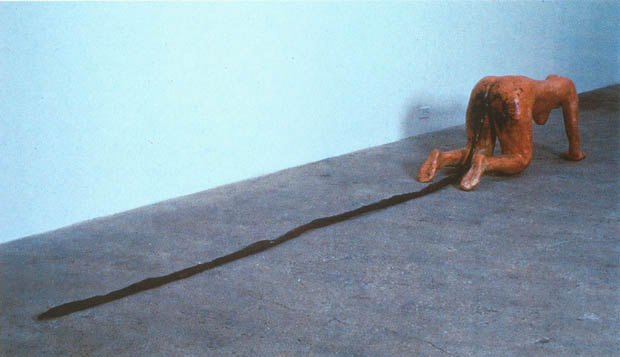
Kiki Smith: Tale, 1992. Beeswax, microcrystaline wax, pigment, and papier-mache. Not at Whitney.
Birds Flying Around in Her House
A fellow art critic recently catalogued 34 materials used by Smith in the Whitney show, leaving out glass. How could he ignore glass? I counted 14 pieces made of glass. Invisible glass. Evil glass, I guess. The same writer, glorying in a not very funny paradox, calls Smith a major figure who makes minor art. Is her use of craft materials and methods what makes her minor? I also detect his usual loathing of the political. What else could calling Smith the "leading light of communally minded downtown avant-gardes" mean? Was there something wrong with being against the U.S. Nicaragua incursion or calling attention to AIDS?
One reason Smith is major is that she is fearless when it comes to materials, no matter how despised or humble. And, as the exhibition shows quite clearly, she employs beeswax, glass, clay, fabric and paper toward astoundingly expressive ends. If anyone thinks her work is just about material and form, then he needs his eyes examined. There are reasons for body parts and full-body casts, for representations of body fluids and eventually monsters, myths, and magical beasts.
Three of Smith's most powerful nudes are not included in the survey at the Whitney --- Pee Body, 1992; Untitled (Train), 1993; and Tale, 1992. The first two are made of wax and glass beads. In the first, yellow glass beads clearly represent urine; in the second red ones emerge as menstrual fluid. In her catalog essay "Unholy Postures: Kiki Smith and the Body," art historian Linda Nochlin is particularly enamored, if that's the right word, of Tale, which depicts another naked woman, but with a long tail of excrement coming out of the appropriate opening. It is a shame these sculptures were not included, but obviously there's still enough indelicate material to discombobulate delicate souls. Even empty bottles labeled with the names of various body fluids ---Untitled, 1987, originally shown at MoMA-are enough to disturb.
Some are also strangely offended, it appears, by Smith's high visibility. She was indeed carried aloft as Art Goddess in Francis Alÿs' 2002 art parade from Manhattan to Queens, when part of the MoMA permanent collection was temporarily moved. There is also no denying she is the daughter of Tony Smith, who, by the way, will be seen as one of the great sculptors of our time, along with his daughter.
Smith claims not to have been reacting against her father's clean, clear, abstract, geometric sculptures -- she and her sisters even helped with making the cardboard maquettes, a story everyone repeats -- but instead was influenced by his devotion to art. Wouldn't this unfamilial devotion be annoying to a child? Perhaps she protests too much. She didn't start making art until he had passed on. The sons and daughters of famous fathers or mothers (I've known a few) have a hard go of it; don't let anyone tell you otherwise. Any material or leg-up advantage is cancelled by the hard-act-to-follow syndrome or simply the normal need for approval.
Smith, who never went to Yale, or Rhode Island School of Design, or Columbia Teachers College, or any other art school, never felt the need for a proper studio and to this day blends living and working. And, of course, when required she works at foundries, residencies and workshops. You are not expected to pour your own bronze or blow your own glass. Sewing and drawing is possible at home, as it were, but other forms of making are more specialized, and you need furnaces and people with specialized skills. Minimalism made outsourcing a visible part of its aesthetic. Kiki inherits that, but gives it her own, handmade twist.
If nothing else, one of Kiki Smith's great contributions to art culture is this fact: artists don't need big clean studios. Perhaps we can bury that requirement once and for all. If you can't imagine how an artwork will look in a gallery without an ersatz gallery to see it in, then you shouldn't be looking at art. Too often, dealers, curator, and collectors require the perfect white-walled studio, or they do not take the artist seriously -- even though all it means is a mommy or daddy who can come up with the bucks.
I remember an artist whose work I had followed for years telling me a horror story. He came from a poor background and liked working in a modest, cluttered apartment. In fact, his apartment on the Lower East Side was part of his art. He was able to move to a bigger place in Hell's Kitchen (now called Clinton), but soon it was merely a double-size version of his tinsel-strewn downtown digs. Once, an extremely famous and well-connected curator from Europe paid a visit. He took one look at my friend's amazing workplace and, proclaiming "I cannot look at art in a place like this, you are not a serious artist," marched right out the door.
Alice Neel painted in her living room. So did Hopper.
Kiki Smith, I am told, has birds flying around inside her house.
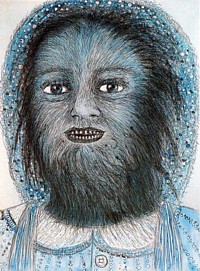
Kiki Smith: Wolf Girl, 1994. Etching
She Is Our Shaman
As an art-world personage, Smith is indeed strange and dreamy, with her mane of silver hair; but her art is deeper than fashion. What other artist do we know who, since Joseph Beuys, has attempted so much? She is our shaman.
A naked woman stepping out of the body of a dead wolf, as in Rapture of 2001? A hirsute Little Red Riding Hood as in Daughter of 1999? This is not the kind of art you can dismiss as bad form. It is not about formal values. Cross-culturally, shamans get their bodies cut up and they are reborn with a suitable animal guide. Smith has moved from body parts, to whole bodies, to saints and wolves."
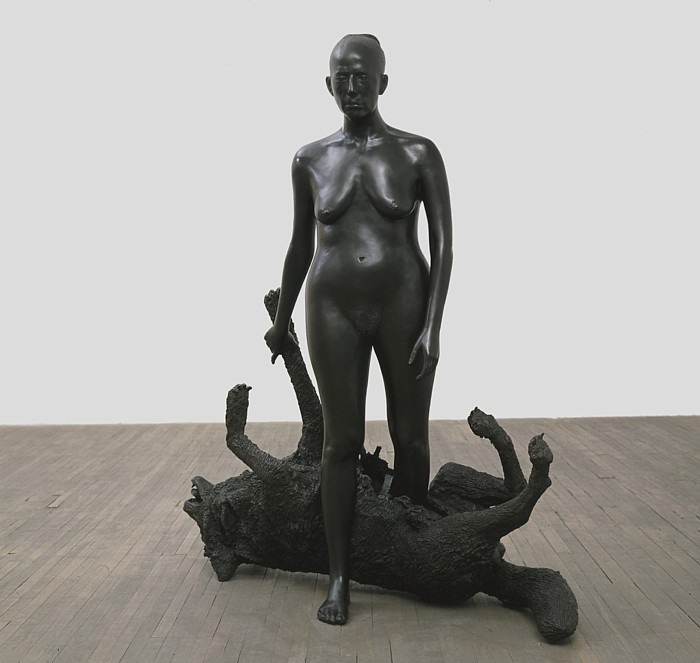
Kiki Smith: Rapture, 2001. Bronze
Perreault, J. "Kiki Smith: glass is the new fat." December 4, 2006. Artopia blog. accessed June 19, 2009. http://www.artsjournal.com/artopia/2006/12/kiki_smith_glass_is_the_new_fa.html2006 Business Wire:
"CHICAGO -- Global Arts Publishing LLC today announced the launch of World Art Glass Quarterly at the Sculpture Objects & Functional Art (SOFA) show. An upscale magazine, it is the only publication to focus solely on architectural and art glass. In the inaugural issue, featured artists include British artist Peter Layton, Savoy Studios, Bernard Katz, Melissa Ayotte, David Ruth, Rich Samsel, and the Tacoma Museum of glass. Upcoming issues will be featuring world famous artists such as Susan Rankin, Rick Satava, George Bucquet, Rick Strini, Steven Lundberg, and Narcissus Quagliata.
The magazine is filled with articles and photos, which allows readers to be immersed in the beauty of glass and the inspirations of the featured artists. The magazine itself is a work of art and something that can be displayed on coffee tables and in reference libraries. World Art Glass Quarterly offers large galleries as well as smaller galleries and artists the opportunity to connect with the world-wide community of collectors, designers, architects, and studios.
"The quality of our Quarterly is unmatched in print quality, photography, writers and layout," said Curt Walton, co-founder and editor-in-chief of Art Glass Quarterly. "It is a world-class publication that showcases the finest glass artists throughout the globe."
World Art Glass Quarterly will be available November 24, 2006 at Borders, Barnes and Noble, and other fine bookstores throughout the United States and the U.K. Cover price is $11.95. For more information or to subscribe to the publication, visit www.artglassquarterly.com."
Unknown. "World Art Glass Quarterly Magazine Focuses Exclusively on Architectural and Art Glass." Business Wire. November 10, 2006.
2006 Regina Hackett:
"Dale Chihuly is the most inventive glass sculptor in the history of the medium, but a massive career and many honors have not insulated him from personal and professional troubles that trail him lately like a bad smell.
A few weeks ago, the bad smell metaphor took material form.
Standing in an ornate garden surrounding a mansion in Medina, this son of a Tacoma meatpacker and union organizer frowned and checked his shoes.
"Did I step in something?" he asked. The garden was lovely, but the stink of fertilizer was overwhelming.
"Pig shit," he said. "Sometimes you can't get away from it."
You wouldn't know it to look at his work. Full of play and dazzling in its high theatrics, his sculptures give voluptuous shape to excess, making it shine.
But at age 64, he's where he never wanted to be, in court. He's suing two glass blowers for copyright infringement, contending they're imitating his work. They're threatening to sue him back, questioning whether Chihuly is the creative intelligence behind the art bearing his signature. And a former dealer is attacking him with a gusto rare in the art world. If that's not enough, his feet hurt.
Emotionally, he has been through the wringer.
Since 2001, a significant number of the people closest to him have died, some without warning. Partially because both his brother and father died in quick succession in his teens, he tends to experience each death as a blow to the body.
Last year he sank into a depression from which he is now recovering. Friends who haven't seen him in many months are being invited over for dinner. Another sign of his recovery: He married Leslie Jackson, his long-term girlfriend (and mother of his 8-year-old son) late last year. In the wedding photo, he's trying on a smile like a cautious man venturing into new land.
Interviewed several times in recent weeks, Chihuly appears to be a fragile version of his old self, but he becomes animated when talking about his work, his young son, the fine BLTs at a nearby diner and the movies. Chihuly loves the movies.
A mark of his distraction is how few he has seen lately.
He used to pop up everywhere in his pastel shirts, paint-splattered shoes and rakish eye patch. Although he travels less now, wherever he goes he's there already, with installations in seemingly numberless art museums and with glass vegetation giving God's handiwork a run for its money in garden conservatories, parks, public pools and aquariums.
That's not counting the tens of thousands of Chihulys resting on tabletops, floating in pools and hanging in brazenly spectacular chandelier form from the ceilings of private homes. Add his splatter paintings and thousands of lithographs, hundreds of picture books, DVDs, posters and notecards churned out by his Seattle publishing arm known as Portland Press, and the man's an industry.
Glass artist Benjamin Moore called Chihuly the most generous person he has ever known: "He's generous with everything, his friendship, his time, his loyalty, everything. But is he difficult? That's putting it mildly."
Bipolar disorder
Starting in his 40s, Chihuly has suffered from bipolar disorder. One glass blower said working for him was like reading tea leaves. "You have to allow for the emotional thing and work around it," he said.
Chihuly said he understands the problem more than he used to. "I thought I couldn't work well when I was down, but then I noticed the work could still be good," he said. "The reverse is true, too."
That means because quality of the art doesn't necessarily relate to the mood swings, he decided to balance them out medically and save his own life.
Glass artist William Morris said it's nice to see Chihuly return to the land of the living. "I was pretty worried about him for a while," he said.
Moore called Chihuly's disease "terrifying and heartbreaking, especially last year, when we didn't know if he'd make it."
Even in Chihuly's bleakest moments, however, the one constant is work.
"Nobody works harder than Dale," said Moore. "I think about the artists I know. They have lives. Dale is Dale all the time, constantly spiraling into his work, 365 days a year. He never makes time for anything but his mania for glass and mania for promoting himself."
Chihuly doesn't agree, quite, but he'll acknowledge that his work is rarely out of his mind. He does laps in his pool, and he's thinking about lighting and installation problems. He's watching his son play, and the shape of the child's arm thrown out reminds his father of the silky reach of glass reeds rising in green ponds.
Each month, his crews turn out Chihulys by the ton. He declined to say how much it costs him to keep his business afloat, but friends speculate it's somewhere between $250,000 and $500,000 each month. That's before he sees a profit and not counting the cost of special projects, which can run to the millions.
Asked if he thought his work ran him, rather than the other way around, he paused.
"There's probably truth in that," he said. "But there's also the thrill of figuring out a new piece or installation and coming up with new ideas. The vocabulary is there, but what I do with it continues to change."
'His own invention'
It takes a village to produce Chihulys, but what happens to the industry of that village when Chihuly's energy fails him? If the sorcerer's gone and the sorcerer's apprentices continue to punch the clock, whose work is it?
"If you're asking if Dale Chihuly is the artist of his own work, the answer is yes, absolutely," said Elizabeth Brown, chief curator at the University of Washington's Henry Art Gallery. "It doesn't matter who fabricates it. He has a complete formal vocabulary that is his own invention."
This issue is of more than aesthetic interest. On the issue of copyright infringement, he's suing several glass blowers who are threatening to sue him back, arguing he can't copyright organic-looking glass.
These suits are not the only issue keeping Chihuly's legal team busy. An art dealer Chihuly fired won't go away. Even after an arbitration that Chihuly won on nearly all counts, the dealer, Doyle LaCount, claimed victory on his Web site, chihulyscrewedme.com, and boasted he's the reason the sun is setting on the Chihuly empire.
The glass blowers heading to court against Chihuly's legal team and the disgruntled former dealer all question whether Chihuly is entitled to claim his work as his own.
What is obvious inside the art world (it's his) may not be so obvious in court. That's why, when asked about it, curators and artists who have worked with him tend to sound as if they're speaking through megaphones.
Brown said once Chihuly approves a series of sculptures, drawings and prints, other people can create them for him. She's "amazed" that anyone could question his authorship after looking at his work.
"It's his without any ifs, ands or buts," said Moore. "I know. I worked for him and know people who still do. No matter what, Dale is always in charge."
Morris met Chihuly at Pilchuck Glass School when Chihuly was already a big deal and Morris was earning money for tuition by driving the Pilchuck truck. He remembers his reaction when he heard the older artist didn't make his own sculptures.
"I was appalled," he said. "I asked myself, 'What kind of f - - king phony is this?' But when I saw him on the floor, I realized how in charge he was. And when I started to blow for him, it was clear I was working on his work. You work for Dale, you tune in to his aesthetic. Everything about Dale is in his art. He's a great self-promoter, and that promotion is his art, too."
Glass sculptor Rich Royal said that Chihuly has figured out a system to allow other people to help create his visions. "Even when he was sick, he knew exactly what was happening with his work."
Throughout art history, artists have used assistants, sometimes liberally, but in the 20th century artists directly challenged the idea that art is more valuable as a hands-on operation.
From Marcel Duchamp to Andy Warhol, Jeff Koons, Lawrence Weiner and Robert Gober, artists say that hands-on production is a choice, not an imperative.
'I liked the view'
Chihuly started out blowing his own glass and might still be if it weren't for a 1976 car accident that left him blind in one eye and lacking depth perception. Another accident that dislocated his shoulder meant he couldn't hold the glass blowing pipe.
"Once I stepped back, I liked the view," he said, seeing the work from more angles and able to anticipate problems faster.
Chihuly patiently explains that he's more choreographer than dancer, more supervisor than participant, more director than actor. And yet, people wonder if he's pulling a fast one.
It's the kind of dilemma Warhol appreciated, just as he appreciated Chihuly. In 1978, Warhol called the young glass sculptor and asked if he wanted to trade artwork.
Chihuly said yes immediately, but on the appointed day he was too busy to go and sent assistant Kate Elliott in his stead, armed with a slumped glass basket in Bubble Wrap.
In return, Warhol gave her a painting of a dollar sign and asked if she wanted to go shopping.
To this day, Chihuly kicks himself for delegating the opportunity of a lifetime.
"Shopping with Andy, that would have been great," said Chihuly.
Like Warhol in many ways, Chihuly likes to own a wide range of the world's consumer goods, but unlike Warhol, he doesn't like to shop for them.
He collects the way he produces art, in volume, buying big collections from other people. He has a depth in Navajo blankets, bird houses, fishing lures, painted chalk figures from Paris, string holders, vintage children's books, toy airplanes, adult canoes, antique bathing suits and musical instruments, especially accordions.
Chihuly didn't start the studio glass movement. Harvey Littleton did in the 1960s in Madison, Wis. But Littleton's work never went anywhere, and Chihuly's made the studio glass movement catch fire.
Littleton proved that glass could be blown in comparatively intimate, non-factory settings. Chihuly proved that a liquid light medium could carry consequence in contemporary art.
Admirers, critics abound
Those who have never taken glass seriously don't admire Chihuly, but he has admirers in high places, including art critics such as Arthur Danto and Donald Kuspit, and artists such as Jeff Koons, David Hockney, Kiki Smith and John Torreano.
In 2001, a solo Chihuly exhibit at London's Victoria and Albert Museum threw English critics into superlative overdrive. "Sensational," said the London Telegraph. The Sunday Times was "blown away," the Evening Standard was "dazzled," and the London Economist found it "breathtaking."
His shows are big draws in the Northwest, but on the ground among the region's artists, bashing him is a popular sport.
What do they have against him? He turned Seattle into the Manhattan of glass art. There are now more glass blowers in Seattle than in Venice. Even though Chihuly doesn't know more than a fraction, he's the reason they're here. More than anyone else, he created the environment that makes their careers possible.
Without him, there would be no Pilchuck Glass School and no Museum of Glass. No artist since Robert Rauschenberg has done more to create art opportunities for others. He was the prime mover behind the scenes at the Hilltop Glass program in Tacoma, which gives at-risk youths a chance to put hot air to practical use, a program copied in Seattle at Pratt Fine Arts Center and elsewhere around the country. He created Seniors Making Art.
He supports more charities than Jimmy Carter. The list of institutions thanking him is nine pages long (single-spaced) and includes museums, art centers, hospitals, schools and health programs, nearly all in this region. Look in vain for this list on his Web site. It isn't there. The master of self-promotion doesn't promote his own good deeds.
In the end, glass is the issue. If you like it, Chihuly's the guy to thank. If you don't, he's the guy to blame.
A recent online interview between Stranger art critic Jen Graves and arts editor Christopher Frizzelle wallowed in the blame game. Frizzelle began by asking, "Dale Chihuly seems sort of creepy. Is he?"
Dodging it by saying she didn't know Chihuly, Graves invited those who share her negative view ("terrible") of his supposedly bulletproof Bridge of Glass in Tacoma to express their displeasure by shooting at it.
With a gun.
Victim of success?
Is Chihuly victimized by the enormous size of his success? Fame casts both spotlight and shadow, and people disappear into their reputations.
Two weeks ago on a blustery day, Chihuly was noticeably limping as he headed for his car. His feet hurt. They've been hurting for more than a decade. Doctors advised surgery, but Chihuly said he's happy he didn't do it, because he knows somebody who went ahead and is now worse.
When Chihuly wants advice, he polls his friends. For him, it's all about his circle. Its members may not have gone to medical school, but they have his back.
The smell of fertilizer Chihuly noticed on his trip to Medina will be gone by the time a private benefit for the Seattle Art Museum's Olympic Sculpture Park opens there in May.
Chihuly will turn the mansion's wide lawn into a stage for his hothouse of blooming glass flowers, reeds and maybe a floral glass tower or two.
He's not getting paid, but he's thinking big.
"Remember Jeff Koons' giant puppy made of flowers?" he asked. "I love that."
He studied the lawn and its slope to Lake Washington.
"I can work with the yard, but we need to extend into the water," he said to his studio manager, Billy O'Neill. "Be sure they know that, Billy. I want the sensation of moving out and floating away."
THE CAREER OF DALE CHIHULY
1960s
1965: Earns bachelor of arts degree in interior design from the University of Washington.
1967: Earns master's degree in sculpture from the University of Wisconsin.
1968: Studies glass in Venice on a Fulbright Fellowship. Earns master of fine arts degree in ceramics from the Rhode Island School of Design. Establishes glass program at the school, teaches there 15 years, flying back and forth from Seattle.
1970s
1971: Establishes Pilchuck Glass School in Stanwood, underwritten by John and Anne Gould Hauberg. Creates "Glass Forest #1" (glass and neon) with Jamie Carpenter, collected by New York's American Craft Museum. Creates with Carpenter "20,000 Pounds of Neon and Ice."
1975: Navajo Blanket Series: The pattern of the blanket painted onto the glass as a second skin. Major museums begin to collect him as a sculptor, outside the decorative art category.
1977: Northwest Coast Basket Series: Chihuly flies in the face of 2,000 years of symmetrical glass art by allowing hot glass to do what it wants to: slump. His baskets were inspired by Northwest coast Indian baskets he'd seen as a child at the Washington History Society and collected by New York's Metropolitan Museum.
1980s
1980: Seaform Series: Ribbed strands of color strengthen thin glass walls. The sculptures look transparent. Chihuly begins to push the scale of his work, asking the hot shop crews to create larger and larger work. Chihuly's drawings begin to be not just blueprints for the actions of his crew, but art in themselves.
1981: Maccia Series: Italian for "marked." He lights all the candles on the cake, using every possible color in the hot shop and orchestrating the results. His "maccia" bowls, on tall stands, become forests.
1986: Persian Series: 12th- to 14th-century glass from the Middle East is the inspiration. Chihuly's line is supple, and his color restrained. Chihuly goes back to his roots as an installation artist and begins to make glass clusters that take over rooms.
1988: Venetian Series: He improvises off a private collection of Italian Art Deco, transforming history into a current event, a decorative style into mainstream sculpture.
1989: Ikebana Series: Japanese flower arrangements through a Chihuly lens.
1990s
1990: Back to Venetians: Allows eccentricity full rein. Over the top and then some.
1991: Niijima Floats: Six-foot spheres soaked in intricate but fresh color.
1992: Chandeliers: The first ones were relatively modest, but by the mid-1990s Chihuly had reinvented the symbol of a bygone era by hanging a ton of glass orbs together from the ceiling and calling them chandeliers. Some look like snakes, some like breasts, and some bristle with floral life, like Jeff Koons' giant flower puppies. Go to any art fair, and you'll see how many artists are making chandeliers in Chihuly's wake.
1995: Global Chihuly: Chihuly and his crews hit the road, working with glass factory workers in Italy, Finland and Ireland to create internationally celebrated installations.
1998: Chihuly gives gamblers in Las Vegas another kind of risk to contemplate with his "Fiori de Como" permanent glass flowers installation in the lobby of the Bellagio Hotel.
1999: Chihuly Jerusalem: 48-foot-tall glass sculpture in the old city, with Palestinian and Israeli crews.
2000s
2001: Back to the Garden: First exhibit in a greenhouse, at Chicago's Garfield Park Conservatory. His blooms amid the garden's blooms drew record crowds and helped revitalize the rundown neighborhood.
2002: Bridge of Glass: An arched span that presents a retrospective of Chihuly's work flanked by a pair of huge, transparent turquoise rocks. They welcome people to Tacoma, the city saved by art.
2003: Mille Flori: For the opening of the new Tacoma Art Museum, "1,000 Flowers." The show dazzled critics and audiences alike.
2005: London's Kew Gardens: In this most traditional of settings, Chihuly packed the place with so much color and derring-do, people applauded spontaneously, day after day."
Hackett, R. "Chihuly victimized by his own success?" The Seattle Post-Intelligencer. April 17, 2006. Website Accessed May 27, 2009. http://www.seattlepi.com/visualart/266953_dalechihuly17.html
2006 John Perreault:
"Notes on a Conference
1. Andrew Wagner, formerly of Dwell, is introduced as the new editor of American Craft Magazine. After 30 years, Lois Moran is retiring.
2. Sculptor Martin Puryear gives the keynote speech. Beforehand, he wonders why he had been asked, but, always a charmer, he handles his assignment well. Did not show one slide of his own work, which may have left some in the audience totally in the dark about why indeed he had been asked. Certainly not just because he has a show coming up at MoMA or, as he confesses, has a guilty hobby of making traditional furniture for his own use. Clearly he has a particular liking for wood and for handwork. Was he invited because he is not afraid to use the word "craft"?
3. Houston Museum of Fine Arts director Peter Marzio offers a lively exposition of the history of the fine arts versus craft in Houston and tells us why craft has become a part of the museum's program. One wishes for similar local histories to flesh out and complicate the subject, which is far too often generalized.
4. Texas-style sauced BBQ and two-step and line-dancing (not by me) at the Houston Center for Contemporary Craft, where sculptor James Surls' excellent exhibition "Finding Balance: Reconciling the Masculine/Feminine in Contemporary Art and Culture" holds forth.
It breaks some rules. Surls himself has work in the show, as does his wife, Charmaine Locke. Plus there's work of two former directors of the Anderson Ranch, at Snowmass, Colorado, where Surls sometimes teaches. (Full disclosure requires me to note that I have taught there, too.)
In the catalogue there's a kind of summary of Leonard Shlain'spopularizing "Sex, Time, and Power: How Women's Sexuality Shaped Human Evolution" by the author himself. Here, since the exhibition is about the relationship between men and women, he omits his gay chapter, wherein one may learn that gay men have a 15% larger corpus callosum than everyone else. The corpus callosum connects left and right hemispheres of the brain, thus suggesting easier traffic between the opposing lobes and less specialization, perhaps explaining the proposed greater creativity of gay men.
And yet the art is on the whole exceptional, the theme (or themes) explored in a complicated way, and the pauses-for-thought unavoidable. Surls was motivated by two factors: he not only has a wife, he is the father of seven daughters, and an Internet search with one of them revealed that most women's organizations worldwide exist mostly toprotect women from men. I say break more rules and certainly let more artists like Surls curate exhibitions. Surls is a shamanistic sculptor who most typically works with found wood in the form of branches and trees and is not usually thought of as a craftsperson. Perhaps it takes a craft venue like the Houston Center to force art out of its rule-abiding box.
5. Glenn Adamson (of the Victoria and Albert) and Edward Cooke (of Yale) use their discussion to announce their new peer-review periodical, The Journal of Modern Craft, forthcoming in 2008 out of Great Britain. Can they rewrite craft history by reexamining what has already been written, but is not acknowledged? Can a peer-review periodical offering academic points to contributors rise above the conformist and the mundane? We certainly hope so.
6. My friend had a great idea. We played hooky late one afternoon to tour some Houston Outsider Art treasures: Cleveland Turner's Flower Man House, Jefferson Davis McKissack's The Orange Show, John Milovisch's Beer Can House and the Art Car Museum. Craft may overlap sculpture, but no one ever points out the craft used in Outsider Art. The spectacular Orange Show, for instance, required woodworking, tiling, metalwork. Is this blind spot because of the Craft World's fear of Folk Art -- although Folk and Outsider are very different -- or because craft, to be Craft, now must be schooled?
7. David McFadden, the bright chief curator of the Museum of the Arts and Design, reveals that institution's opening exhibition in its controversial new site, the former Edward Darrel Stone Gallery of Modern Art at Columbus Circle. The opener will be called "Making It: Materials, Process, Meaning." His point seems to be to avoid both the words "craft" and "design." Although some design objects show up in the slides, most of the objects are craft. So maybe a rose with no name is still a rose.
8. Curator Timothy Anglin Burgard of the Fine Arts Museum of San Francisco shows us how he has successfully integrated selected craft objects from their Sachs Collection into their fine-arts array.
9. Curator James Elaine of the Hammer Museum in L.A is puzzled, like Puryear, by his invitation to speak. The mystery is solved when he shows slides of his award-winning 2005 exhibition, "Thing." Many of the works use craft materials and techniques. By the way, Kristin Morgan's unfired clay, life-size automobile (from "Thing") is, next to works by Josiah McElheney, the most-shown image at the conference. What does this prove?
10. Brett Littman's panel seemed to upset a few people because of a handout called "New Paradigms in Curating Craft and Design: A Manifesto." Littman, that firebrand, is deputy director of P.S. 1 and a self-identified crafts patsy, having worked with me at UrbanGlass in Brooklyn. At this point he has also curated a number of craft and design exhibitions, most notoriously "Civic Matters," a Swedish-American continuous collaboration with no end or end-product. During the Q & A, my anonymous contribution to "The Manifesto" was publicly singled out by one university jeweler as being particularly outrageous: "Change the name of the Museum of Modern Art to the Museum of Modern Art, Craft and Design." Irony, alas, will always fail. (And I had always liked her work!) Perhaps, as now seems to be the fashion, the ACC should also drop "craft" from its name and begin calling itself the American Arts Council. This would please a lot of collectors and, alas, craft artists too.
* * *
The conference, however, can best be judged by what it did not include: no discussion of whether the ACC mission is still valid, no discussion of the use of computers in craft-making, no discussion of the Internet as a salesroom for craft, no discussion of the bland ACC Website, no discussion of how the public can be educated to embrace craft values, no discussion of how to improve the taste level of the craft fairs that give craft such a bad name.
If the ACC mission is to educate, then the mission is in trouble.
If the mission should be to encourage and preserve handmade art that uses traditional craft forms, techniques and materials, then one might wonder if craft-media groups such as G.A.S., S.N.A.G., N.C.E.C.A. are already doing that, plus providing peer-to-peer forums, pep rallies, and technical and career information.
American Craft Magazine is still important because of the possibility of cross-referencing among ceramists, glassworkers, woodworkers, weavers, metalsmiths and the promotion of a common cause. More cross-disciplinary conferences are needed. Twenty years was too long to wait. But why not hold a conference of representatives from all the media groups?
On the other hand, perhaps the American Craft Movement is over. It has been around for over 80 years. Did Cubism or Surrealism or Abstract Expressionism last that long?
Answer: Craft is not an art movement. Craft is a belief system, like art itself."
Perreault, J. Excerpted from blog post: "The Texas Cure: Art and Life part two." Artopia Blog. October 30 2006. accessed June 17, 2009. http://www.artsjournal.com/artopia/2006/10/the_texas_cure_art_and_life_pa.html
2006 John Perreault:
"
How cynical can I be? Is it an accident that not too long after the Edward Broida Collection display at MoMA, which included a whole room of Ken Price ceramic "gloop" works, Matthew Marks Gallery schedules an exhibition of more of the same? Business is business. The Broida gloops are now in the MoMA permanent collection.
The gloops have no openings, so they are not vessels. Cups used to be what Price was famous for, and we loved them for their references and wit. The gloops, except for a giant bronze (at Matthew Marks, 522 West 22nd Street, to Nov. 4), are made of clay that has been painted rather than glazed. They are Arps in color or shiny, speckled ca-ca, outsize Chelsea penthouse poodle poop. The latter association, which makes them funny -- unlike Piero Manzoni's classic canned excrement -- shows that you cannot totally defunk one of the primo California funksters of years gone by.
A big display of Price's previously unexhibited drawings gives the show away. Cups lurk here and there. Also, the openings of previous vessels are compared to vaginas. Anyone who knows ceramics knows that vessels are bodies and their openings are vaginas, anuses, mouths. Oh, what a surprise. That is part of their charm. But I guess sculpture people need to be shown this, graphically.
Discounting the vessel drawings, the stealth tactic works. Price is no longer a ceramic artist. His prices probably reflect this. On the other hand, instead of competing with Peter Voulkos, Robert Arneson, and Ron Nagel, he now has to compete with Tony Smith, Donald Judd, and Richard Serra. How will his gloops hold up?
CanCraft Have Class?
A younger craftsmen, glassblower Josiah McElheny, became a sculptor when he had his first show at Andrea Rosen. He was subsequently in a Whitney Biennial and then ascended to the MoMA permanent collection. As director of UrbanGlass in Brooklyn, I facilitated McElheny's first exhibition in N.Y. in 1994, but that didn't count: the curse of craft, I suppose. The exhibition does not appear on the artist's official biography. But now, McElheny has won a MacArthur Fellowship.
McElheny is indeed extremely talented. Not only is he a master glassblower, he has the brains to marry his skill to narrative-art perspectives and art-about-art points of view. The latter are not new, but the marriage is surprising enough to impress the informed. I wish I could say: call it craft, call it sculpture, a rose by any other name is still a rose.
I used to say, rather sarcastically, that the only difference between craft and art is that you are allowed to handle craft before you buy it -- and, even more important, art costs more.
I gave up trying to convince both crafters and sculptors that the craft/art muddle is a language mistake. It is not a question of art versus craft. Craft is art as much as photography, performance art, painting, et al., are Formulating art versus craft is like proposing fruit versus apples, meat versus ham. If you like oppositions, you should be opposing sculpture and craft. And, of course, we have not addressed the idea of hierarchy, or if there really needs to be one. Some might put craft at the top and conceptual art at the bottom. But are apples better than pears?
Then again, one could say, as former MoMA curator Robert Storr once did at a Glass Art Conference, that craft and art are engaged in different games, so why would MoMA be interested? You could have heard a pin drop. Or a blowpipe.
I myself would rather say that craft artists are competing with a different set of ancestors than sculptors are. A ceramist is competing with George Ohr; a sculptor is competing with David Smith.
The C-Word
As it happens, this week I am off to the American Craft Council's Leadership Conference in Houston, where I am sure the muddle will hold forth, particularly now that there is no American Craft Museum, but instead something called the Museum of Arts and Design (M.A.D.).
Mad, indeed. Just because currently there is a rampant fear of the C-word doesn't mean that craft will go away. I think some artists will continue to make things by hand, referencing utilitarian forms and using craft-based processes, but the word "craft" is now too hard a sell. Are the values associated with the American Craft Movement irrelevant? And if so, why?
In general, these values are:
The preservation and the encouragement of traditional craft techniques and the use of traditional craft materials.
The use of utilitarian forms.
The valorization of the designer and the maker as one.
This does not mean that individual expression and originality are disdained. In fact, within the above brief, they are more difficult than in unfettered and perhaps overtly self-indulgent object-making.
There can be no doubt that most of what is called craft is garbage; but the same can be said for painting or sculpture or photography. One walk through the Washington Square Outdoor Art Show never made anyone give up on painting (although nowadays, one walk through Chelsea might).
Since there is a conservative, mindless, focus-group-generated trend to drop the C-word from the names of museums and even schools, my proposal is that the Museum of Modern Art -- which once operated a craft program for G.I.s; where genius James Prestini, the turned-wood vessel-maker, had a solo exhibition in 1949; which includes George Ohr in its design collection; which now owns work by Kenneth Price and Josiah McElheny -- should seize the opportunity and change its name to the Museum of Modern Art and Craft."
Perreault, J. "Ken Price." October 15, 2006. Artopia blog, excerpted. accessed June 17, 2009. http://www.artsjournal.com/artopia/2006/10/ken_price.html