June 2010, William Grimes:
[excerpted] "Doubtful about his ability to make a career as an artist, Mr. Buechner accepted a job as assistant manager of the display department at the Metropolitan Museum of Art. When the Corning Glass Works created the Corning Museum of Glass in south central New York State, he was named its first director and served in the position from 1951 to 1960.
Mr. Buechner established the museum as a scholarly institution whose exhibitions on ancient and contemporary glass traveled to museums around the country. He founded two professional journals, The Journal of Glass Studies and New Glass Review.
After resigning from the Brooklyn Museum in 1971, he returned to Corning Glass, where he became president of its Steuben Glass division in 1973, a position he held until 1982. He also served again as director of the Corning Museum of Glass from 1973 to 1980.
After retiring from Corning in 1987, he returned to painting full time, executing portraits, landscapes and still lifes. His portrait of Alice Tully, a granddaughter of the founder of Corning Glass, hangs in Alice Tully Hall in Lincoln Center."
Grimes, W. "Thomas S. Buechner, Former Director of Brooklyn Museum, Dies at 83." New York Times. June 17, 2010. Accessed June 18, 2010. http://www.nytimes.com/2010/06/18/arts/design/18buechner.html?src=mv
Showing posts with label corning museum of glass. Show all posts
Showing posts with label corning museum of glass. Show all posts
Friday, June 18, 2010


Friday, January 8, 2010
New Glass Review 32 Call for Entries
Issue #31 will be available for purchase in May.
A few of the selected artists were: Sara Gilbert, Bernd Kniel, Kait Rhoads, Masahiro Sasaki, and Michael Janis,
"All glassmakers, artists, designers, and companies are invited to participate in New Glass Review 32. Only glass designed and made between October 1, 2009, and October 1, 2010, may be submitted for this annual survey.
A few of the selected artists were: Sara Gilbert, Bernd Kniel, Kait Rhoads, Masahiro Sasaki, and Michael Janis,
From CMOG: "This year’s guest jurors were: Jon Clark, Professor, Tyler School of Art, Temple University, Elkins Park, Pennsylvania; Rosa Barovier Mentasti, independent art historian, curator, and critic, Venice, Italy; Zesty Meyers, artist and principal, R20th Century, New York, New York; and Tina Oldknow, curator of modern glass, Corning Museum of Glass, is a continuing juror on the panel."
http://www.cmog.org/dynamic.aspx?id=9844
"All glassmakers, artists, designers, and companies are invited to participate in New Glass Review 32. Only glass designed and made between October 1, 2009, and October 1, 2010, may be submitted for this annual survey.
- Entry Deadline: October 1, 2010
- Check back for entry form
- See a few of the winners from New Glass Review 31
Each year, The Corning Museum of Glass conducts a worldwide competition to select 100 images of new works in glass. A committee drawn from designers, artists, curators, and critics makes the selection. The publication is intended to keep its audience, which includes museums, artists, libraries, collectors, scholars, and dealers, informed of recent developments in the field. Objects considered excellent from any of several viewpoints—such as function, subject matter, aesthetics, and technique—will be chosen. The objects selected will be published in color with the names of the makers and brief descriptions of the pieces."
http://www.cmog.org/dynamic.aspx?id=2632
Monday, November 2, 2009
Josh Simpson in The Phoenix
2009 Ellen Bernhard:
"This month, Phoenixville's Barnstone Gallery has had the chance to host an art exhibit that is out of this world. Space shuttles and astronauts were not on location, but miniature representations of our massive galaxy have made an appearance, brought to the gallery by Western Massachusetts artist Josh Simpson, whose handcrafted glass "planets" have made a safe landing in Phoenixville.
Like most space discoveries, Josh's ultimate profession as a glass artist was not something planned. As a psychology major at Hamilton College in Clinton, New York, Josh took art classes, but did not specialize in art. When an opportunity occurred to take classes in a field he was interested in, Josh transferred for a semester to Goddard College in Vermont to study glassblowing, only to discover their glass studio had been dismantled. With the help of another student, Josh used the materials on the premises to make "the most rudimentary glass furnace imaginable," he recalled, "but it worked!"
Since then, Josh's glassblowing equipment has advanced to a more professional level, as he has made is profession from selling his handmade glass pieces. One of his most popular and favorite things to create are what he calls "planets," small glass structures that recreate what the globe, or other planets, may look like from a distance. "Imagine you are an astronaut flying around one of these little glass globes," Josh said, "and you can see enormous oceans and continents and mountain ranges. Imagine that it's populated with some sort of intelligent life."
Like the hypothetical astronaut flying around one of Josh's "planets," Josh himself has had the opportunity to fly around the globe, bringing his artwork to places far and wide. This past year, Josh and his artwork have made appearances in New Zealand at the Chronicle Gallery in Wanganui, where he gave a lecture and taught glassblowing at the Sarjeant Arts Museum. "Ten years ago, I went to New Zealand for the first time and I taught there…and had a fantastic time." Josh said, "It was particularly nice to go back to Wanganui because a lot of the students I had ten years ago came back to study again." More recently, Josh visited Prague where he completed a 2-person exhibit at the historic Prague Castle.
Although many of Josh's pieces come from his personal inspiration, some of it has received cosmic assistance from beyond our atmosphere. Josh's wife, NASA astronaut Cady Coleman has returned from two separate space launches with images that Josh has used for inspiration in his own work. Using "incredibly beautiful images of black holes and neutron stars," Josh has recreated these images into small glass objects that can be experienced by anyone, not just astronauts.
As a continuation on his work with "planets," Josh's Infinity Project has also gained popularity. "I take little planets and hide them around the world," he said, "They're not signed; it just has an infinity symbol on the bottom. They're little glass spheres. If left undisturbed a planet can be in the ground for hundreds or even thousands of years." Over 1,700 participants have hid these globes all over the world since 2000.
Josh's Infinity Project may stand the test of time across deserts and oceans around the world, but his Megaplanet project has conquered more than just the globe. In 2005, Josh was commissioned by the Corning Museum of Glass in New York to help with a project. Upon realizing they had 999 paperweights in their collection, the Museum approached Josh to make the 1,000th paperweight to make it "something really, really special. There was a catch to it—that paperweight had to be the biggest one ever made." The largest one previously made weighed 26 pounds, also made by Josh. Within the next 18 months, through a series of trial and error, Josh and his team constructed this paperweight. "I made 14 of them before I got one that was successful." Josh said, "And that planet is in the permanent collection of the museum." Clocking in at a massive 100 pounds, it is believed to be the world's largest paperweight.
The level of success was also met with a lot of hassle and danger. "(The glass) is a liquid and it doesn't care about you, the artist, at all. It just wants to drip on the floor. If I made a mistake, it was possible that someone could get really injured. That much weight of that much liquid molten glass is really a force to reckon with." Josh recalled, "It was really a challenge for me.""
Bernhard, E. "Artist Spotlight Josh Simpson." The Phoenix. Phoenixville News, Pennsylvania. October 31, 2009. Accessed November 2, 2009. http://www.phoenixvillenews.com/articles/2009/10/31/life/srv0000006718089.txt
"This month, Phoenixville's Barnstone Gallery has had the chance to host an art exhibit that is out of this world. Space shuttles and astronauts were not on location, but miniature representations of our massive galaxy have made an appearance, brought to the gallery by Western Massachusetts artist Josh Simpson, whose handcrafted glass "planets" have made a safe landing in Phoenixville.
Like most space discoveries, Josh's ultimate profession as a glass artist was not something planned. As a psychology major at Hamilton College in Clinton, New York, Josh took art classes, but did not specialize in art. When an opportunity occurred to take classes in a field he was interested in, Josh transferred for a semester to Goddard College in Vermont to study glassblowing, only to discover their glass studio had been dismantled. With the help of another student, Josh used the materials on the premises to make "the most rudimentary glass furnace imaginable," he recalled, "but it worked!"
Since then, Josh's glassblowing equipment has advanced to a more professional level, as he has made is profession from selling his handmade glass pieces. One of his most popular and favorite things to create are what he calls "planets," small glass structures that recreate what the globe, or other planets, may look like from a distance. "Imagine you are an astronaut flying around one of these little glass globes," Josh said, "and you can see enormous oceans and continents and mountain ranges. Imagine that it's populated with some sort of intelligent life."
Like the hypothetical astronaut flying around one of Josh's "planets," Josh himself has had the opportunity to fly around the globe, bringing his artwork to places far and wide. This past year, Josh and his artwork have made appearances in New Zealand at the Chronicle Gallery in Wanganui, where he gave a lecture and taught glassblowing at the Sarjeant Arts Museum. "Ten years ago, I went to New Zealand for the first time and I taught there…and had a fantastic time." Josh said, "It was particularly nice to go back to Wanganui because a lot of the students I had ten years ago came back to study again." More recently, Josh visited Prague where he completed a 2-person exhibit at the historic Prague Castle.
Although many of Josh's pieces come from his personal inspiration, some of it has received cosmic assistance from beyond our atmosphere. Josh's wife, NASA astronaut Cady Coleman has returned from two separate space launches with images that Josh has used for inspiration in his own work. Using "incredibly beautiful images of black holes and neutron stars," Josh has recreated these images into small glass objects that can be experienced by anyone, not just astronauts.
As a continuation on his work with "planets," Josh's Infinity Project has also gained popularity. "I take little planets and hide them around the world," he said, "They're not signed; it just has an infinity symbol on the bottom. They're little glass spheres. If left undisturbed a planet can be in the ground for hundreds or even thousands of years." Over 1,700 participants have hid these globes all over the world since 2000.
Josh's Infinity Project may stand the test of time across deserts and oceans around the world, but his Megaplanet project has conquered more than just the globe. In 2005, Josh was commissioned by the Corning Museum of Glass in New York to help with a project. Upon realizing they had 999 paperweights in their collection, the Museum approached Josh to make the 1,000th paperweight to make it "something really, really special. There was a catch to it—that paperweight had to be the biggest one ever made." The largest one previously made weighed 26 pounds, also made by Josh. Within the next 18 months, through a series of trial and error, Josh and his team constructed this paperweight. "I made 14 of them before I got one that was successful." Josh said, "And that planet is in the permanent collection of the museum." Clocking in at a massive 100 pounds, it is believed to be the world's largest paperweight.
The level of success was also met with a lot of hassle and danger. "(The glass) is a liquid and it doesn't care about you, the artist, at all. It just wants to drip on the floor. If I made a mistake, it was possible that someone could get really injured. That much weight of that much liquid molten glass is really a force to reckon with." Josh recalled, "It was really a challenge for me.""
Bernhard, E. "Artist Spotlight Josh Simpson." The Phoenix. Phoenixville News, Pennsylvania. October 31, 2009. Accessed November 2, 2009. http://www.phoenixvillenews.com/articles/2009/10/31/life/srv0000006718089.txt
Tuesday, September 29, 2009
Levent Ozler on Richard Craig Meitner
2009 Levent Ozler:
"The ever-evolving work of the American artist Richard Craig Meitner, distinguished by its intellectual wit and poetry, reflects a variety of influences and ideas, from Japanese textiles, Italian painting, and German Expressionist graphics to science and the natural world. A new survey of his work, Masters of Studio Glass: Richard Craig Meitner, will be on view at The Corning Museum of Glass from April 4 - October 18, 2009, and will feature 30 objects dating from 1978 to 2001, including early blown vessels with graphic images made of fired enamels, and later multi-media sculptures.
The exhibition is the third installment in the Museum's ongoing series, Masters of Studio Glass, which was developed to provide a platform for in-depth surveys of a range of artists represented in the Corning Museum's permanent collection. The exhibition includes an installation commissioned for the Venezia Aperto Vetro exhibition in Venice, Italy in 1998, a series of four sculptures on the theme of the four seasons, titled Ognico/Sahala/Suasta/Gione (For Everything There is a Season)
In his work, Meitner explores unusual juxtapositions of forms and communicates his ideas in a distinct visual language. He has said that his aim in making images and objects is to create moments of astonishment and surprise, "magical" moments when the viewer, questioning what he or she is seeing, begins to think about things and the relationships between them in new ways. "Magic," he says, "is a moment in which something happens that does not fit into your belief system."
"Through his work, Meitner does not aim to make statements about anything and he is not trying to tell the viewer what he knows," says Tina Oldknow, curator of modern glass at the Museum. "Rather, Meitner is trying to communicate what he does not know, and he does so using pictures rather than words. For him, art functions as it ideally should, which is as a place where questions are asked and not necessarily answered, a place where any and all things may be considered. If you think you understand Meitner's objects at first glance, you need to look again."
Meitner's desire to change the ways in which things are perceived and his on-going pursuit of beauty link him with the French Surrealists, who also worked in the realm of the marvelous (la merveille), where beauty was convulsive, a force of power and meaning. Meitner's objects are related to the Surrealists' "object-poems," universes unto themselves where the physics of poetry reigns.
The glass surfaces of Meitner's eccentric objects often incorporate assorted materials such as rust, enamel, bronze, tile, paint, and print. For Meitner, glass is beguiling in its ability to assume a variety of physical guises. As a transparent material, it is paradoxical in its quality of being there and not there: it is mass that can be seen through. The qualities of fragility and preciousness attributed to glass, Meitner says, also create meaning and context.
Meitner was born in 1949 in Philadelphia. Inspired by the career of his great-aunt, the famous Austrian physicist Lise Meitner (1878-1968), and other scientists in his family, he began his university studies in science. However, he completed his undergraduate coursework in 1972 with a degree in fine arts from the University of California at Berkeley.
Later that year, he traveled to Amsterdam for postgraduate study at the Gerrit Rietveld Academie, one of the few European art academies offering instruction in glass. Thirty-seven years later, Meitner continues to live and work in Amsterdam, where he has maintained an independent studio since 1976. From 1981 to 2000, he was the head of the glass program at the Rietveld Academie with Dutch artist Mieke Groot.
Meitner's work is represented in 48 museum collections worldwide, including The Corning Museum of Glass, the Detroit Institute of the Arts, Hokkaido Museum of Modern Art (Sapporo, Japan), Musee des Arts Decoratifs du Louvre (Paris), Museo Vetrario (Murano, Italy), Museum of Arts and Design (New York), National Gallery of Victoria, (Melbourne, Australia), Stedelijk Museum, Amsterdam, Netherlands) and Victoria and Albert Museum (London)."
Ozler, Levent. Editor in Chief of Dexinger. NY, NY. "New Corning Museum of Glass Exhibition Explores the Work of Richard Craig Meitner." February 2, 2009. Accessed September 29, 2009. http://www.dexigner.com/design_news/new-corning-museum-of-glass-exhibition-richard-craig-meitner.html
"The ever-evolving work of the American artist Richard Craig Meitner, distinguished by its intellectual wit and poetry, reflects a variety of influences and ideas, from Japanese textiles, Italian painting, and German Expressionist graphics to science and the natural world. A new survey of his work, Masters of Studio Glass: Richard Craig Meitner, will be on view at The Corning Museum of Glass from April 4 - October 18, 2009, and will feature 30 objects dating from 1978 to 2001, including early blown vessels with graphic images made of fired enamels, and later multi-media sculptures.
The exhibition is the third installment in the Museum's ongoing series, Masters of Studio Glass, which was developed to provide a platform for in-depth surveys of a range of artists represented in the Corning Museum's permanent collection. The exhibition includes an installation commissioned for the Venezia Aperto Vetro exhibition in Venice, Italy in 1998, a series of four sculptures on the theme of the four seasons, titled Ognico/Sahala/Suasta/Gione (For Everything There is a Season)
In his work, Meitner explores unusual juxtapositions of forms and communicates his ideas in a distinct visual language. He has said that his aim in making images and objects is to create moments of astonishment and surprise, "magical" moments when the viewer, questioning what he or she is seeing, begins to think about things and the relationships between them in new ways. "Magic," he says, "is a moment in which something happens that does not fit into your belief system."
"Through his work, Meitner does not aim to make statements about anything and he is not trying to tell the viewer what he knows," says Tina Oldknow, curator of modern glass at the Museum. "Rather, Meitner is trying to communicate what he does not know, and he does so using pictures rather than words. For him, art functions as it ideally should, which is as a place where questions are asked and not necessarily answered, a place where any and all things may be considered. If you think you understand Meitner's objects at first glance, you need to look again."
Meitner's desire to change the ways in which things are perceived and his on-going pursuit of beauty link him with the French Surrealists, who also worked in the realm of the marvelous (la merveille), where beauty was convulsive, a force of power and meaning. Meitner's objects are related to the Surrealists' "object-poems," universes unto themselves where the physics of poetry reigns.
The glass surfaces of Meitner's eccentric objects often incorporate assorted materials such as rust, enamel, bronze, tile, paint, and print. For Meitner, glass is beguiling in its ability to assume a variety of physical guises. As a transparent material, it is paradoxical in its quality of being there and not there: it is mass that can be seen through. The qualities of fragility and preciousness attributed to glass, Meitner says, also create meaning and context.
Meitner was born in 1949 in Philadelphia. Inspired by the career of his great-aunt, the famous Austrian physicist Lise Meitner (1878-1968), and other scientists in his family, he began his university studies in science. However, he completed his undergraduate coursework in 1972 with a degree in fine arts from the University of California at Berkeley.
Later that year, he traveled to Amsterdam for postgraduate study at the Gerrit Rietveld Academie, one of the few European art academies offering instruction in glass. Thirty-seven years later, Meitner continues to live and work in Amsterdam, where he has maintained an independent studio since 1976. From 1981 to 2000, he was the head of the glass program at the Rietveld Academie with Dutch artist Mieke Groot.
Meitner's work is represented in 48 museum collections worldwide, including The Corning Museum of Glass, the Detroit Institute of the Arts, Hokkaido Museum of Modern Art (Sapporo, Japan), Musee des Arts Decoratifs du Louvre (Paris), Museo Vetrario (Murano, Italy), Museum of Arts and Design (New York), National Gallery of Victoria, (Melbourne, Australia), Stedelijk Museum, Amsterdam, Netherlands) and Victoria and Albert Museum (London)."
Ozler, Levent. Editor in Chief of Dexinger. NY, NY. "New Corning Museum of Glass Exhibition Explores the Work of Richard Craig Meitner." February 2, 2009. Accessed September 29, 2009. http://www.dexigner.com/design_news/new-corning-museum-of-glass-exhibition-richard-craig-meitner.html
Tuesday, September 8, 2009
1984 part two
In this time line I pull quotes to illustrate a thread in popular and scholarly writing and criticism about glass. Here we will see current glass artists defending their art against the accusations and separating themselves from these stereotypes and, hopefully, find out how and where the now-common opinion was born. Fundamentally, the general thesis seems to be born of the question, What Is Art? This question I will leave to others to answer, here I am only documenting the written history of a popular way of thinking and a popular taste.
1984 Dean Jensen:
"Wausau, Wis. –The glass artist still doesn’t get much respect. In the hierarchy of the art world, he seems to rank just a rung or two above the artisans who tool leather belts.
Oh, there have been times when museums of the stature of Washington’s Corcoran Gallery of Art or New York’s Metropolitan Museum of Art mount surveys of contemporary studio glass. But such shows are very rare and excite little interest outside glass circles. Rarely, if ever, are glass artists taken seriously enough to be represented in such prestigious derbies as the Whitney Biennial or the Venice Bienale.
Like glass artists, potters and fiber artists used to be viewed by the art world as pariahs, mere craftsmen who really did not qualify for the honorific of artist. By bringing the visions of their towering imaginations into contact with their chosen media, ceramists like Peter Voulkos and Robert Arneson and weavers like Lenore Tawney and Claire Zeisler demonstrated that it is at least possible for works in clay and fiber to hold their own with painting, sculpture and photography.
Some glass artists say their medium hasn’t yet gained the recognition of painting or sculpture because the studio glass movement is still comparatively young. There could be some validity to their argument. As recently as 25 years ago, almost all art glass was mass-produced in factories. Then in the early 1960s, ceramist Harvey Littleton established glassblowing facilities at the University of Wisconsin and showed that technology had advanced to the point where individuals could create glass art in their own studios. Universities across the country followed suit in establishing glass programs and the studio glass movement was born
If the relatively low esteem of glass artists can be explained by the newness of studio glass movement, though, this would seem to be only part of the story. One might learn of another big reason for the low estate of contemporary glass by visiting ‘Americans in Glass, a show organized by the Leigh Yawkey Woodson Art Museum in Wausau that will continue at the Woodson through July 8.
Among the show’s more than 60 exhibitors are Dale Chihuly, Marvin Lipofsky, Littleton, Joel Philip Myers and Thomas Patti—artists who are as much venerated by contemporary glass connoisseurs as Jasper Johns and Willem de Kooning are by painting enthusiasts. For all of the admiration these artists might hold in glass circles, though, not one produces work that has anything close to the impact of, say, one of Voulkos’ monumental forms in clay or one of Zeisler’s great constructions of braided, woven and crocheted yarns.
Most of the work in ‘Americans in Glass’ seems to fall into one of two categories—pure decoration or restatements of expressions that have already been made and remade in other media. The studio glass movement seems to be waiting for some messianic figure of the force and originality of a Voulkos who could smash all of the shibboleths of glass art and deliver its makers from the esthetically arid land they now habitate.
What this exhibition does well, though, is demonstrate the seemingly magical property of glass to take on the qualities of just about any other substance. Flo Perkins, for example, seems to have metamorphosed glass into spiky cacti. Chihuly, who well may be the greatest master among glass artists, seems to have transmuted glass into a living, organic material in a ravishing work that, in its form and rich and varied colors, suggests some great sea creature. And in Mary Shaffer’s sculpture, ‘Mamore,’ the glass spilling from an iron block has the look of cool, clear water.
While one might be momentarily wowed by the alchemy these artists practiced, their works really do not engage the mind. The primary message of their art seems to be about the transmutability of glass.
There is a clunkiness about Christian M. Schiess’ ‘igna Serrata’ that is hard to love. The work resembles a transparent plastic pillow that is stuffed with a large, rainbow-colored and bacon-like strip of glass. But there is something compelling about the work because it seems to transform light into tangible form.
Also arresting is James C. Watkin’s wall relief ‘Still Life,’ an arrangement of three simple vessels. Glass artist William Warmus, one of the judges for the show, accurately states in the show’s catalog that the Watkins’ work conveys the magical spirit of Giorgio Morandi painting.
Probably Italo Scanga has created the most jolting works—pedestals on which rest wine bottles and primitively conceived human heads. Scanga, an artist who is better known as a sculptor and painter than a glassblower, seems intent on renouncing the glassness of glass in the new-primitive sculptures that are part of what he calls his ‘Funnel Head’ series. He has so heavily slathered his creations with paint that their glassness has disappeared.
The seriousness with which the Woodson museum took on the job of organizing ‘Americans in Glass’ should be evident to all by the caliber of the judges who were selected to make the selections—J. Stewart Johnson, curator at the Museum of Modern Art in New York; William Warmus, a curator at the Corning Museum of Glass, Helmut Ricke, deputy director of the Kunstmuseum in Dusseldorf, West Germany; and Julian Schnabel, who, just now, is probably the most talked-about painter in the United States.
And what is surprising is the frankness with which some of the judges themselves have spoken out in expressing their disappointment in the glass art that is being done to day. Johnson, for example, concluded his catalog essay this way: ‘…It might have been hoped that this exhibition could be a celebration of the mature achievements of the American studio glass movement. Instead, the challenge not having been met, it could be its requiem.’
After closing at the Woodson, the show will travel to museums in 10 European cities.[…]”
Jensen, D. The Milwaukee Sentinel. June 15, 1984. 'Studio glass works fail to break artistic ground.' accessed September 8, 2009. http://news.google.com/newspapers?id=gdUVAAAAIBAJ&sjid=OhIEAAAAIBAJ&pg=5793,3254550&dq=glass+artist
1984 Barbara Mayer:
[Excerpt] “The public for the work has also increased. Where once gift buyers and individuals decorating their homes might have been the typical purchasers, today serious collectors tend to make the important purchases. Prices for art glass have also substantially increased.
Recently the medium has received a boost with the number of glass artists by American museums. Besides the Corning Museum, which owns 21,000 historic and contemporary pieces, the Metropolitan Museum of Art in New York is known to have acquired work b glass makers such as Harvey Littleton, Dale Chihuly and Michael Glancy, among others.
Other museums interested in glass include the Chrysler in Norfolk, Va., and the San Jose (Calif.) Museum, according to Ruth Summers, a gallery owner in Los Angeles.
Another force in the development of the studio glass movement, according to some authorities, has been the Corning Glass Museum which is part of the Corning Glass Center. Approximately 500,000 people visit the center each year, according to Dwight P. Lanmon, museum director.”
Mayer, Barbara. AP Newsfeatures. Kentucky New Era, June 18, 1984. “Handmade studio glass becoming more popular.” Accessed June 19, 2010 from Google news archive: http://news.google.com/newspapers?id=TPowAAAAIBAJ&sjid=R-AFAAAAIBAJ&pg=3608,6059988&dq=corning+glass+art+society+conference&hl=en
1984 Dean Jensen:
"Wausau, Wis. –The glass artist still doesn’t get much respect. In the hierarchy of the art world, he seems to rank just a rung or two above the artisans who tool leather belts.
Oh, there have been times when museums of the stature of Washington’s Corcoran Gallery of Art or New York’s Metropolitan Museum of Art mount surveys of contemporary studio glass. But such shows are very rare and excite little interest outside glass circles. Rarely, if ever, are glass artists taken seriously enough to be represented in such prestigious derbies as the Whitney Biennial or the Venice Bienale.
Like glass artists, potters and fiber artists used to be viewed by the art world as pariahs, mere craftsmen who really did not qualify for the honorific of artist. By bringing the visions of their towering imaginations into contact with their chosen media, ceramists like Peter Voulkos and Robert Arneson and weavers like Lenore Tawney and Claire Zeisler demonstrated that it is at least possible for works in clay and fiber to hold their own with painting, sculpture and photography.
Some glass artists say their medium hasn’t yet gained the recognition of painting or sculpture because the studio glass movement is still comparatively young. There could be some validity to their argument. As recently as 25 years ago, almost all art glass was mass-produced in factories. Then in the early 1960s, ceramist Harvey Littleton established glassblowing facilities at the University of Wisconsin and showed that technology had advanced to the point where individuals could create glass art in their own studios. Universities across the country followed suit in establishing glass programs and the studio glass movement was born
If the relatively low esteem of glass artists can be explained by the newness of studio glass movement, though, this would seem to be only part of the story. One might learn of another big reason for the low estate of contemporary glass by visiting ‘Americans in Glass, a show organized by the Leigh Yawkey Woodson Art Museum in Wausau that will continue at the Woodson through July 8.
Among the show’s more than 60 exhibitors are Dale Chihuly, Marvin Lipofsky, Littleton, Joel Philip Myers and Thomas Patti—artists who are as much venerated by contemporary glass connoisseurs as Jasper Johns and Willem de Kooning are by painting enthusiasts. For all of the admiration these artists might hold in glass circles, though, not one produces work that has anything close to the impact of, say, one of Voulkos’ monumental forms in clay or one of Zeisler’s great constructions of braided, woven and crocheted yarns.
Most of the work in ‘Americans in Glass’ seems to fall into one of two categories—pure decoration or restatements of expressions that have already been made and remade in other media. The studio glass movement seems to be waiting for some messianic figure of the force and originality of a Voulkos who could smash all of the shibboleths of glass art and deliver its makers from the esthetically arid land they now habitate.
What this exhibition does well, though, is demonstrate the seemingly magical property of glass to take on the qualities of just about any other substance. Flo Perkins, for example, seems to have metamorphosed glass into spiky cacti. Chihuly, who well may be the greatest master among glass artists, seems to have transmuted glass into a living, organic material in a ravishing work that, in its form and rich and varied colors, suggests some great sea creature. And in Mary Shaffer’s sculpture, ‘Mamore,’ the glass spilling from an iron block has the look of cool, clear water.
While one might be momentarily wowed by the alchemy these artists practiced, their works really do not engage the mind. The primary message of their art seems to be about the transmutability of glass.
There is a clunkiness about Christian M. Schiess’ ‘igna Serrata’ that is hard to love. The work resembles a transparent plastic pillow that is stuffed with a large, rainbow-colored and bacon-like strip of glass. But there is something compelling about the work because it seems to transform light into tangible form.
Also arresting is James C. Watkin’s wall relief ‘Still Life,’ an arrangement of three simple vessels. Glass artist William Warmus, one of the judges for the show, accurately states in the show’s catalog that the Watkins’ work conveys the magical spirit of Giorgio Morandi painting.
Probably Italo Scanga has created the most jolting works—pedestals on which rest wine bottles and primitively conceived human heads. Scanga, an artist who is better known as a sculptor and painter than a glassblower, seems intent on renouncing the glassness of glass in the new-primitive sculptures that are part of what he calls his ‘Funnel Head’ series. He has so heavily slathered his creations with paint that their glassness has disappeared.
The seriousness with which the Woodson museum took on the job of organizing ‘Americans in Glass’ should be evident to all by the caliber of the judges who were selected to make the selections—J. Stewart Johnson, curator at the Museum of Modern Art in New York; William Warmus, a curator at the Corning Museum of Glass, Helmut Ricke, deputy director of the Kunstmuseum in Dusseldorf, West Germany; and Julian Schnabel, who, just now, is probably the most talked-about painter in the United States.
And what is surprising is the frankness with which some of the judges themselves have spoken out in expressing their disappointment in the glass art that is being done to day. Johnson, for example, concluded his catalog essay this way: ‘…It might have been hoped that this exhibition could be a celebration of the mature achievements of the American studio glass movement. Instead, the challenge not having been met, it could be its requiem.’
After closing at the Woodson, the show will travel to museums in 10 European cities.[…]”
Jensen, D. The Milwaukee Sentinel. June 15, 1984. 'Studio glass works fail to break artistic ground.' accessed September 8, 2009. http://news.google.com/newspapers?id=gdUVAAAAIBAJ&sjid=OhIEAAAAIBAJ&pg=5793,3254550&dq=glass+artist
1984 Barbara Mayer:
[Excerpt] “The public for the work has also increased. Where once gift buyers and individuals decorating their homes might have been the typical purchasers, today serious collectors tend to make the important purchases. Prices for art glass have also substantially increased.
Recently the medium has received a boost with the number of glass artists by American museums. Besides the Corning Museum, which owns 21,000 historic and contemporary pieces, the Metropolitan Museum of Art in New York is known to have acquired work b glass makers such as Harvey Littleton, Dale Chihuly and Michael Glancy, among others.
Other museums interested in glass include the Chrysler in Norfolk, Va., and the San Jose (Calif.) Museum, according to Ruth Summers, a gallery owner in Los Angeles.
Another force in the development of the studio glass movement, according to some authorities, has been the Corning Glass Museum which is part of the Corning Glass Center. Approximately 500,000 people visit the center each year, according to Dwight P. Lanmon, museum director.”
Mayer, Barbara. AP Newsfeatures. Kentucky New Era, June 18, 1984. “Handmade studio glass becoming more popular.” Accessed June 19, 2010 from Google news archive: http://news.google.com/newspapers?id=TPowAAAAIBAJ&sjid=R-AFAAAAIBAJ&pg=3608,6059988&dq=corning+glass+art+society+conference&hl=en
Monday, July 27, 2009
Heineman Collection at CMOG
2009 Stuart Low:
"A 95-year-old railroad magnate just shipped his most fragile cargo to a new home: Corning Museum of Glass.
"A 95-year-old railroad magnate just shipped his most fragile cargo to a new home: Corning Museum of Glass.
Ben Heineman’s sumptuous collection of contemporary glass art is in residence until Jan. 3. Best of all, these glittering guests will stay for dinner.
Heineman and his wife for the last 75 years, Natalie, have donated all 240 pieces formerly displayed in their Chicago apartment. Next year, the museum will spread these works throughout its permanent collections.
This is the largest single gift of modern glass ever donated to a museum, Corning officials believe.
“Overnight, our collection has become 500 percent better,” says Tina Oldknow, the museum’s curator of modern glass. “I love everything they had.”
A photo at the new exhibit shows the Heinemans at home in 2007, blissfully imprisoned by scores of vases, bowls and sculptures. Their designs range from miniature skyscrapers to a scowling alligator and a crab topped by angels — a true glass menagerie. Two Rochester glass sculptors, Michael Rogers and Michael Taylor, are represented in this array by 87 international artists.
Ben Heineman formerly headed the Chicago & North Western Railway Co. and expanded it into a conglomerate that included Lone Star Steel and Fruit of the Loom.
His corporate rsum instantly evokes a stuffy life spent in board rooms and country club wet bars. However, both his politics and his artistic tastes were adventurous.
In 1952, he backed Adlai Stevenson (a classic lost cause) in his doomed presidential race against Dwight D. Eisenhower. More recently, Heineman had better luck campaigning for a fellow Chicagoan named Barack Obama.
A certain brash enthusiasm also marks his glass collecting. In 1984, he fell instantly in love with avant-garde glass sculptures shown in a Georgetown shop window. They were made by pioneering American artist Harvey K. Littleton, whose daughter, Maurine, happened to be the saleswoman. Heineman bought two, launching his 21-year search for other trailblazers in glass.
He and his wife (a nationally renowned social worker) — who have a policy of not giving media interviews — had a sidewinder missile’s instinct for closing in on hot talents. They brought home experimental pieces by Dale Chihuly, Italian master Lino Tagliapietra and many masters not yet labeled investment grade. Along the way, Ben became a trustee at the Corning — one reason for his recent gift.
Visitors eyeballing the wildly diverse collection will feel like kids gawking in a toy shop. But most of the art shares one paradoxical quality: labor-intensive spontaneity. Dazzlingly imaginative shapes and textures were slowly crafted with homegrown techniques.
Connoisseurs eager to learn how they were made might feel frustrated. The labels are bare-bones, because no museum wants to bombard viewers with long texts on 87 artists. Instead, the Corning offers an audio tour, videos of glass artists at work and live demonstrations on glass molding.
The 240 artworks repose in a spacious re-creation of the Heinemans’ 71st-floor apartment in Water Tower Place, which Oprah Winfrey also calls home.
Guests can relax in white chairs by French designer Philippe Starck and wiggle their toes in shag carpets. The mood is casual elegance, but security is tight: This is not a hands-on display.
No prose can give a fair notion of this indecently opulent exhibit. It’s full of self-contained worlds that keep a sense of mystery even as you peer through them.
Peter Aldridge’s Astrolabe resembles a telescope mirror pierced by prisms. Made of cold, glistening optical glass, it may remind older viewers of Superman’s icy Fortress of Solitude. Rainbow hues filter through the prisms, giving Astrolabe’s austere geometry a touch of warmth.
Swedish artist Bertil Vallien’s Cargo Seed is a thin, sleek canoe suspended from the ceiling. Its interior is solid glass encasing tiny sea creatures and colored stones.
“Vallien modeled it on a Viking burial ship,” says Oldknow. “It evokes a state of suspended animation.”
The figural art is just as challenging. Dan Dailey’s Serpentina is a whimsical queen with a gold crown, bee-stung lips and royal purple robes. But this queen is built from junk. Dailey scavenged early 20th-century Vitrolite glass from dumps and factories to create this regal bust.
No visitor should miss Tagliapietra’s virtuosic sculpture, Spirale. A hypnotic swirl of black and yellow rods, it lures you into an Op Art vortex.
Here and there, recent photographs of the Heinemans line the walls. He was born in 1914, she in 1913. You can’t help feeling what Oldknow did when she invited them to see the exhibit.
“I thought: ‘Please, let them live until it opens,’” she says. “They arrived, and they were enchanted. They said it made them see their pieces very differently.”"
Low, S. "Corning Museum now home to eclectic glass art collection." posted July 26, 2009 at RocNow, published by Democrat and Chronicle. website accessed July 2, 2009. http://rocnow.com/article/arts/2009907260302
Sunday, July 26, 2009
Call for Entry: New Glass Review 31
From the CMOG website:
"All glassmakers, artists, designers, and companies are invited to participate in New Glass Review 31. Only glass designed and made between October 1, 2008, and October 1, 2009, may be submitted for this annual survey.
"All glassmakers, artists, designers, and companies are invited to participate in New Glass Review 31. Only glass designed and made between October 1, 2008, and October 1, 2009, may be submitted for this annual survey.
- Entry Deadline: October 1, 2009
- Download Prospectus (PDF ~ 740K)
Each year, The Corning Museum of Glass conducts a worldwide competition to select 100 images of new works in glass. A committee drawn from designers, artists, curators, and critics makes the selection. The publication is intended to keep its audience, which includes museums, artists, libraries, collectors, scholars, and dealers, informed of recent developments in the field. Objects considered excellent from any of several viewpoints—such as function, subject matter, aesthetics, and technique—will be chosen. The objects selected will be published in color with the names of the makers and brief descriptions of the pieces.
Participants are requested to complete the attached form, submitting a total of three digital images illustrating one work per image. Slides and transparencies will not be accepted. Three images of different pieces are preferred, although participants may send multiple views of one or two pieces. Digital photographs, which should be made using the highest-resolution setting on the camera, must be of actual objects designed and made between October 1, 2008, and October 1, 2009.
Please submit digital photographs on CD-ROM, labeled with the artist’s name and the title of the work. The photograph file should be labeled as follows: artist’s last name_first name_ title.jpg or artist’s last name_first name_title.tif. Do not use quotation marks, apostrophes, parentheses, or any characters that are not numbers or letters. E-mail submissions will not be accepted. Backgrounds will be cropped at the discretion of the editor unless otherwise indicated by the artist. The quality of the Review depends upon the quality of the images submitted; each digital photograph should be suitable for reproduction. All images become the property of The Corning Museum of Glass and are added to the Rakow Library’s extensive audiovisual archive. This collection is used by scholars, dealers, collectors, and artists, and is therefore of considerable potential value to you. We encourage all artists and companies to enter.
Mail to:
New Glass Review
Curatorial Department
The Corning Museum of Glass
One Museum Way
Corning, NY 14830-2253 U.S.A.
Questions? E-mail: curatorial@cmog.org
The New Glass Review competition will be judged in early December. All entries, accompanied by a $20.00 USD entry fee*, must be postmarked no later than October 1, 2009, and sent to: New Glass Review Curatorial Department The Corning Museum of Glass One Museum Way Corning, New York 14830-2253 U.S.A.
Corning Museum of Glass. "New Glass Review 21 Competition." website accessed July 26, 2009. http://www.cmog.org/dynamic.aspx?id=2632
Thursday, June 4, 2009
2008 part three
In this time line I pull quotes to illustrate a thread in popular and scholarly writing and criticism about glass. Here we will see current glass artists defending their art against the accusations and separating themselves from these stereotypes and, hopefully, find out how and where the now-common opinion was born. Fundamentally, the general thesis seems to be born of the question, What Is Art? This question I will leave to others to answer, here I am only documenting the written history of a popular way of thinking and a popular taste.
2008 Seattle Weekly:
"The furnaces inside Viscosity Studio are set at 2000°. Tomoko Yoshitake repeatedly wipes sweat away from her forehead and downs several bottles of water as she works. "Glass is tricky," she says as she grabs a blowtorch and accosts the shapeless material before her. "It's like a relationship. I try my best, but that doesn't mean it's going to work out how I want. I can't control the whole thing."
But sometimes it seems she can. After an hour, she pulls her blowpipe from the fiery inferno, and emerging from the bubbling glass, still glowing orange from the heat, is...a teddy bear. Yoshitake cheers and sticks the creature back in the furnace to sit a little longer. Glass bears like this one are becoming this eccentric artist's most in-demand creation. Her ability to contort molten glass into zoo animals sets her apart from the countless glassblowers who produce (yawn) vases, chandeliers, and candleholders. To get to this point, Yoshitake admits, took years of trial and error. She's burnt herself badly more than once.
But in the process of studying and mastering the art form, Yoshitake also created a genre all her own. The beguiling beauty dresses up in fetishistic fashions and shoots photos of herself posing with her glass objects. Here's Yoshitake in a sexy nurse getup drinking out of a self-created martini glass. Or Yoshitake draped in chains and leather as she bends over a glass flower. The photos double as sellable art in their own right, and ingenious marketing. "Americans like Asians," Yoshitake says with a giggle. "I make sure to take advantage of that."
Most of her projects are inspired by visits to the toy store. And though her work reflects the kawaii (cute) aesthetic so prevalent in J-pop culture, she also wants it to be functional. The glass bubblegum machine she's planning is meant to hold real candy. She wants the goblets she creates to actually be used for drinking.
The latter activity, Yoshitake says, is another weakness she's discovered in Americans, one she took advantage of at the opening of her debut show, "All About Me," in April at Art/Not Terminal. The reception featured burlesque dancers, QFC catering, and...lots of beer. "People stick around if there's a keg of beer to finish," Yoshitake observes. She'll show her newest pieces at a collective exhibit titled "Toy Story" at Gallery 110 next month.—Erika Hobart www.tokyoglassart.com.
Tomoko Yoshitake's Picks: BEST CHEESECAKE: The Confectional in Pike Place Market. “Japanese people are obsessed with sweets,” Yoshitake says. “It took me a long time to find a good cheesecake, but I did. This is the best dessert in Seattle—actually, in King County.” BEST SCONE: Yoshitake orders the apple scone at Hi-Spot Café. “If you eat one, you’ll understand why it’s best,” she promises. BEST POLE DANCING CLASS: Free Movement Zone in the U District. Yoshitake attends this 90 minute class weekly. “It’s a hardcore workout,” she says. “You spend a lot of time strengthening your core muscles so you can climb up a pole.” BEST JAPANESE IMPORT: Daiso. “I buy my fake eyelashes there when I have a photo shoot. They have so much fun and random stuff.”"
Unknown. Date: 2008. Seattle Weekly. "Best Utilitarian Fetish-Modeling Glass Blower Tomoko Yoshitake" Website Accessed June 4, 2009. http://www.seattleweekly.com/bestof/2008/award/best-utilitarian-fetish-modeling-glass-blower-477023/
2008 Hollis Walker:
"Arnold and Doris Roland first fell for glass art in the mid-1990s at an auction in Santa Fe for a Native American charity. A small piece by Dale Chihuly, the most prominent glass artist in the country, captured their attention. They placed the winning bid—on a work from Chihuly’s basket series, in light blue with a red lip—and took it home, not knowing how it would fit into their existing collection. “We had a houseful of Native American art,” Doris recalls. “But it worked.”
An article on Wednesday about theCorning Museum GlassLab, a mobile hot-glass studio, misspelled the name of an Italian glass company that employed the designer Massimo Vignelli, who brought some designs to the GlassLab during its current visit to the Cooper-Hewitt, National Design Museum . It is Venini, not Vanini."
Shattuck, K. "At Cooper-Hewitt, designers teach glass (and themselves) new tricks." May 28, 2005. The New York Times. website accessed June 12, 2009. http://www.nytimes.com/2008/05/28/arts/design/28glas.html?_r=1&ex=1212638400&en=4fd503442764c9da&ei=5070&emc=eta1
2008 John Perreault:
"
2008 Seattle Weekly:
"The furnaces inside Viscosity Studio are set at 2000°. Tomoko Yoshitake repeatedly wipes sweat away from her forehead and downs several bottles of water as she works. "Glass is tricky," she says as she grabs a blowtorch and accosts the shapeless material before her. "It's like a relationship. I try my best, but that doesn't mean it's going to work out how I want. I can't control the whole thing."
But sometimes it seems she can. After an hour, she pulls her blowpipe from the fiery inferno, and emerging from the bubbling glass, still glowing orange from the heat, is...a teddy bear. Yoshitake cheers and sticks the creature back in the furnace to sit a little longer. Glass bears like this one are becoming this eccentric artist's most in-demand creation. Her ability to contort molten glass into zoo animals sets her apart from the countless glassblowers who produce (yawn) vases, chandeliers, and candleholders. To get to this point, Yoshitake admits, took years of trial and error. She's burnt herself badly more than once.
But in the process of studying and mastering the art form, Yoshitake also created a genre all her own. The beguiling beauty dresses up in fetishistic fashions and shoots photos of herself posing with her glass objects. Here's Yoshitake in a sexy nurse getup drinking out of a self-created martini glass. Or Yoshitake draped in chains and leather as she bends over a glass flower. The photos double as sellable art in their own right, and ingenious marketing. "Americans like Asians," Yoshitake says with a giggle. "I make sure to take advantage of that."
Most of her projects are inspired by visits to the toy store. And though her work reflects the kawaii (cute) aesthetic so prevalent in J-pop culture, she also wants it to be functional. The glass bubblegum machine she's planning is meant to hold real candy. She wants the goblets she creates to actually be used for drinking.
The latter activity, Yoshitake says, is another weakness she's discovered in Americans, one she took advantage of at the opening of her debut show, "All About Me," in April at Art/Not Terminal. The reception featured burlesque dancers, QFC catering, and...lots of beer. "People stick around if there's a keg of beer to finish," Yoshitake observes. She'll show her newest pieces at a collective exhibit titled "Toy Story" at Gallery 110 next month.—Erika Hobart www.tokyoglassart.com.
Tomoko Yoshitake's Picks: BEST CHEESECAKE: The Confectional in Pike Place Market. “Japanese people are obsessed with sweets,” Yoshitake says. “It took me a long time to find a good cheesecake, but I did. This is the best dessert in Seattle—actually, in King County.” BEST SCONE: Yoshitake orders the apple scone at Hi-Spot Café. “If you eat one, you’ll understand why it’s best,” she promises. BEST POLE DANCING CLASS: Free Movement Zone in the U District. Yoshitake attends this 90 minute class weekly. “It’s a hardcore workout,” she says. “You spend a lot of time strengthening your core muscles so you can climb up a pole.” BEST JAPANESE IMPORT: Daiso. “I buy my fake eyelashes there when I have a photo shoot. They have so much fun and random stuff.”"
Unknown. Date: 2008. Seattle Weekly. "Best Utilitarian Fetish-Modeling Glass Blower Tomoko Yoshitake" Website Accessed June 4, 2009. http://www.seattleweekly.com/bestof/2008/award/best-utilitarian-fetish-modeling-glass-blower-477023/
2008 Hollis Walker:
"Arnold and Doris Roland first fell for glass art in the mid-1990s at an auction in Santa Fe for a Native American charity. A small piece by Dale Chihuly, the most prominent glass artist in the country, captured their attention. They placed the winning bid—on a work from Chihuly’s basket series, in light blue with a red lip—and took it home, not knowing how it would fit into their existing collection. “We had a houseful of Native American art,” Doris recalls. “But it worked.”
From that serendipitous beginning grew a collection of some 200 pieces of glass, 27 of which the Rolands have loaned to the New Mexico Museum of Art (formerly the Museum of Fine Arts) for Flux: Reflections on Contemporary Glass, an exhibition opening June 7.
At first the brilliance and variety of colors were the medium’s main attraction, Arnold explains. “But as you learn about glass, study it, see what a wonderful variety of shapes the artists are capable of producing in blown and cast glass, how lighting can make a piece look totally different. … It’s a never-ending discovery process.” The couple even went to great expense to retrofit their house’s existing lighting system for the best effect on their collection, which now fills both their Santa Fe and Tucson homes. “You fall in love, you get in trouble,” Doris says sheepishly.
That love affair has also lead to Flux. A few years ago, the couple—by then dedicated glass collectors—approached the NMMA about the possibility of mounting an exhibition of contemporary glass art. Museum director Marsha Bol embraced the idea, which coincided with the institution’s plans to change its name, effectively broadening its mission from a focus on painting and sculpture to include more works in other mediums. The Rolands also offered to fund an endowment that would help finance the show as well as the acquisition, display, and storage of contemporary glass art.
Laura Addison, the museum’s curator of contemporary art, was thrilled. Though she had included fine craft in exhibits in the past, Flux offered a rare opportunity to fully explore a material-based art. Glass was the obvious choice. “Glass art is omnipresent now,” Addison explains. “Everybody is collecting glass.”
The resulting show, on display through September 21, features 50 works, incorporating pieces by world-renowned glass artists including Chihuly, William Morris, the Czech husband-and-wife team of Stanislav Libensky and Joroslava Brychtová, Italian Lino Tagliapietra, and others. Also included are 13 New Mexico artists: Larry Bell, Michelle Cooke, Tammy Garcia, Elodie Holmes, Timothy Horn, Tony Jojola, Charlie Miner, Stacey Neff, Flo Perkins, Mary Shaffer, Judy Tuwaletstiwa, and the husband-and-wife team of Anne Marie Jugnet and Alain Clairet. Most pieces in Flux are on loan from private collectors; besides those of the Rolands, there are numerous works from the collections of Doug Ring and Cindy Miscikowski, and Susan Steinhauser and Daniel Greenberg. Both couples, oddly enough, split their time between Santa Fe and Los Angeles.
Today’s glass craze in the United States has actually been percolating since the development of what is called the “studio glass” movement of the 1960s (so called to distinguish handmade glass art from factory-made glass) and the 1971 opening of the Pilchuck Glass School, cofounded by Chihuly, outside of Seattle. Chihuly’s increasingly high profile and the many fine glass artists produced by Pilchuck and other institutions continued to raise public awareness of glass art. More recent significant events include the 2002 opening of the Tacoma Museum of Glass, with its spectacular pedestrian overpass created by Chihuly; and the Toledo Museum of Art’s 2006 addition of its Glass Pavilion, showcasing a 5,000-object collection. Many more museums are acquiring glass art, too, Addison says.
The movement reached Santa Fe shortly after its inception, through the trickle-down influence of the earliest studio glass artists. Mel Knowles and Jack Miller opened the city’s first “hot shop’’ glass-blowing operation, Canyon Road Studio, in 1968; Peet Robison, who had helped Chihuly build Pilchuck, soon joined the glassblowers there. In the mid-1970s, Chihuly came to visit, recalls artist Charlie Miner, who was also involved at the studio. Impressed with Santa Fe, Chihuly stayed on to help build a glass studio at the Santa Fe Indian School, as well as one in Taos. “The truth is, Chihuly has done more for the glass world than anyone else,” Miner notes.
After learning or honing their skills at Canyon Road Studio, many struck out on their own, like Miner, now of Tesuque Glassworks, who also shows at LewAllen Contemporary; and Elodie Holmes, of Liquid Light Glass and Prairie Dog Glass. “There’s a lot of glass art happening in Santa Fe, and there has been for a long time,” Holmes points out. “But the representation for glass in Santa Fe is a more recent thing.”
A few galleries here have long carried glass, including LewAllen. And until its closure this year, Glory Hole Glassworks, on Canyon Road, exhibited many local artists’ works. But for a long time, most Santa Fe glass artists sold the bulk of their pieces through businesses in other cities. Today the list of area galleries representing glass artists from here and elsewhere is extensive, including Jane Sauer Gallery, Blue Rain Gallery,
Gebert Contemporary, C Gallery, Victoria Price Art & Design, Winterowd Gallery, Wiford Gallery, Manitou Galleries, Arlene Siegel Gallery, Legends, and more.
LewAllen currently represents seven artists who work solely in the medium, like Miner and Lucy Lyon, and a few, including the pioneering feminist artist Judy Chicago, who work with other materials as well. In the five years since owners Kenneth Marvel and Robert Gardner purchased the gallery, they’ve spent a great deal of time following developments in the field and seeking out new artists, according to Gardner. This year they’ve added Steve Klein, Sean Albert, and Ethan Stern to their glass “stable.” “Other than paintings, glass is the fastest-growing category” of art sold, he says. In June, they’ll open an exhibition of glass sculpture by Hiroshi Yamano, a Japanese artist whose works often have fish motifs and incorporate gold and silver leaf.
The heightened awareness of the medium in Santa Fe is due in part to Betsy Ehrenberg, a collector who moved here in September 2004 and was disappointed to find little in the way of glass art on display. Ehrenberg made it her personal, voluntary mission to persuade gallery owners to exhibit more glass art. “I spent six months putting artists and galleries together, showing galleries books on art glass,” she says.
But she went further than that, setting up tours for out-of-town collectors and taking them to artists’ studios, hot shops, and local galleries that carried glass works. True to her expectations, the visitors bought a great deal of art during the tours, reinforcing galleries’ growing interest.
Next Ehrenberg formed a group to do what glass artists here had been able to do only informally: network. The two-year-old New Mexico Glass Alliance includes artists, collectors, gallerists, and others, hosts talks and demonstrations, and brings renowned artists from around the world to Santa Fe to lecture and offer master classes.
Glass making, by necessity, is a collaborative process. Large works require teamwork, and it’s common for artists to help each other and borrow each other’s assistants. Hot-shop owners rent or trade time to those who don’t have shops, which are expensive to build and maintain. “We have a nice camaraderie here,” Holmes says. “Our attitude is ‘the more the merrier, let’s see what you’re doing,’ and we share new techniques and ideas.” Among the beneficiaries of that community spirit are a cadre of young and emerging entrepreneurs.
Meredith Gill works for veteran artist Lucy Lyon in her studio north of Santa Fe. Gill, 25, earned an art degree with a focus on glass at Ohio State University before moving to Santa Fe. She has worked for Lyon, who makes exquisite cast-glass artworks (exhibited locally at LewAllen Contemporary), for about a year. In addition to learning from a master, Gills says, “I get to use her equipment; that’s part of the deal.”
Robert “Spooner” Marcus, of Ohkay Owingeh Pueblo, learned the basics of glass in a factory in Española, followed by a stint with artist Tony Jojola at Taos Glass Arts. Marcus, 33, has since been active in other hot shops in Santa Fe. He makes glass vessels based on the shapes and surface designs of the traditional Pueblo ceramics his mother and grandmother made. Another young artist, Taos Pueblo native Ira Lujan, also blows glass into forms adapted from Pueblo culture, such as the ceramic water canteen. Both show their work at Victoria Price Art & Design.
Marcus and Lujan are the second generation of Native American artists to explore their cultural heritage in this new medium. Preston Singletary, of Seattle, who studied
at Pilchuck in the 1980s, has been transforming Tlingit woodcarving designs into contemporary glass art for nearly two decades, with his blown-glass vessels, masks,
animal figures, and abstract forms in museums throughout the country. In Santa Fe, he is represented by Blue Rain Gallery.
Tammy Garcia, a Santa Clara Pueblo native who also shows at Blue Rain (owned by her husband, Leroy Garcia), has spent the past several years collaborating with Singletary to produce two bodies of glass works. In doing so, Garcia follows in the footsteps of other established artists attracted to this relatively new material. After proving herself as one of the world’s foremost indigenous potters, Garcia added bronze to her repertoire. But her recent explorations of glass offered something neither of her previous mediums could: “Every single piece is a different color,” she explains. “I’m really exploring how it affects the design, and allowing the color to affect the imagery.” She’s also experimented with casting lead crystal and architectural-style panels. “It’s still new to me,” she says. (See blueraingallery.com for a video of Garcia and Singletary in process.) Her exploration has also led the gallery to expand its offerings: Four new glass artists debut work at Blue Rain in July.
The growing enthusiasm has also prompted the opening of at least one new gallery. Judy Youens owned an eponymous gallery in Houston, one of the first contemporary glass galleries in the country, from 1981 until 1998, when she moved to Santa Fe. On July 3, she opens another: Judy Youens Gallery, at 826 Canyon, where she will show glass art and a variety of other mediums. Youens never dreamed she’d be expanding, she says, “but it’s in my blood.”
The event that nudged longtime Santa Fe gallerist Jane Sauer into adding glass to her lineup of artists, primarily focused on redefining fine craft, is emblematic of the still-blossoming appreciation for this medium here. About two years ago, Brent Kee Young, a glass artist and the chairman of the glass department at Cleveland Art Institute, stopped in while on a lecture tour to meet Sauer and show her his work. She was enchanted by his delicate boat form, which was woven of “threads” of glass and glowed in the light flowing in through the building’s French doors. The gallery was full of people that day, including Arnold and Doris Roland, Sauer recalls, and everyone was impressed.
“Arnie took me aside and asked, ‘Do you love this work? And are you going to ask him to join the gallery?’” Sauer recounts. “I said yes.” The Rolands bought the piece on the spot—although they had to wait months, until Young had finished his tour, to claim it. Today, Sauer shows the work of eight glass artists from around the world, and the
medium has come to comprise a significant portion of her sales, she says.
Just as for the Rolands, all it took was one extraordinary piece to make Sauer a convert. And yes, the piece that did the trick—Young’s Matrix Series: Vessel I—will be on display all summer, courtesy of Flux."
Walker, H. "Blown Away." June/July 2008. Santa Fean Magazine. website accessed June 6, 2008. http://santafean.com/Santa-Fean-Magazine/June-July-2008/Blown-Away/
2008 Pilchuck:
"The Pilchuck Glass School board of trustees is thrilled to announce the selection of Arthur Jacobus to serve as the Chief Executive Officer and Executive Director of the school, effective October 27, 2008. Jacobus is an accomplished arts executive with strong ties to the Northwest. He succeeds Executive Director Patricia Watkinson, who retired from the position May 16, and Interim Executive Director Ralph Bufano.
Arthur Jacobus most recently served for three years as president of Copia: The American Center for Wine, Food and the Arts, Napa, CA, and during the previous three years, he served as president of The Kentucky Center for the Performing Arts in Louisville, KY. He distinguished himself as an exemplary leader in the arts as executive director of the San Francisco Ballet. Jacobus led the creation of a strategic plan at the San Francisco Ballet and helped build a $30M endowment that focused on national and international touring. Previous to his position at the San Francisco Ballet he served as president of Pacific Northwest Ballet for nine years. He helped build a strong board there and directly led a successful $13.5M capital campaign and increased corporate sponsorships.
Patricia Wallace, president of Pilchuck Glass School Board of Trustees, welcomes Jacobus warmly; "Arthur is a great leader, he has the perfect combination of experience and knowledge to guide the school. We look forward to working with him as we plan for the future of Pilchuck."
Jacobus feels "honored to have the opportunity to work closely with the Pilchuck community. Pilchuck is lucky to have such an extensive family of artists, donors and supporters who are all directly invested in the future of the school." Jacobus holds masters degrees in Business Administration, Arts Administration, and Human Resources Management, and has completed the University of Washington's Executive Management Program, as well as the Harvard Business School's Strategic Perspectives for Non-Profit Management Program and their program on non-profit governance."
Unknown. "Executive Director Selected." October 9, 2008. website accessed June 7, 2009. http://www.pilchuck.com/information/news_5.shtml
2008 Kathryn Shattuck:
"Summer hadn’t quite arrived in the city over the Memorial Day weekend, but in the garden of the Cooper-Hewitt, National Design Museum, on upper Fifth Avenue, it was several hundred degrees in the shade. Onstage in the Corning Museum GlassLab, four sweat-beaded men in black T-shirts rotated elongated rods — tipped with molten glass hot enough to ignite anything it touched, whether metal, wood or flesh — with the nonchalance of baton twirlers.
Behind them a pyrotechnician stood ready in case the kilns, which turn glass to liquid at 2,100 degrees Fahrenheit, or the reheating furnaces called glory holes, which burn to a volcanic white-orange 2,300 degrees, got unruly. At the stage’s edge the designers Tobias Wong and Tom Scott hovered out of heat and harm’s way, gun glasses shielding their eyes from the occasional ricocheting glass shard.
Armed with inspiration and images, Mr. Wong, whose designs include a chair that lights up as a lamp and a white-rubber chandelier, and Mr. Scott, who fashions knitwear, gave gently precise instructions. After spinning yellow-hot lumps into pliable glass yarn, the craftsmen wove it into braids, chain stitches and, in homage to Central Park and Claes Oldenburg, pretzels. Pretzels with salt, no less.
“A big part of this process was an exploration in boundaries and how far you can push them, and knowing what your restrictions as a designer might be,” Mr. Wong said.
Mr. Scott added: “It was a true collaboration. We gave them a couple of ideas, and they took them to the next level. Who knew you could knit and crochet in glass?”
By the time the Corning GlassLab packs up its two-and-a-half-week visit on June 3, 19 designers will have tested the limits of a material that few of them had previously used, even as the artistic and structural potential of glass is being explored and exploited in fields like architecture and technology.
The GlassLab, a mobile hot-glass studio and offspring of the Corning Museum of Glass in upstate New York, made its debut last December at Design Miami 2007, where artists competed to become involved in the process. For its sojourn in Manhattan, GlassLab and the Cooper-Hewitt invited New York designers in a variety of mediums, including the product designers Harry Allen, and Constantin and Laurene Boym; Francisco Costa of Calvin Klein; the humorously avant-garde Sebastian Errazuriz; the architect Paul Haigh; Chad Phillips of the toymaker Kidrobot; Sigi Moeslinger and Masamichi Udagawa of Antenna Design (MetroCard vending machines, JetBlue check-in kiosks); Ted Muehling (jewelry, porcelain, glassware); and the sculptor Michele Oka Doner. Most had two or more sessions of transforming their concepts into prototypes.
The Corning Museum has long offered public demonstrations at its home base and, since 2001, it has gone on tour, with its Hot Glass Roadshow traveling to places like the Getty Villa in Malibu, Calif., and the Art Basel Miami. Later this year it will set sail on Celebrity cruise ships.
The GlassLab grew out of a three-year-old partnership with the Vitra Design Museum in Weil am Rhein, Germany; the two institutions have collaborated in summer design workshops at Domaine de Boisbuchet in southwestern France.
“The ‘aha moment’ was this magical thing that occurred when we brought the material and the horsepower of hot glass into the design environment and fundamentally let it happen,” said Robert K. Cassetti, the Corning Museum’s senior director of creative services and marketing.
For most designers, he said, “hot glass and the prototyping that can take place with glassblowing is relatively inaccessible. Take the obstacles away, and it can be a very rich creative environment.”
In his sessions at GlassLab, Tim Dubitsky, of the creative agency Li Inc., tried to create three-dimensional typography by cutting out glass with cookie molds and draping it in sheets over metal letters. His most ambitious project was to encase a book in glass, with the caveat that the container would have to be broken for the book to be read. The glass masters created a delicate casing a little more than one-eighth of an inch thick, which they allowed to cool overnight before inserting the book and then sealing up the end.
“It was super lovely — communication without words, like choreography, ” Mr. Dubitsky said of watching the men toil in silent unison. “You could tell they were going into a perfectionist mode.”
The august designer Massimo Vignelli, who worked for the Italian glass firm Venini at the start of his career nearly 50 years ago, arrived with intricate sketches for ribbed Venetian-style vessels.
A clear conical vase was meant to hold Mr. Vignelli’s favorite flower, the peony; a narrow-stemmed cylinder, an orchid.
“I prepared some drawings that apparently look easy but are not so easy,” he said. “Making glass is playing with the light. When you play with the corrugation of glass, you don’t need to add color because the light is adding color.”
Mr. Vignelli was fearless, following the glass masters — Eric Meek, Lewis Olson, Matt Urban and Dan Spitzer — to the kilns and glory holes, and leaning in closely as they silently twirled, shaped, reheated and reshaped the glowing wads until they started resembling what the designer imagined they could. “Glass is really a perfect design of teamwork, a ballet of designer and master,” Mr. Vignelli said.
Mr. Meek, who has been making glass for 15 years, said that the GlassLab collaboration with designers had opened his eyes to fresh possibilities. “It always leads to new and exciting ideas for things you might never think of until someone else leads you there,” he said.
If there’s one thing glassmakers live for, said the Corning Museum’s Mr. Cassetti, a former designer for Steuben, it’s the material’s future. “In Corning, it’s all about what’s next with glass,” he said. “So often you’ll see people talking to the material as they work, saying, ‘O.K., teach me something new today.’ ”
This article has been revised to reflect the following correction:
Correction: May 30, 2008An article on Wednesday about the
Shattuck, K. "At Cooper-Hewitt, designers teach glass (and themselves) new tricks." May 28, 2005. The New York Times. website accessed June 12, 2009. http://www.nytimes.com/2008/05/28/arts/design/28glas.html?_r=1&ex=1212638400&en=4fd503442764c9da&ei=5070&emc=eta1
2008 John Perreault:
"
H. P. Lovecraft
Cthulhu or Chihuly?
A few weeks later, on our way back from our winter trip to Provincetown, we stopped at Providence, Rhode Island, not to offer our usual homage to boyhood favorite H. P. Lovecraft's beloved native city -- which nowadays doesn't look particularly possessed by ancient visitors from other galaxies or particularly spooky or eldritch, but to see Beth Lipman's installation at the Art Museum of the Rhode Island School of Design.
Lipman's installation is topnotch. But before we go there, some general considerations are in order.
Harvey Littleton is usually credited with jump-starting the studio glass movement, but it was Dale Chihuly at RISD (and then in Seattle) who pushed it over the top. RISD has a new exhibition space inaugurated by a so-so Chihuly show and a related exhibition of works by those many artists he taught or influenced.
Otherwise, the Museum of Art secretly ambles along behind the facades of several historic buildings. Nice for the preservationist in all of us, but difficult for pedestrians to picture what lurks behind the charming facades: Lovecraft's domains of Cthulhu? His realms of Azathoth?
Here I cannot resist the revelation that Lovecraft's Cthulhu prose cycle - concerning the malevolent presence of an ancient, horrific race from another world, hidden among us, in places like Providence, Red Hook (in Brooklyn, New York), or secluded New England forests further north - begins, it would seem, with the feverish "dreams" of young Henry Anthony Wilcox, a sculpture student at the Rhode Island School of Design. The story is called "The Call of Cthulhu," and the "dreams" it turns out are worldwide and seem to be offered selectively, turning sundry dreamers -- not just art students -- raving mad.
Note here that Lovecraft once escaped from Rhode Island and lived for two years in Brooklyn Heights in demonic New York City, where one of his pals was the great American poet Hart Crane. Returning to Providence, parents both in the madhouse, he spent the rest of his life living with two maiden aunts.
Note also how after reading a volume of Lovecraft even a modernist/postmodernist like myself begins to employ longer and longer sentences under the influence of this pulp pioneer who was truly one of the greatest 19th-century writers of tales of terror, second only to Edgar Allan Poe, although he composed his horrific, horror ouevre in the 20th.
I can report, however, that as of my visit two weeks ago, RISD is not currently the entrance to K'n-yan, Yoth, or N'Kar. In the immortal words of H.P., in Providence there can be no "hellish tracks of the living fungi from Yuggoth." I guess. I will also wager that no library in Providence has a copy of the dreaded, madness-inducing Arabic Necronomicon, so central to H.P.'s literary output.
If you want to get a glimpse of this oddball from Rhode Island, check out YouTube HERE for a WPA snippet filmed in 1937, the year of his death.
Reading the Icebox
What really surprised me was one particular display of permanent-collection items housed elsewhere in the museum. Mid-20th-century objects from RISD's extensive permanent collection are now deployed in several rooms with none of the usual department store divisions. Furniture, fashion, jewelry, dinnerware are offered in conjunction with and placed to demand the same level of attention as, for instance, a painting by Jackson Pollock or Mark Rothko. And it all works. Dare we posit something as backward-looking as a "period style" or a congruence of visual forms within particular time-frames? Is there a "trickle down" from painting to clothing? Or is everyone looking at and being influenced by the same things?
This kind of cross-discipline survey is a great setup for teaching, but even the uncoerced can deduce connections among items usually held far apart for fear of intra-categorical contamination or confusion of price-points. The array seems both charmingly old-fashioned and breathtakingly avant-garde: the former, because in ancient times the various arts were so displayed in academies and homes of the well-heeled; the latter, because separate and unequal is generally the rule.
So why the usual rigidity in most other museums? Retrieval devices for image repositories, like slide libraries, required hard categories before digitalization, but now we should be able to search over a multitude of fields. Yet fiefdoms everywhere have hardened. Is this because they are threatened? Try proposing to a museum an exhibition that will require cooperation among its various esoteric departments. It simply will not work. Professionals will risk their jobs rather than loosen territorial control or dilute the prestige of their uncontested expertise.
Another, but perhaps more amusing, theory is that art categories have to do with storage, preservation, and display. Particularly storage. Backstage, paintings need racks, and everything else needs shelves or specially reinforced floors. Fiber art and paintings have the same climate-control requirements. Metal sculpture probably shouldn't be stored next to glass. And metal, which may rust or oxidize, shouldn't be stored within the same humidity parameters required by cloth, paper, or canvas. But specialization has taken command, becoming a rule rather than a tool.
Although a period style is just as much a construct as anything else, it is also an art angle that could be nicely reinstated. I would like full-blown 20th-century "period rooms" like the "period rooms" in the RISD Art Museum's Pendleton House that provided the inspiration for Lipman's remarkable installation in another building, on another floor.
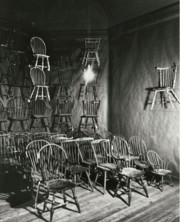 Installation of Windsor chairs, from "Raid the Icebox With Andy Warhol," exhibition at the Museum of Art, Rhode Island School of Design, April 23 - June 30, 1970
Andy's Icebox
Beth Lipman's After You've Gone reminded me of "Raid the Icebox With Andy Warhol," which I saw at Rice University in Houston in 1969. It was Andy at his best: a gigantic readymade consisting of old shoes amassed, chairs on the floor and chairs in the air; everything and nothing. Things broken, things that were fixed, real things and things that were fakes. Everything had been selected from RISD's collection of "decorative arts."
"Decorative arts"? This is a too-fancy and misleading category that some of us prefer to call material culture so that it may include the humble as well as emblems of wealth -- and not exclude meanings, both formal and social. Chairs and guitars, porridge bowls, hat boxes, and chamber pots often have more meanings and tell better stories than ruby-red goblets or paintings.
Hot Glass Comes in Out of the Cold
Alembic. Europe. 18th century? Corning Museum of Glass
There is something ghostly about glass. Something both scientific and weird. A smidgeon of research will turn up too many details about the alchemical pursuit of crystal clarity. I was entertained by "Glass of the Alchemist" at Corning, mentioned above. I learned that alchemy, might be seen as merely the mother of chemistry rather than as an occult discipline of personal/universal transformation. I learned how crystal-clear glass, ruby-red glass (achieved by a smidgeon of gold added to the "metal"), and milk glass were invented in the West; how glass discoveries spread throughout Europe and even to China and Jamestown in the New World. I confess I truly hated the profusion of ruby-glass goblets, but loved the few examples of alchemy instruments - an alembic, two retorts, and what is identified as an oil separator. And then there's the little matter of the glob of gold that was supposedly created by alchemist Johann Bottger in Dresden on March 20, 1713, in the presence of King Augustus II of Poland. Now that's exhibition gold!
As partial closure, here's a quote from the sumptuous catalog:
And hence the most ancient Commentators upon the Sacred Writings have told us, that the whole World, when it shall be destroyed by Fire at the general conflagration, will be turned into Glass." -- Herman Boerhaave, London, 1735.
Glass Today
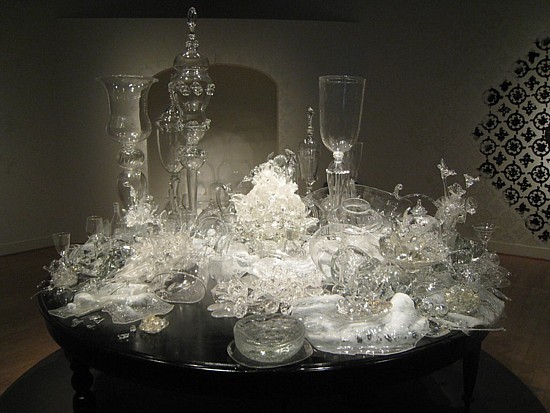
Beth Lipman: Laid Table (Still Life With Metal Pitcher) from 2007. Centerpiece of After You're Gone, 2008.
 Beth Lipman's installation (through Jan. 18, at RISD Museum of Art) is primarily made up of clear glass -- blown and/or hot-sculpted with some monochromatic black and white glass here and there. Lipman is known for her blown-glass still lifes, usually inspired by or echoing real-life paintings. Returning the glassware in the paintings to their three-dimensional, glittery glory, paradoxically makes them less real, but also faintly scary.
Lipman: Wallpaper, blown, lampworked and kiln-formed glass. 2008
Glass like gold has an easy beauty, an unearned beauty. But Lipman transforms the glass act into a class act, offerings meanings as well as glitz.
Prediction: Lipman will be the next artist to leap from the glass world to the art world, like the very clever storyteller Josiah McElheny. Like McElheny, Lipman has not shielded herself from the curse of glass (as many have) by hiring artisans to make her work. The blown glass and instances of cast glass are all her own efforts, but they are in service of concepts far more complicated than what is usually found in glass art coming from the studio-craft movement. In any case, some now claim that Post-World War II phenomenon is over and done with.
Corning curator Tina Oldknow, in her catalog essay for her "Contemporary Glass Sculptures and Panels in The Corning Museum of Glass" has this to say:
In the 2000s glass has increasingly been used as a material for sculpture by artists from outside the glass world as well as by artists form whom glass is a primary material. Glass is intersecting with the world of design and contemporary art in multiple directions, and the American Studio Glass movement as it was defined from the 1960s through the 1980s no longer exists..
These statements, on top of rechristening the American Craft Museum the Museum of Arts and Design --do not bode well for art-world alternatives. But now that pricing will drop across the board for all artworks will there be any need for craft to turn its back on crafts? The craft cult will merely be further purified - having been purged of far too many High Art wannabees - and go underground, again.
In the meantime, we gotta have art, in no matter what form. Even if it is made of glass or grass or linoleum or body fluids. Or marble. Or even paint on canvas.
Beth Lipman's fresh work is a case in point.
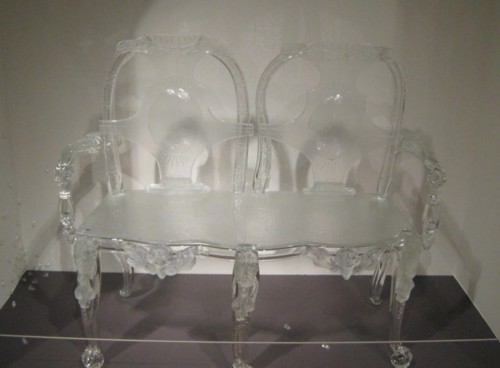
Lipman: Settee (After Grinling Gibbons), 2008
.
Who's Going to Miss You?
The centerpiece of Lipman's installation, "After You've Gone," is Laid Table (Still Life With Metal Pitcher) from 2007, which is a profusion of vessels all made of blown glass including the "metal pitcher" of the title. But Lipman has added a jumping squirrel, a sitting squirrel, and lampworked snails on the periphery of vision. But then there are creations inspired directly by the RISD collection and made on site in the school hot-shop, beginning with glass wallpaper. I kid you not. And a glass settee. Meanings proliferate. The spectacular and dangerous double-chair-back settee is based on an early-20th century copy of a 19th-century reproduction of an 18th-century chair that collector/patron Mr. Charles Pendelton thought until his death was "the greatest 18th century English chair in this country."
Still-life paintings are often memento mori. In this case, a whole room is a memento mori. Lipman's After You've Gone is about what we leave behind: piles of drinking glasses, wallpaper, empty picture frames. Art! Ghosts! Glass is usually perceived as glitzy and celebratory; Lipman uncovers the emotions attached to loss and fragility. And of fakery, too.
Like Warhol's surprisingly forlorn "Raid the Icebox" so many decades ago, Lipman's installation points out the stuff - sometimes loveable, sometimes vulgar, always telling - that clutters up the world with fascinating but mostly unintended messages and meanings. Can we see through materialism, or are we possessed by our possessions and afterwards haunted by them? Are we determined by our decor? Isn't there a strange beauty in how we grasp for stability? And how we remember?"
Perreault, J. "Beth Lipman, smart glass and various time warps." Artopia: John Perreault's art diary. exact posting date unknown, 2008. accessed June 17, 2009. http://www.artsjournal.com/artopia/2008/12/beth_lipman_smart_glass_and_va.html
2008 National Endowment for the Arts:
"Pilchuck Glass School
Seattle, WA
$10,000
To support a summer artist residency program. Artists will be provided with resources, facilities, and technical assistance to experiment with new work in glass.
Wheaton Arts and Cultural Center, Inc. (on behalf of Creative Glass Center of America)
Millville, NJ
$20,000
To support a residency program for emerging and mid-career glass artists at the Creative Glass Center of America. Artists will be provided with housing, a stipend, studio facilities, and technical assistance to work in glass."
National Endowment for the Arts FY 2008 Visual Arts Grants. website accessed June 19, 2009. http://www.nea.gov/grants/recent/disciplines/Visualarts/08visual.php?CAT=Access%20to%20Artistic%20Excellence&DIS=Visual%20Arts&TABLE=1
Sunday, May 10, 2009
Heineman Collection at CMOG
Artdaily.org (March 4, 2009):
"CORNING, NY.- A new survey of one of the largest and finest collections of contemporary studio glass in the United States will open at The Corning Museum of Glass on May 16, 2009. Part of a year-long series of contemporary glass exhibitions and programming at the Museum, Voices of Contemporary Glass: The Heineman Collection, will present 240 works in glass by 87 international artists.
Voices of Contemporary Glass will showcase the collection donated to the Museum in 2006 by Ben W. Heineman, Sr. and his wife, Natalie G. Heineman. Mr. Heineman collected with a discerning eye, thoughtfully assembling a grouping of works that represents the full breadth of a defining period in contemporary glassmaking. He was intrigued by the extraordinary potential of the material to take on a broad range of expressions and forms. Although interested in all kinds of art in glass, he was drawn primarily to works that explored abstraction and color.
The exhibition at the Corning Museum features video interviews with a selection of artists represented in the Heineman Collection, exploring their individual ideas, or “voices,” in glass. This multitude of voices and perspectives celebrates the infinite possibilities of glass as a medium for contemporary vessels and sculpture, and documents the ongoing process of discovery and innovation that has shaped the story of the Studio Glass movement.
“The Heineman Collection reflects the remarkable achievements made in studio glass over the past 35 years,” said David Whitehouse, the Corning Museum’s executive director. “The collection is distinguished by its in-depth focus on a key group of individuals whose work has been influential to artists working in glass worldwide. The exhibition explores the appeal of glass and its essence as a creative medium for artists of all backgrounds. At the Museum, visitors can always experience the energy of artists at work but, this year, the artists will be even more present.”
[...]
“This extensive collection allows us to present the story of studio glassmaking, and to examine the variety of ways in which artists have used glass to find their artistic voices,” said Tina Oldknow, curator of modern glass and of the exhibition. “The exceptional compilation of objects displayed in the exhibition documents a remarkable material and a deeply introspective process of working that helps to explain the often indefinable, but always captivating, allure of glass.”
The Heineman Collection nearly completely documents the chronology of the American Studio Glass movement, with objects dating from 1969 to 2005, and it presents the work of several artists over the course of their careers. Highlights of the exhibition include:
• Architectonic sculptures by Thomas Patti, who pioneered the exploration of industrial and architectural glass as a sculptural medium.
• Blown vessels by Lino Tagliapietra, considered to be the world’s foremost glassblower and one whose influence has had a lasting impact on American studio glass.
• Glass sculptures evoking elements of architecture and industry by Howard Ben Tré, who led the way in the use of cast glass as a sculptural medium in the United States.
• A rare group of “Navajo Blanket” cylinders blown in the mid-1970s by the internationally recognized artist, Dale Chihuly.
• Iconic sculptures by the acknowledged “fathers” of American studio glass, Harvey K. Littleton and Dominick Labino, who, in 1962, introduced the first studio-sized glass furnace that enabled glassworking to move outside of a factory environment, launching the American Studio Glass movement.
Voices of Contemporary Glass, which runs through January 3, 2010, will be accompanied by a fully illustrated catalog of the collection by Tina Oldknow. As part of a year-long celebration of contemporary glass at the Museum, it is complemented by the exhibitions, Favorites from the Contemporary Glass Collection (March 1, 2009 – January 3, 2010), and Masters of Studio Glass: Richard Craig Meitner (April 4 – October 18, 2009).
The installation, designed by Paul and Barbara Haigh, is inspired by the Heinemans’ Chicago residence in which the collection was originally displayed. The exhibition design transforms the large and open spaces of the Museum into a more intimate setting, reminiscent of domestic interiors, with the objects arranged primarily by artist, rather than by artistic theme, chronology, or technique.
The Corning Museum of Glass has historically taken the lead in disseminating information about contemporary glass. This year marks the 50th anniversary of the Museum’s landmark show, Glass 1959, one of the first significant surveys of mid-20th-century glass design. Workshops introducing studio artists to hot glass, held three years later, in 1962, at The Toledo Museum of Art, Toledo, Ohio, launched the American Studio Glass movement, which is explored in-depth in Voices of Contemporary Glass."
Artdaily.org [edited and published by Ignacio Villarreal, Jr.] March 4, 2009. "Corning Museum of Glass Announces Radiant Survey of Studio Glass." website accessed May 10, 2009. http://www.artdaily.com/index.asp?int_sec=11&int_new=29394&int_modo=1
"CORNING, NY.- A new survey of one of the largest and finest collections of contemporary studio glass in the United States will open at The Corning Museum of Glass on May 16, 2009. Part of a year-long series of contemporary glass exhibitions and programming at the Museum, Voices of Contemporary Glass: The Heineman Collection, will present 240 works in glass by 87 international artists.
Voices of Contemporary Glass will showcase the collection donated to the Museum in 2006 by Ben W. Heineman, Sr. and his wife, Natalie G. Heineman. Mr. Heineman collected with a discerning eye, thoughtfully assembling a grouping of works that represents the full breadth of a defining period in contemporary glassmaking. He was intrigued by the extraordinary potential of the material to take on a broad range of expressions and forms. Although interested in all kinds of art in glass, he was drawn primarily to works that explored abstraction and color.
The exhibition at the Corning Museum features video interviews with a selection of artists represented in the Heineman Collection, exploring their individual ideas, or “voices,” in glass. This multitude of voices and perspectives celebrates the infinite possibilities of glass as a medium for contemporary vessels and sculpture, and documents the ongoing process of discovery and innovation that has shaped the story of the Studio Glass movement.
“The Heineman Collection reflects the remarkable achievements made in studio glass over the past 35 years,” said David Whitehouse, the Corning Museum’s executive director. “The collection is distinguished by its in-depth focus on a key group of individuals whose work has been influential to artists working in glass worldwide. The exhibition explores the appeal of glass and its essence as a creative medium for artists of all backgrounds. At the Museum, visitors can always experience the energy of artists at work but, this year, the artists will be even more present.”
[...]
“This extensive collection allows us to present the story of studio glassmaking, and to examine the variety of ways in which artists have used glass to find their artistic voices,” said Tina Oldknow, curator of modern glass and of the exhibition. “The exceptional compilation of objects displayed in the exhibition documents a remarkable material and a deeply introspective process of working that helps to explain the often indefinable, but always captivating, allure of glass.”
The Heineman Collection nearly completely documents the chronology of the American Studio Glass movement, with objects dating from 1969 to 2005, and it presents the work of several artists over the course of their careers. Highlights of the exhibition include:
• Architectonic sculptures by Thomas Patti, who pioneered the exploration of industrial and architectural glass as a sculptural medium.
• Blown vessels by Lino Tagliapietra, considered to be the world’s foremost glassblower and one whose influence has had a lasting impact on American studio glass.
• Glass sculptures evoking elements of architecture and industry by Howard Ben Tré, who led the way in the use of cast glass as a sculptural medium in the United States.
• A rare group of “Navajo Blanket” cylinders blown in the mid-1970s by the internationally recognized artist, Dale Chihuly.
• Iconic sculptures by the acknowledged “fathers” of American studio glass, Harvey K. Littleton and Dominick Labino, who, in 1962, introduced the first studio-sized glass furnace that enabled glassworking to move outside of a factory environment, launching the American Studio Glass movement.
Voices of Contemporary Glass, which runs through January 3, 2010, will be accompanied by a fully illustrated catalog of the collection by Tina Oldknow. As part of a year-long celebration of contemporary glass at the Museum, it is complemented by the exhibitions, Favorites from the Contemporary Glass Collection (March 1, 2009 – January 3, 2010), and Masters of Studio Glass: Richard Craig Meitner (April 4 – October 18, 2009).
The installation, designed by Paul and Barbara Haigh, is inspired by the Heinemans’ Chicago residence in which the collection was originally displayed. The exhibition design transforms the large and open spaces of the Museum into a more intimate setting, reminiscent of domestic interiors, with the objects arranged primarily by artist, rather than by artistic theme, chronology, or technique.
The Corning Museum of Glass has historically taken the lead in disseminating information about contemporary glass. This year marks the 50th anniversary of the Museum’s landmark show, Glass 1959, one of the first significant surveys of mid-20th-century glass design. Workshops introducing studio artists to hot glass, held three years later, in 1962, at The Toledo Museum of Art, Toledo, Ohio, launched the American Studio Glass movement, which is explored in-depth in Voices of Contemporary Glass."
Artdaily.org [edited and published by Ignacio Villarreal, Jr.] March 4, 2009. "Corning Museum of Glass Announces Radiant Survey of Studio Glass." website accessed May 10, 2009. http://www.artdaily.com/index.asp?int_sec=11&int_new=29394&int_modo=1
Monday, May 4, 2009
Branding of the CMOG

Here's an article that, while basing all its arguments on the thesis of another book and containing unsupported statements, provides an interesting overview of the effects of capitalism on the Corning Museum of Glass. One such unsupported statement is in paragraph two: Because of the branding necessary to create revenue from admissions, the artwork at the CMOG has been "dumbed down." Maybe Petrillo is unaware of the long history of criticism that berates this medium's art for lacking intellect, but if not, then an interesting hypothesis arises...What do collectors such as glass museums, do for the reputation of their artists by placing them in "Museum Worlds" (a play on Disney World or Sea World I assume)? Petrillo would say the museum "commodifies" their artworks. It's unsupported because he does not prove that commodification reduces or erases the meaning of the art, but I wish he would have tried.
It's nostalgic to look at contemporary art as being separate from the marketplace and money, as Petrillo wishes for, and to believe that the old days of art were less about money and more about meaning. But this article is reprinted in ABJ Seattle Glass Online because it helps us to reframe the argument against glass artists as "lacking meaning" by examining the role of the museum. Branding is an interesting result of a capitalist market and museums survive by branding themselves, Petrillo argues, thus commodifying everything they do.
The article is supplemented by a picture I took while there last summer, 2008, of an American-made truck filled with Chinese-made, inexpensive, hand-blown glass flowers in the gift shop of CMOG.
Neale Petrillo, Oct 9, 2008: The Corning Museum of Glass (located in the scenic metropolis of Corning, New York) unarguably contains one of the world’s foremost collections of glass art and literature concerning glass. Unfortunately, the Corning Museum has fallen victim to what James Twitchell refers to as “Museum World” in his 2004 book Branded Nation. The Corning Museum, like so many others, has moved away from the higher calling by which museums were conceived and down-stepped into the modern world of commercialism. Furthermore, the museum has “branded” itself in precisely the way Twitchell describes it. The Corning Museum has moved away from the preservation of and display of art and wholeheartedly embraced the world of marketing, sales, competition, and money. From the internationally identifiable “CMoG” label, to the centrally located gift shop featuring all kinds of articles ranging from one dollar trinkets to thousand dollar display pieces, all the way up to the one-of-a-kind “make your own glass” workshop.
First, I will discuss the most obvious form of branding: the CMoG label. Everything these days has a label; brands are used for several different purposes. Foremost, a label distinguishes. No other museum in the world uses the Corning Museum’s CMoG lettering and circle logo; but, how does this help the museum? Ideally, at least according to Twitchell, museums wouldn’t need a label; they would be able to support themselves through their endowment and trustees and thus wouldn’t need to be readily identifiable to the masses. However, this is not the case. Due to the lack of endowment, little to no funding from state and federal governments, an absolutely huge surge in the number of organization calling themselves museums, and a sharp increase in operating expenses it has become vitally important for a museum to identify itself to the consumer. In that way museums can ensure a steady stream of revenue from admissions. This may not be as important for the CMoG, as Nancy Earley explained in her interview, because the Corning Museum is funded every year by Corning Incorporated, a well-to-do glass company. However, as she explained, the money given to the museum by Corning Inc. only covers operating expenses and doesn’t provide for new exhibits or shows and thus it is still important for the museum to maintain its brand. While the practice of labeling opens up museums to the argument that the art work is “dumbed down” in some way, it has nevertheless become an important part of how museums operate and survive. Another important part of the “branded museum” is the gift shop.
The museum gift shop has become an integral part of just about everyone’s educational experience, and that’s exactly how the board of directors wants it. In the case of the Corning museum of Glass, and most museums, it’s virtually impossible to avoid the gifts shop. It seems as though the whole of the art gallery was built around one giant department store and it becomes necessary to cross through it to move between exhibits. Again, how does this help the museum? Obviously, money is the most important factor taken into account when a museum decides to install a gift shop and the reasons for this need are the same as above. Again, the argument holds that the use of gift shops degrades the value of the art displayed. Unfortunately, it is another necessary evil.
Sharing a similar role to the gift shop, the museum restaurant is often one of the most talked about destinations in any gallery, and the Corning Museum is no exception. As museums have grown and popped up everywhere, Twitchell argues, they have had to come up with unique and extraordinary ways to set themselves apart, and what better way (especially in America) than with food. While it is not so much an issue in the Corning Museum, the restaurant is a first-class buffet but nothing more, some museums have gone so far as to include five-star dining establishments complete with Champagne and exotic cheeses. This inclusion is one of the more brilliant marketing ideas; now, instead of going for the art, you go to have a fabulous meal in a grandiose setting. There is no better way to reach an American consumer than through his or her stomach. Once again, the argument is made that this practice of playing to the consumers’ stomach rather than their brain forces the establishment to loose something in translation. Unfortunately, is has become another important part of how we identify museums and a very important reason as to why we go. Even with all of these different means of identification and branding a museum still needs to set itself apart; after all restaurants, logos, and gift shops are omnipresent. So, the Corning Museum of Glass has developed a program in which visitors can create their own art.
Who hasn’t sat in front of a vase, painting, or sculpture and said to themselves “Could I do that?” Who hasn’t thought “If I took the time, could I make a masterpiece?” Well, you can! Or so the CMoG would have you believe. The Corning museum has available a wholly unique program (though the idea is widespread): you can make your own glass sculpture. This is not only entertainment to keep children busy, but a destination for many hundreds of visitors each year as well as a giant money making endeavor for the museum. It also brings many visitors back to the museum. Turning the museum experience into an entertainment experience is a definite slap in the face for everything a museum is supposed to represent; however, with falling visitation rates, the “drying up” of endowment funds, and the recent cuts in government support more and more places of learning are being forced to play towards an audience that seeks a fun experience rather than an intellectual journey.
Similarly, the Corning Museum puts on a live glass blowing show every hour or so. This is an obvious example of playing to people’s love of entertainment rather than their intellectual curiosity. While the show serves to bring people into the museum its more meaningful goal is to bring them back. What good is going to a museum if it never changes? Once you’ve seen it you don’t need to see it again, especially if you’ve taken pictures. But the glass show is different, it changes with every visit. So, now instead of seeing a bunch of artifacts and sculpture for the fifth time a visitor can have a brand new experience. Unfortunately though, a good portion of the museum’s somewhat limited gallery space has been devoted to this task which adds more fuel to the combustible idea that having such entertainment venues detracts from the museum’s higher purpose; but, without such pursuits the museum would never be able to provide the intellectual content that it does.
Finally, the Corning Museum of Glass does what almost every other museum does to draw in visitors: it provides a traveling exhibit gallery. In this day and age the focus for many museum goers is the traveling exhibit gallery. While there you can see something you’ve never seen before; the experience is unique and somewhat exciting. More importantly, the exhibits are usually famous so you would have no shame in telling all of your friends about it. Like the live shows, the traveling exhibit gallery serves the important role of bringing people back to the museum. Without the return visitors the establishment would become broke in very little time (Earley). Furthermore, unlike all the other things previously discussed, a traveling exhibit room doesn’t really detract from the ultimate goal of the museum. After all, bringing in a new set of things to learn about or appreciate is exactly what a museum is supposed to do.
Like most museums, the Corning Museum of Glass has moved away from the pure world of art appreciation and has begun to play in the land of capitalism. Since they don’t fit with the original goal of the museum, such drastic steps are somewhat regrettable; unfortunately, as the world becomes flooded with museums, public funds become scarce, and long standing endowment monies run out, they are becoming more and more necessary. No longer is the museum a place for quiet scholarly pursuit; it has become a place of family fun, a quality meal, and maybe a place to learn an odd fact or two.
References
- Twitchell, James B. . Branded Nation. New York: Simon & Schuster Paperbacks, 2004.
- Earley, Nancy. Group discussion. 8 September, 2007.
Subscribe to:
Posts (Atom)


