Showing posts with label beth lipman. Show all posts

Sunday, January 10, 2010

'See Through' reviewed in NYT

Writer Benjamin Genocchio, in his eight-year career as art and culture critic for the New York Times, has reviewed many shows inclusive of glass. Among the artists he's reviewed are contemporaries Dale Chihuly, Josiah McElheny, Fred Wilson, and Robert Jolley. He has played no small part in placing glass on the pages of this major publication. In his reviews he often comments on the place of glass artists in the larger art world and explores glass as it relates to the themes of kitsch, craft, and art. Here he reviews a show on Long Island.

January 2010, Benjamin Gennocchio:

"The pleasures and challenges of working with glass are explored in “See Through,” the current group exhibition at the Islip Art Museum, organized by Karen Shaw. But the show also invites wider contemplation of transparency..."

Genocchio, B. "Where a close look goes right through." New York Times. January 8, 2010. http://www.nytimes.com/2010/01/10/nyregion/10artsli.html?scp=2&sq=see+through&st=nyt

Friday, January 8, 2010

Beth Lipman & Ingalena Klenell @ MOG

January 20-24, 27-31, 2010 @ Tacoma Museum of Glass:

From MOG:

"Beth Lipman and Ingalena Klenell have embarked on a professional collaboration to develop a new exhibition, Glimmering Gone, which will open at MOG in October, 2010. During this residency, the two artists will work together to create pieces for the exhibition that will comprise three vignettes of glass: Memento, or objects of desire; Landscape, large-scale components that will create a veritable glass curtain; and Artifacts, an installation of sandblasted black and white glass components bathed in light."

http://museumofglass.org/live-glassmaking/visiting-artists/


Tuesday, September 8, 2009

2008 part five

In this time line I pull quotes to illustrate a thread in popular and scholarly writing and criticism about glass. Here we will see current glass artists defending their art against the accusations and separating themselves from these stereotypes and, hopefully, find out how and where the now-common opinion was born. Fundamentally, the general thesis seems to be born of the question, What Is Art? This question I will leave to others to answer, here I am only documenting the written history of a popular way of thinking and a popular taste.

2008 Lisa Fondo:

"
Glass and metal art are not the first mediums that come to mind when considering an art gallery's offerings. However, many galleries have round that carrying these niche mediums has been a profitable investment that bas diversified their sales and overall clientele.

Although glass and metal art are sometimes considered crafts, and its practitioners craftsman, the work by the fine artists in this article certainly challenges the generalization.

Craft Vs. Fine Art

The debate continues among many gallery owners and artists as to the distinction between craftsman and artist. "We straddle the line of art and craft, engineering and design," says Angelique Jackson of Jancik Arts International. "Craft is round in the shop drawings and glass and metal frame fabrications while art is found in the interpretations and results."

Livia V. Garson of Glass Place Gallery in Jackson Hole, Wyo., has been specializing in glass art sculptures since the 1980s when artists working behind the Iron Curtain were able to introduce their work to American galleries and collectors. She is of the opinion that glass art offers a myriad of possibilities for an artist and gallery. "The glass medium gives infinite possibilities to be played with; the tire of life is given the chance by artists to create new and unique pieces each day, from classic to contemporary shapes."

Dale Chihuly is arguably the best known, living glass artist in the world. He is an interior designer, ceramic artist and painter, but it is his work in the medium of glass that has garnered the most acclaim. Chihuly offered the following advice to anyone considering a career as a glass artist in the fine-art realm. "I would tell them to figure out what they want to do," he says. "Do they want to be an artist, designer, or do they want to be a craftsman? Naturally, the hardest thing to be is an artist."

The Transition to Fine Art

Initially a student of interior design and architecture, Chihuly realized he wanted to concentrate instead on glass. Chihuly enrolled in the University of Wisconsin's hot glass program--the first of its kind in the United States--established by Harvey K. Littleton, founder of the Studio Glass Movement. After receiving a degree in sculpture, Chihuly enrolled in the ceramics department at Rhode Island School of Design (RISD) and later established the renowned glass program at RISD.

"Back when I first started, I wanted to get a job as a professor, which I got at RISD, so that allowed me to have a glass shop and earn an income and be able to do my own work," he explains. "Some professors can do that, but some can't; it is not an easy thing to do."

Artist Max Gold, known as "The Father of Fusion Art," began his career as a glass artist for a more pragmatic reason. "I ran out of canvas, and there were some sheets of glass in the apartment building I was living in; I loved the way the reverse painting looked," Gold says.

The process then evolved into something different--sculptures that merge digital art and original reverse glass paintings. "My first glass sculptures came about a few years later when I would layer multiple sheets of painted glass; I only painted about 20 percent of each sheet, negative space was as important as the painted part."

Metal artist Jason Mernick started his career working in glass but made the transition to metal. "I like the element of tire in my creative process--there's no hesitation," he says. "I have been given credit in the industry for developing 'torch painting;' that is, I use tire the way painters use paint."

From Concept to Finished Works

Working in hard metals and glass can prove challenging, at times, for fine artists.

Mernick works with stainless steel, aluminum and copper at his studio in Lake Mathews, Calif. The designs he produces are free flowing and spontaneous. "I just begin, and the process takes me," he explains. "One thing leads to another. The keys are knowing when to stop and how one works with spontaneous developments."

Chihuly works with hand-picked teams in his Seattle studio to create works of art that vary in scale from small free-flowing pieces to large-scale installations that require serious planning.

Jancik Arts International provides large pieces for corporate and private clients. Known for its stained-glass domes, most pieces require strict specifications. "The right and left sides of our brains need to work together in order to create a work with structural integrity; we must use calculus to determine the surface area of a curved dome," Jackson says.

Brad Lorang, a metal sculptor from Oregon, incorporates various techniques, including engraving and heat-applied patinas, to create textural and reflective effects on the metal.

"The work I am now doing has really been more than a 30-year process of adapting techniques I learned along the way for my own specific purposes; each new corner I turned has taken my work a little further off the beaten path," Lorang says.

Defining Form and Function

Las Vegas-based artist Dale Mathis creates high-relief wall sculptures that challenge and defy many physical and artistic boundaries. A typical Mathis artwork is mechanical with hand-carved, moving gears and neon-lit areas. Weighing 80 pounds or more, the metallic mixed-media sculptures are created with what the artist has dubbed a Steampunk style.

"Steampunk is a mixture of old and new, Victorian era meets today," Mathis explains. "It's a blending of different forms and ideas, materials and function. I'm an artist and an engineer."

Artist Henry Jerome has also taken a unique approach to the functionality of his work. He has made a townhouse his personal gallery, allowing potential clients to view his glass and granite works in a home setting.

Works by many fine glass and metal artists can be found in private collections while corporate collections, museums and sculpture gardens hold pieces of monumental scale.

Translation to Sales

Maggie Munro, owner of Munro Gallery in San Diego, uses the glass art she features in her display window as a way to attract a diverse clientele into her store. She came across some fine-art glass and jewelry at an industry trade show a few years back and began carrying it in her gallery as a way to pick up some additional income and diversify her clientele. The initiative took off, bringing her an increase in holiday buyers and purchases from homeowners, corporations and interior designers.

Kelly's Fine Art Gallery in Joseph, Ore., has been offering hand-blown glass and metal art, in addition to bronze sculpture and paintings, for the past 10 years. Owner Kelly Wick began offering the two niche mediums as a way to add more color and variety to her offerings. She says glass and metal art appeal to collectors with contemporary and more rustic home settings and offers the following advice when selling these genres.

"For glass, proper lighting is very important," she explains. "I recently purchased a well-lit display case for some of my glass, and my sales went up significantly. Selling glass and metal require a personalized sales approach, like any other type of art. I stay in tune to what the client is interested in, tell them why I love the artwork and get excited about it with them.""

Fondo, Lisa. "Glass & metal art: in a time when new business is paramount, these niche mediums offer glaring possibilities." Art Business News. November 1, 2008. Retrieved November 05, 2009 from accessmylibrary: http://www.accessmylibrary.com/coms2/summary_0286-35970592_ITM

2008 Lotta Lewenhaupt.

The Swedish jury for Elle Deco’s seventh annual EDIDA/ELLE Deco International Design Awards has presented its choice: Kosta Boda designer Åsa Jungnelius is 2008 Designer of the Year.

Lotta Lewenhaupt, editor-in-chief of Swedish Elle Interiör, writes:

“Suggestive is a word that often comes up when describing Åsa Jungnelius’s works. With good reason: thought-provoking and beguiling, most everything Åsa does sends out double signals. And this is often extremely intentional; she likes to challenge and question conventions such as what is true or false, ugly or attractive. As always, the answer is in the eye of the beholder. For example, Åsa has her own way of commenting on phenomena such as consumerism and shopping, expressed even before she was hired at Kosta Boda in the form of a giant glass lipstick with obvious references to brand-name tubes. Once at Kosta Boda she continued with her Make Up series, which includes oversized bottles of nail polish and a serving dish with a relief pattern very reminiscent of the oft-imitated logo of a certain purse brand.

“Just like their creator, everything that Åsa makes is clear and confident. She is consistent; she follows her own path and has done so since she left school at 17 to become an apprentice glassblower at the National School of Glass in Orrefors. The addictive, intoxicating effect of glass as a material becomes evident when we see that Åsa has also worked in blowing rooms in the UK, Italy, Kenya and the United States (Pilchuck) over the years. In 2004 she earned a degree from the Ceramics & Glass department of the University College of Arts, Crafts and Design in Stockholm. Her degree exhibition featured, among other things, a pair of transparent glass stiletto shoes and a crystal chandelier, which later appeared in Liljevalch’s Formbart exhibition in 2005, along with a pair of candlesticks that looked like melted wax. The latter is now a part of her Mysstake series at Kosta Boda.”

Åsa received the award at the Elle Interiör design gala in Stockholm on 3 February 2009, and the complete statement of the jury will be published in the February issue of Elle Interiör, which will be released in connection with the Furniture Fair in Stockholm."

Lewenhaupt, L. "Asa Jungnelius named 2008 designer of the year by Elle interior." September 2, 2009. Accessed October 26, 2009. http://www.kostaboda.se/index.php?id=press&tx_ttnews[tt_news]=238&tx_ttnews[backPid]=40&cHash=c832576018


2008
Evan Schauss:

Photobucket

Photo Credit: ABJ Seattle Glass Online

2008 Lisa Orkin Emmanuel:

"
CORAL GABLES, Fla. (AP) --

Artist William Carlson dips the large steel ladle into the blazing furnace and fills it with liquid glass. With sweat pouring down his face, he quickly moves to a graphite mold he has made and pours in the seething yellow-colored liquid.

He is making glass wall tiles with an imprint of fiber knots in them that he will remove with tweezers. This will leave a fossil of the knot. The tiles will then be hung together in a grid format. Carlson says he is trying to start a discourse about language with the way he lays out the fiber.

Glass art is attracting more admirers and collectors today, and gaining more attention as a fine art, as artists explore more with the medium. Meanwhile, prices for pieces are on the rise.

"It's a maturation of the field. More and more we are seeing people interested," said Michael Heller, vice president of the Heller Gallery in New York, where glass art is sold. "More and more collectors have also started to realize the value of work that has integrity."

The artistic content of glass art has developed over the last decade or so, artists say.

"It's kind of coming of age where craft is no longer the title of the work. Craft is the means to an end. ... It really is the strength of the concept and power of the image," says Carlson, who also teaches at the University of Miami in Coral Gables.

Fran Kaufman, director of the contemporary art fair palmbeach3, says the reason glass art is on the rise is because many collectors aren't purchasing just one type of art anymore, but varying the kinds of art they collect. Prices are also getting higher, which is enticing people to buy it.

"Prices getting higher, that is appealing to collectors. People are looking beyond the more traditional glass pieces. ... Collections are not so specific anymore," Kaufman says. "I think the experimentation has grown more."

Mark Lyman, director of the two annual shows called SOFA, which take place in New York and Chicago, says that 10 to 15 years ago an expensive glass piece would cost between $50,000 to $100,000. Now, such works can reach anywhere from $500,000 to $1 million.

"It's a very active market for them," Lyman says of the glass pieces. "It's really come along. ... We're seeing a lot of growth and strength."

In an effort to expand public awareness, collectors Sheldon and Myrna Palley of Miami donated about 100 pieces that they have been amassing since the 1970s to the University of Miami's Lowe Art Museum. The exhibit opened last month.

They say they have about 200 more works at home. The collection at the museum includes a piece by William Morris that looks like a prehistoric artifact with cave paintings on it. Next to it, attached to a metal stand, is a glass shaped to resemble a horn. It was created in 1992. Christina Bothwell's glass yellow baby with ceramic head and extremities also sits on one of the shelves.

Myrna Palley says they scour fairs and work with well-known glass art dealers to decide what they will buy.

"When you go to a cafeteria and there's all this food, how do you know what to pick?" Myrna Palley says of her experience buying glass art. "It just calls me."

Sheldon Palley says the feeling of power in Tom Patti's small glass objects really pull him to them.

"It's very architectural. They are like huge buildings, even though they are small," he says.

Patti, whose studio is in Pittsfield, Mass., says he also sees an increased interest in glass art.

"I think the interest in glass is continuously growing, getting larger," Patti says. "It's been accumulating. It's just something that if the art form is strong, it inherently progresses in many avenues. ... The museums are not just collecting it, they are seeing it as an applied art form that can be incorporated as part of the building itself."

Some artists credit Seattle-based Dale Chihuly for getting their art more publicity. His colorful glass works have reached audiences across the United States and throughout the world.

Studio glass was introduced into college programs in the 1960s and then increasingly explored by students. It really started being considered art after 1960 when artists began to work in their own studios and not in factories. Around the same time, a non-industrial glass furnace was created, which opened up opportunities for creative use, artist Carlson says.

Now, a common recipe for the material is sand or silica mixed with sodium carbonate, lime, magnesium carbonate and any additives that may change the color.

Wisconsin-based artist Beth Lipman, who creates glass still lifes inspired by Dutch, German and Italian paintings of the 1600s, says she feels a definite shift in the way her art is perceived.

"I think people are kind of hungry for more of a dialogue," Lipman says. "There is this overall shift of looking at the capitalist community that we're living in and being mindful about what you are using your money for."

(This version CORRECTS city of Tom Patti's studio to 'Pittsfield, Mass.')"

Emmanuel, L.O. "Glass art is attracting more collectors." June 27, 2008. San Francisco Chronicle. accessed September 8, 2009. http://www.sfgate.com/cgi-bin/article.cgi?f=/n/a/2008/06/27/entertainment/e130950D25.DTL

2008 Pauline Dubkin Yearwood:

"Visitors to the 15th-anniversary SOFA Chicago (Sculptural Objects & Functional Art Fair) at Navy Pier will view a spectacular installation in glass, among other always-impressive works from 100 galleries in 16 countries. "Chandelier" encompasses three of those objects and many others besides and is a visual meditation on no less a theme than the opposing pull of the good and evil sides of human beings.

A Tel Aviv showroom, Litvak Gallery, is spending $100,000 on the installation by Italian glass artist Lucio Bubacco.

How an Israeli gallery came to represent one of the top Italian glass artists in the world at first seems a puzzle, but Orit Topuol, a gallery spokesperson, explained it all in an e-mail exchange from Tel Aviv.

"The Litvak Gallery was established in 2006 by Muly Litvak, an art collector and Internet entrepreneur," she writes. "The gallery supports new and leading artists and assists them by promoting their work internationally." It also commissions large-scale projects from well-known "master artists" and commits to promoting them internationally, she writes.

As for the SOFA installation, titled "Eternal Temptation," Topuol writes that "Muly Litvak is an avid glass collector. His personal collection incorporates pieces from some of the world's leading glass artists, including Lucio Bubacco, one of (his) favorites. Since Bubacco is a master glass artist and is represented solely by Litvak Gallery, the two decided to collaborate on a project."

Bubacco, born in the Italian city of Murano, where he still lives, has been a glass artist since age 15 and is considered one of the world's foremost proponents of the "lume" glass technique, which involves hand-forming figures in glass and incorporating them in blown and cast vessels. He draws his imagery from Greek, Roman and Byzantine art and medieval and Renaissance theater, and often treats classic themes like love, birth, death, heaven and hell, according to a recent catalogue.

Mark Lyman, SOFA's founder and director, writes in an introduction to the show that the Litvak installation "personally raises the bar for the SOFA Fairs and at the same time matches the extraordinary surreal artistry of Bubacco."

Visitors to last year's SOFA who marveled at American glass artist Dale Chilhuly's spectacular chandelier might imagine "Eternal Temptation" to be similar, but Topuol, the gallery spokesperson, says it is not. Chilhuly's chandeliers, she writes, "are created using an entirely different technique. ... Bubacco uses lampworking to create his pieces, with each piece figuratively expressing specific topics and themes."

"Eternal Temptation" is composed of 15 major pieces, each containing dozens of elements, she writes. The centerpiece is a representation of "Man on his Journey through Life" with scenes of "Inferno" (hell) and "Paradiso" (heaven). Three chandeliers also represent Inferno, Paradiso and "the artist's fantasy chandelier." On the periphery are four vases, two depicting Inferno and two Paradiso along with five "watchers," all surrounding the centerpiece.

In the piece, Bubacco "shows his greatness as a surrealist figurative artist, with phenomenal human body sculpting, architectural instinct, and dramatic skill, combined to make an unforgettable impression on the viewer," Topuol writes.

"Eternal Temptation," she continues, "simply stretches the lampworking technique to its limits. (The piece) deals with ambitious topics, focusing on existential and moral dilemmas without taking a stand. Good and evil, paradise and inferno are portrayed as both tempting and threatening by the artist. In 'Eternal Temptation' Bubacco poses the ultimate question of the human dilemma: with the duality of good and evil evident in every direction, which path is the right path to take, and does the path we take even matter in the end?"

A catalogue description of "Eternal Temptation" calls it "a combination of architecture ... and theater. (Bubacco's) architecture is constructed by means of a series of extended vessel forms, chalices, goblets, vases and chandeliers; his theater by means of a cast of many hundreds of small figures who enact the story of Eternal Temptation played out simultaneously in heaven and hell."

Unlike most of the works shown at SOFA, "Eternal Temptation" is not for sale. Later Bubacco and the Litvak Gallery will select eight scenes from the piece, from which the artist will crate "variations" that will be offered for sale, Topuol writes. She adds that while the piece is making its debut at SOFA, it will eventually be exhibited at other fine art fairs and museums as well as at the gallery.

Meanwhile SOFA celebrates its 15th year with its biggest fair yet, giving viewers a look at art objects from galleries as far-flung as Argentina and China. The United States is represented by 14 Chicago galleries, among many others. Special exhibits, besides "Eternal Temptation" and other works in glass by Bubacco, include more work from the Association of Israel's Decorative Arts and a celebration of the Racine (Wisconsin) Art Museum.

A special exhibit will feature works by Israeli artists Yael Herman, Noa Hagiladi, Rory Hooper, Alon Meron and Noa Nadir. The entire exhibit will be housed in a one-of-a-kind cavelike structure designed by architect Guy Zucker, a first-of-its-kind exhibit at SOFA.

In addition, a lecture series featuring museum curators, professional art advisors, artists, collectors, interior designers, critics and art market journalists will take place throughout the duration of the show (visit www.sofaexpo.com for schedules).

The artwork on display ranges from Japanese ceramics to hollowware by Scandinavian silversmiths to contemporary furniture to avant-garde American and European jewelry and much more. but-in answer to a question that still gets asked-no sofas."

Yearwood, P.D. "Glass that shatters expectations: Israeli gallery goes beyond the chandelier." Chicago Jewish News. November 7, 2008. Accessed November 2, 2009. http://www.chicagojewishnews.com/story.htm?sid=7&id=252443

2008 Bill Van Siclen:

"

The first thing you see as you enter “Chihuly at RISD,” the sometimes dazzling but ultimately disappointing Dale Chihuly exhibition at Rhode Island School of Design, isn’t one of the artist’s flamboyant blown-glass sculptures. Instead, it’s a copy of Chihuly’s signature blown up to billboard size and rendered in a swirling semi-abstract scrawl.

As it turns out, it’s a strangely appropriate way to start the show, which opens Saturday at RISD’s new Chace Center complex on North Main Street.

For one thing, the free-form twists and turns in Chihuly’s signature look a lot like the free-form twists and turns in his sculptures. And the color of the signature — a venomous shade of acid-green — seems appropriate for an artist whose titles (among them, Citron-Spotted Ebony Venetian with Coiled Lilies and Black Basket Set with Cadmium Orange Lip Wraps) often read like shopping lists for a color-crazed Impressionist.

Unfortunately, Chihuly’s super-sized John Hancock is also appropriate in less flattering ways.

As much a showman as he is an artist, Chihuly is best known for his large blown-glass sculptures — dramatic works whose lush colors and fluid shapes often evoke shells, flowers, baskets and other organic forms. During the 1970s and ’80s, these eye-catching, technically challenging pieces helped rekindle interest in glass as a medium for serious contemporary artists.

Along the way, Chihuly, a Tacoma, Wash., native who graduated from RISD in 1968 (with a master’s degree in ceramics) and later founded the school’s studio-glass program, became the most famous American glass artist since Louis Comfort Tiffany.

In recent years, however, Chihuly has spent much of his time seeking ever larger and more grandiose stages for his work. In 1995, a Chihuly-led team of glassmakers transformed the streets, bridges and canals of Venice into a giant outdoor glass gallery. The result, dubbed Chihuly Over Venice, also spawned a coffee table book and a video documentary.

Other high-profile projects include the lobby ceiling of the Bellagio casino in Las Vegas and Chihuly at the V & A, a 2001 installation at London’s Victoria and Albert Museum.

While these projects have helped introduce Chihuly’s work to a wider public, they’ve also taken a toll on his reputation. A 1999 survey of American art critics, for example, ranked Chihuly in the top 10 in both the “name recognition” and “most overrated” categories.

More recently, a prominent West Coast critic (Kenneth Baker of the San Francisco Chronicle) slammed Chihuly for indulging in “empty virtuosity” and mere “decoration.” (Ouch!)

The result is a kind of mid-career stalemate, in which Chihuly and his work remain hugely popular with everyday museum-goers while eliciting yawns — or worse — from a growing number of artists and critics (and, it must be said, from many of Chihuly’s fellow glassmakers).

It’s a pattern that “Chihuly at RISD,” which features about a dozen large sculptural ensembles as well as a smattering of smaller works, seems likely to repeat.

After making their way past the king-size “Chihuly” signature, the first thing visitors see is a smaller version of the famous glass-filled ceiling at the Bellagio Resort. In many ways, it’s a great way to start the show. Not only does it evoke one of Chihuly’s most famous artworks — the Bellagio ceiling — but it introduces many of the artistic concerns — lush color, the transformative properties of light, sensuous form — that have occupied him throughout his career.

If you’ve never experienced a Chihuly exhibit before, prepare to be dazzled.

On the other hand, if you have seen a Chihuly show before, you may have a different reaction: déjà vu. Indeed, ceiling installations have become something of a staple at Chihuly exhibits — the equivalent of a rock band kicking off a concert with a couple of crowd-pleasing oldies.

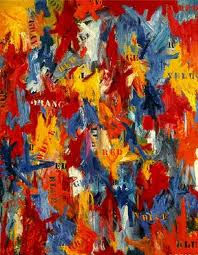
Next up: a huge wall filled with the poster-size “drawings” Chihuly likes to make in between glass-blowing sessions. Here again, casual museum-goers will probably be impressed by the sheer scale of the installation, which suggests a cross between a Jackson Pollock painting and an IMAX screen. On the other hand, there’s a lot more doodling than drawing in these pieces, most of which look as if they were tossed off in a few seconds.

Next, it’s on to one of the show’s highlights: a trio of blown-glass chandeliers. Though Chihuly has been making these show-stopping works for a long time now, the ones at RISD, all of which were completed in 2008, are among the best I’ve seen — visually striking and inventive, yet surprisingly elegant and understated (at least by Chihuly’s standards).

Then again, “understated” is not a word I’d use to describe to Mille Fiori, one of several large installation-style pieces in the exhibition. Located in the same area as the chandeliers, Mille Fiori consists of dozens of tube-shaped glass sculptures that seem to sprout, like a crop of mutant tulips, from a mirrored black floor.

The result is quintessential Chihuly — technically challenging, dramatically presented and beautiful to look at, yet with more than a hint of calculated slickness and showmanship. Indeed, you could also imagine Mille Fiori and its two companion installations — the lilac-hued Neodymium Reeds and the neon-lit Glass Forest — as high-end Christmas-window displays.

Museum visitors will also find several displays devoted to Chihuly’s smaller table-top sculptures, including examples of his Venetians, Baskets and Navajo Blanket Cylinders series.

Of these, the Venetians make the strongest impression, perhaps because they represent Chihuly at his most flamboyant and over-the-top. (Chihuly being Chihuly?) The pieces from the Baskets and Navajo Blanket series, meanwhile, all date from 2008, suggesting that Chihuly has begun mining his past work in much the same way that aging rock stars mine their back catalogs.

Meanwhile, Chihuly’s influence on other glassmakers is the focus of “Studio Glass in Rhode Island: The Chihuly Years,” a small companion exhibit installed just outside the Chace Center’s main gallery.

Besides giving props to some local talent — many of the artists are based in Rhode Island — the show highlights the diversity of contemporary art glass, with some artists emphasizing fluid shapes and colors (Toots Zynsky), others referencing art history (James Watkins) and still others treating glass as an offshoot of minimalist sculpture (Steven Weinberg, Howard Ben Tre).

The show also features several older Chihuly sculptures, including one of the original Navajo Blanket Cylinders that helped launch the artist’s career back in the mid-1970s. Though small and nearly colorless by Chihuly’s current standards, it has a freshness and unassuming beauty that’s missing from many of his more recent works. Indeed, it may be the best Chihuly of the bunch."

Van Siclen, B. "Chihuly glass dazzles, with a touch of deja vu." Sept. 25, 2008. Acc. November 2, 2009. http://www.projo.com/art/content/wk-artscene25_09-25-08_VJBM3P4_v18.323c1e.html

Thursday, June 4, 2009

2008 part three

In this time line I pull quotes to illustrate a thread in popular and scholarly writing and criticism about glass. Here we will see current glass artists defending their art against the accusations and separating themselves from these stereotypes and, hopefully, find out how and where the now-common opinion was born. Fundamentally, the general thesis seems to be born of the question, What Is Art? This question I will leave to others to answer, here I am only documenting the written history of a popular way of thinking and a popular taste.

2008 Seattle Weekly:

"The furnaces inside Viscosity Studio are set at 2000°. Tomoko Yoshitake repeatedly wipes sweat away from her forehead and downs several bottles of water as she works. "Glass is tricky," she says as she grabs a blowtorch and accosts the shapeless material before her. "It's like a relationship. I try my best, but that doesn't mean it's going to work out how I want. I can't control the whole thing."

But sometimes it seems she can. After an hour, she pulls her blowpipe from the fiery inferno, and emerging from the bubbling glass, still glowing orange from the heat, is...a teddy bear. Yoshitake cheers and sticks the creature back in the furnace to sit a little longer. Glass bears like this one are becoming this eccentric artist's most in-demand creation. Her ability to contort molten glass into zoo animals sets her apart from the countless glassblowers who produce (yawn) vases, chandeliers, and candleholders. To get to this point, Yoshitake admits, took years of trial and error. She's burnt herself badly more than once.

But in the process of studying and mastering the art form, Yoshitake also created a genre all her own. The beguiling beauty dresses up in fetishistic fashions and shoots photos of herself posing with her glass objects. Here's Yoshitake in a sexy nurse getup drinking out of a self-created martini glass. Or Yoshitake draped in chains and leather as she bends over a glass flower. The photos double as sellable art in their own right, and ingenious marketing. "Americans like Asians," Yoshitake says with a giggle. "I make sure to take advantage of that."

Most of her projects are inspired by visits to the toy store. And though her work reflects the kawaii (cute) aesthetic so prevalent in J-pop culture, she also wants it to be functional. The glass bubblegum machine she's planning is meant to hold real candy. She wants the goblets she creates to actually be used for drinking.

The latter activity, Yoshitake says, is another weakness she's discovered in Americans, one she took advantage of at the opening of her debut show, "All About Me," in April at Art/Not Terminal. The reception featured burlesque dancers, QFC catering, and...lots of beer. "People stick around if there's a keg of beer to finish," Yoshitake observes. She'll show her newest pieces at a collective exhibit titled "Toy Story" at Gallery 110 next month.—Erika Hobart www.tokyoglassart.com.
Tomoko Yoshitake's Picks: BEST CHEESECAKE: The Confectional in Pike Place Market. “Japanese people are obsessed with sweets,” Yoshitake says. “It took me a long time to find a good cheesecake, but I did. This is the best dessert in Seattle—actually, in King County.” BEST SCONE: Yoshitake orders the apple scone at Hi-Spot Café. “If you eat one, you’ll understand why it’s best,” she promises. BEST POLE DANCING CLASS: Free Movement Zone in the U District. Yoshitake attends this 90 minute class weekly. “It’s a hardcore workout,” she says. “You spend a lot of time strengthening your core muscles so you can climb up a pole.” BEST JAPANESE IMPORT: Daiso. “I buy my fake eyelashes there when I have a photo shoot. They have so much fun and random stuff.”"

Unknown. Date: 2008. Seattle Weekly. "Best Utilitarian Fetish-Modeling Glass Blower Tomoko Yoshitake" Website Accessed June 4, 2009. http://www.seattleweekly.com/bestof/2008/award/best-utilitarian-fetish-modeling-glass-blower-477023/

2008 Hollis Walker:

"
Arnold and Doris Roland first fell for glass art in the mid-1990s at an auction in Santa Fe for a Native American charity. A small piece by Dale Chihuly, the most prominent glass artist in the country, captured their attention. They placed the winning bid—on a work from Chihuly’s basket series, in light blue with a red lip—and took it home, not knowing how it would fit into their existing collection. “We had a houseful of Native American art,” Doris recalls. “But it worked.”

From that serendipitous beginning grew a collection of some 200 pieces of glass, 27 of which the Rolands have loaned to the New Mexico Museum of Art (formerly the Museum of Fine Arts) for Flux: Reflections on Contemporary Glass, an exhibition opening June 7.

At first the brilliance and variety of colors were the medium’s main attraction, Arnold explains. “But as you learn about glass, study it, see what a wonderful variety of shapes the artists are capable of producing in blown and cast glass, how lighting can make a piece look totally different. … It’s a never-ending discovery process.” The couple even went to great expense to retrofit their house’s existing lighting system for the best effect on their collection, which now fills both their Santa Fe and Tucson homes. “You fall in love, you get in trouble,” Doris says sheepishly.

That love affair has also lead to Flux. A few years ago, the couple—by then dedicated glass collectors—approached the NMMA about the possibility of mounting an exhibition of contemporary glass art. Museum director Marsha Bol embraced the idea, which coincided with the institution’s plans to change its name, effectively broadening its mission from a focus on painting and sculpture to include more works in other mediums. The Rolands also offered to fund an endowment that would help finance the show as well as the acquisition, display, and storage of contemporary glass art.

Laura Addison, the museum’s curator of contemporary art, was thrilled. Though she had included fine craft in exhibits in the past, Flux offered a rare opportunity to fully explore a material-based art. Glass was the obvious choice. “Glass art is omnipresent now,” Addison explains. “Everybody is collecting glass.”

The resulting show, on display through September 21, features 50 works, incorporating pieces by world-renowned glass artists including Chihuly, William Morris, the Czech husband-and-wife team of Stanislav Libensky and Joroslava Brychtová, Italian Lino Tagliapietra, and others. Also included are 13 New Mexico artists: Larry Bell, Michelle Cooke, Tammy Garcia, Elodie Holmes, Timothy Horn, Tony Jojola, Charlie Miner, Stacey Neff, Flo Perkins, Mary Shaffer, Judy Tuwaletstiwa, and the husband-and-wife team of Anne Marie Jugnet and Alain Clairet. Most pieces in Flux are on loan from private collectors; besides those of the Rolands, there are numerous works from the collections of Doug Ring and Cindy Miscikowski, and Susan Steinhauser and Daniel Greenberg. Both couples, oddly enough, split their time between Santa Fe and Los Angeles.

Today’s glass craze in the United States has actually been percolating since the development of what is called the “studio glass” movement of the 1960s (so called to distinguish handmade glass art from factory-made glass) and the 1971 opening of the Pilchuck Glass School, cofounded by Chihuly, outside of Seattle. Chihuly’s increasingly high profile and the many fine glass artists produced by Pilchuck and other institutions continued to raise public awareness of glass art. More recent significant events include the 2002 opening of the Tacoma Museum of Glass, with its spectacular pedestrian overpass created by Chihuly; and the Toledo Museum of Art’s 2006 addition of its Glass Pavilion, showcasing a 5,000-object collection. Many more museums are acquiring glass art, too, Addison says.

The movement reached Santa Fe shortly after its inception, through the trickle-down influence of the earliest studio glass artists. Mel Knowles and Jack Miller opened the city’s first “hot shop’’ glass-blowing operation, Canyon Road Studio, in 1968; Peet Robison, who had helped Chihuly build Pilchuck, soon joined the glassblowers there. In the mid-1970s, Chihuly came to visit, recalls artist Charlie Miner, who was also involved at the studio. Impressed with Santa Fe, Chihuly stayed on to help build a glass studio at the Santa Fe Indian School, as well as one in Taos. “The truth is, Chihuly has done more for the glass world than anyone else,” Miner notes.

After learning or honing their skills at Canyon Road Studio, many struck out on their own, like Miner, now of Tesuque Glassworks, who also shows at LewAllen Contemporary; and Elodie Holmes, of Liquid Light Glass and Prairie Dog Glass. “There’s a lot of glass art happening in Santa Fe, and there has been for a long time,” Holmes points out. “But the representation for glass in Santa Fe is a more recent thing.”

A few galleries here have long carried glass, including LewAllen. And until its closure this year, Glory Hole Glassworks, on Canyon Road, exhibited many local artists’ works. But for a long time, most Santa Fe glass artists sold the bulk of their pieces through businesses in other cities. Today the list of area galleries representing glass artists from here and elsewhere is extensive, including Jane Sauer Gallery, Blue Rain Gallery,
Gebert Contemporary, C Gallery, Victoria Price Art & Design, Winterowd Gallery, Wiford Gallery, Manitou Galleries, Arlene Siegel Gallery, Legends, and more.

LewAllen currently represents seven artists who work solely in the medium, like Miner and Lucy Lyon, and a few, including the pioneering feminist artist Judy Chicago, who work with other materials as well. In the five years since owners Kenneth Marvel and Robert Gardner purchased the gallery, they’ve spent a great deal of time following developments in the field and seeking out new artists, according to Gardner. This year they’ve added Steve Klein, Sean Albert, and Ethan Stern to their glass “stable.” “Other than paintings, glass is the fastest-growing category” of art sold, he says. In June, they’ll open an exhibition of glass sculpture by Hiroshi Yamano, a Japanese artist whose works often have fish motifs and incorporate gold and silver leaf.

The heightened awareness of the medium in Santa Fe is due in part to Betsy Ehrenberg, a collector who moved here in September 2004 and was disappointed to find little in the way of glass art on display. Ehrenberg made it her personal, voluntary mission to persuade gallery owners to exhibit more glass art. “I spent six months putting artists and galleries together, showing galleries books on art glass,” she says.

But she went further than that, setting up tours for out-of-town collectors and taking them to artists’ studios, hot shops, and local galleries that carried glass works. True to her expectations, the visitors bought a great deal of art during the tours, reinforcing galleries’ growing interest.

Next Ehrenberg formed a group to do what glass artists here had been able to do only informally: network. The two-year-old New Mexico Glass Alliance includes artists, collectors, gallerists, and others, hosts talks and demonstrations, and brings renowned artists from around the world to Santa Fe to lecture and offer master classes.

Glass making, by necessity, is a collaborative process. Large works require teamwork, and it’s common for artists to help each other and borrow each other’s assistants. Hot-shop owners rent or trade time to those who don’t have shops, which are expensive to build and maintain. “We have a nice camaraderie here,” Holmes says. “Our attitude is ‘the more the merrier, let’s see what you’re doing,’ and we share new techniques and ideas.” Among the beneficiaries of that community spirit are a cadre of young and emerging entrepreneurs.

Meredith Gill works for veteran artist Lucy Lyon in her studio north of Santa Fe. Gill, 25, earned an art degree with a focus on glass at Ohio State University before moving to Santa Fe. She has worked for Lyon, who makes exquisite cast-glass artworks (exhibited locally at LewAllen Contemporary), for about a year. In addition to learning from a master, Gills says, “I get to use her equipment; that’s part of the deal.”

Robert “Spooner” Marcus, of Ohkay Owingeh Pueblo, learned the basics of glass in a factory in Española, followed by a stint with artist Tony Jojola at Taos Glass Arts. Marcus, 33, has since been active in other hot shops in Santa Fe. He makes glass vessels based on the shapes and surface designs of the traditional Pueblo ceramics his mother and grandmother made. Another young artist, Taos Pueblo native Ira Lujan, also blows glass into forms adapted from Pueblo culture, such as the ceramic water canteen. Both show their work at Victoria Price Art & Design.

Marcus and Lujan are the second generation of Native American artists to explore their cultural heritage in this new medium. Preston Singletary, of Seattle, who studied
at Pilchuck in the 1980s, has been transforming Tlingit woodcarving designs into contemporary glass art for nearly two decades, with his blown-glass vessels, masks,
animal figures, and abstract forms in museums throughout the country. In Santa Fe, he is represented by Blue Rain Gallery.

Tammy Garcia, a Santa Clara Pueblo native who also shows at Blue Rain (owned by her husband, Leroy Garcia), has spent the past several years collaborating with Singletary to produce two bodies of glass works. In doing so, Garcia follows in the footsteps of other established artists attracted to this relatively new material. After proving herself as one of the world’s foremost indigenous potters, Garcia added bronze to her repertoire. But her recent explorations of glass offered something neither of her previous mediums could: “Every single piece is a different color,” she explains. “I’m really exploring how it affects the design, and allowing the color to affect the imagery.” She’s also experimented with casting lead crystal and architectural-style panels. “It’s still new to me,” she says. (See blueraingallery.com for a video of Garcia and Singletary in process.) Her exploration has also led the gallery to expand its offerings: Four new glass artists debut work at Blue Rain in July.

The growing enthusiasm has also prompted the opening of at least one new gallery. Judy Youens owned an eponymous gallery in Houston, one of the first contemporary glass galleries in the country, from 1981 until 1998, when she moved to Santa Fe. On July 3, she opens another: Judy Youens Gallery, at 826 Canyon, where she will show glass art and a variety of other mediums. Youens never dreamed she’d be expanding, she says, “but it’s in my blood.”

The event that nudged longtime Santa Fe gallerist Jane Sauer into adding glass to her lineup of artists, primarily focused on redefining fine craft, is emblematic of the still-blossoming appreciation for this medium here. About two years ago, Brent Kee Young, a glass artist and the chairman of the glass department at Cleveland Art Institute, stopped in while on a lecture tour to meet Sauer and show her his work. She was enchanted by his delicate boat form, which was woven of “threads” of glass and glowed in the light flowing in through the building’s French doors. The gallery was full of people that day, including Arnold and Doris Roland, Sauer recalls, and everyone was impressed.

“Arnie took me aside and asked, ‘Do you love this work? And are you going to ask him to join the gallery?’” Sauer recounts. “I said yes.” The Rolands bought the piece on the spot—although they had to wait months, until Young had finished his tour, to claim it. Today, Sauer shows the work of eight glass artists from around the world, and the
medium has come to comprise a significant portion of her sales, she says.

Just as for the Rolands, all it took was one extraordinary piece to make Sauer a convert. And yes, the piece that did the trick—Young’s Matrix Series: Vessel I—will be on display all summer, courtesy of Flux."

Walker, H. "Blown Away." June/July 2008. Santa Fean Magazine. website accessed June 6, 2008. http://santafean.com/Santa-Fean-Magazine/June-July-2008/Blown-Away/

2008 Pilchuck:

"The Pilchuck Glass School board of trustees is thrilled to announce the selection of Arthur Jacobus to serve as the Chief Executive Officer and Executive Director of the school, effective October 27, 2008. Jacobus is an accomplished arts executive with strong ties to the Northwest. He succeeds Executive Director Patricia Watkinson, who retired from the position May 16, and Interim Executive Director Ralph Bufano.

Arthur Jacobus most recently served for three years as president of Copia: The American Center for Wine, Food and the Arts, Napa, CA, and during the previous three years, he served as president of The Kentucky Center for the Performing Arts in Louisville, KY. He distinguished himself as an exemplary leader in the arts as executive director of the San Francisco Ballet. Jacobus led the creation of a strategic plan at the San Francisco Ballet and helped build a $30M endowment that focused on national and international touring. Previous to his position at the San Francisco Ballet he served as president of Pacific Northwest Ballet for nine years. He helped build a strong board there and directly led a successful $13.5M capital campaign and increased corporate sponsorships.

Patricia Wallace, president of Pilchuck Glass School Board of Trustees, welcomes Jacobus warmly; "Arthur is a great leader, he has the perfect combination of experience and knowledge to guide the school. We look forward to working with him as we plan for the future of Pilchuck."

Jacobus feels "honored to have the opportunity to work closely with the Pilchuck community. Pilchuck is lucky to have such an extensive family of artists, donors and supporters who are all directly invested in the future of the school." Jacobus holds masters degrees in Business Administration, Arts Administration, and Human Resources Management, and has completed the University of Washington's Executive Management Program, as well as the Harvard Business School's Strategic Perspectives for Non-Profit Management Program and their program on non-profit governance."

Unknown. "Executive Director Selected." October 9, 2008. website accessed June 7, 2009. http://www.pilchuck.com/information/news_5.shtml

2008 Kathryn Shattuck:

"Summer hadn’t quite arrived in the city over the Memorial Day weekend, but in the garden of the Cooper-Hewitt, National Design Museum, on upper Fifth Avenue, it was several hundred degrees in the shade. Onstage in the Corning Museum GlassLab, four sweat-beaded men in black T-shirts rotated elongated rods — tipped with molten glass hot enough to ignite anything it touched, whether metal, wood or flesh — with the nonchalance of baton twirlers.

Behind them a pyrotechnician stood ready in case the kilns, which turn glass to liquid at 2,100 degrees Fahrenheit, or the reheating furnaces called glory holes, which burn to a volcanic white-orange 2,300 degrees, got unruly. At the stage’s edge the designers Tobias Wong and Tom Scott hovered out of heat and harm’s way, gun glasses shielding their eyes from the occasional ricocheting glass shard.

Armed with inspiration and images, Mr. Wong, whose designs include a chair that lights up as a lamp and a white-rubber chandelier, and Mr. Scott, who fashions knitwear, gave gently precise instructions. After spinning yellow-hot lumps into pliable glass yarn, the craftsmen wove it into braids, chain stitches and, in homage to Central Park and Claes Oldenburg, pretzels. Pretzels with salt, no less.

“A big part of this process was an exploration in boundaries and how far you can push them, and knowing what your restrictions as a designer might be,” Mr. Wong said.

Mr. Scott added: “It was a true collaboration. We gave them a couple of ideas, and they took them to the next level. Who knew you could knit and crochet in glass?”

By the time the Corning GlassLab packs up its two-and-a-half-week visit on June 3, 19 designers will have tested the limits of a material that few of them had previously used, even as the artistic and structural potential of glass is being explored and exploited in fields like architecture and technology.

The GlassLab, a mobile hot-glass studio and offspring of the Corning Museum of Glass in upstate New York, made its debut last December at Design Miami 2007, where artists competed to become involved in the process. For its sojourn in Manhattan, GlassLab and the Cooper-Hewitt invited New York designers in a variety of mediums, including the product designers Harry Allen, and Constantin and Laurene Boym; Francisco Costa of Calvin Klein; the humorously avant-garde Sebastian Errazuriz; the architect Paul Haigh; Chad Phillips of the toymaker Kidrobot; Sigi Moeslinger and Masamichi Udagawa of Antenna Design (MetroCard vending machines, JetBlue check-in kiosks); Ted Muehling (jewelry, porcelain, glassware); and the sculptor Michele Oka Doner. Most had two or more sessions of transforming their concepts into prototypes.

The Corning Museum has long offered public demonstrations at its home base and, since 2001, it has gone on tour, with its Hot Glass Roadshow traveling to places like the Getty Villa in Malibu, Calif., and the Art Basel Miami. Later this year it will set sail on Celebrity cruise ships.

The GlassLab grew out of a three-year-old partnership with the Vitra Design Museum in Weil am Rhein, Germany; the two institutions have collaborated in summer design workshops at Domaine de Boisbuchet in southwestern France.

“The ‘aha moment’ was this magical thing that occurred when we brought the material and the horsepower of hot glass into the design environment and fundamentally let it happen,” said Robert K. Cassetti, the Corning Museum’s senior director of creative services and marketing.

For most designers, he said, “hot glass and the prototyping that can take place with glassblowing is relatively inaccessible. Take the obstacles away, and it can be a very rich creative environment.”

In his sessions at GlassLab, Tim Dubitsky, of the creative agency Li Inc., tried to create three-dimensional typography by cutting out glass with cookie molds and draping it in sheets over metal letters. His most ambitious project was to encase a book in glass, with the caveat that the container would have to be broken for the book to be read. The glass masters created a delicate casing a little more than one-eighth of an inch thick, which they allowed to cool overnight before inserting the book and then sealing up the end.

“It was super lovely — communication without words, like choreography, ” Mr. Dubitsky said of watching the men toil in silent unison. “You could tell they were going into a perfectionist mode.”

The august designer Massimo Vignelli, who worked for the Italian glass firm Venini at the start of his career nearly 50 years ago, arrived with intricate sketches for ribbed Venetian-style vessels.

A clear conical vase was meant to hold Mr. Vignelli’s favorite flower, the peony; a narrow-stemmed cylinder, an orchid.

“I prepared some drawings that apparently look easy but are not so easy,” he said. “Making glass is playing with the light. When you play with the corrugation of glass, you don’t need to add color because the light is adding color.”

Mr. Vignelli was fearless, following the glass masters — Eric Meek, Lewis Olson, Matt Urban and Dan Spitzer — to the kilns and glory holes, and leaning in closely as they silently twirled, shaped, reheated and reshaped the glowing wads until they started resembling what the designer imagined they could. “Glass is really a perfect design of teamwork, a ballet of designer and master,” Mr. Vignelli said.

Mr. Meek, who has been making glass for 15 years, said that the GlassLab collaboration with designers had opened his eyes to fresh possibilities. “It always leads to new and exciting ideas for things you might never think of until someone else leads you there,” he said.

If there’s one thing glassmakers live for, said the Corning Museum’s Mr. Cassetti, a former designer for Steuben, it’s the material’s future. “In Corning, it’s all about what’s next with glass,” he said. “So often you’ll see people talking to the material as they work, saying, ‘O.K., teach me something new today.’ ”

GlassLab continues daily through June 3 at the Cooper-Hewitt, National Design Museum, 2 East 91st Street, Manhattan; (212) 849-8400, cooperhewitt.org.

This article has been revised to reflect the following correction:

Correction: May 30, 2008
An article on Wednesday about the Corning Museum GlassLab, a mobile hot-glass studio, misspelled the name of an Italian glass company that employed the designer Massimo Vignelli, who brought some designs to the GlassLab during its current visit to the Cooper-Hewitt, National Design Museum. It is Venini, not Vanini."

Shattuck, K. "At Cooper-Hewitt, designers teach glass (and themselves) new tricks." May 28, 2005. The New York Times. website accessed June 12, 2009. http://www.nytimes.com/2008/05/28/arts/design/28glas.html?_r=1&ex=1212638400&en=4fd503442764c9da&ei=5070&emc=eta1

2008 John Perreault:

"
Sometimes subjects and themes just fall into place. I was invited by American Craft Magazine to write a review of the work of Frantisek Vizner (Czech, b.1936), on exhibit at the Corning Museum of Glass in upstate New York. I had been impressed with Vizner's work, and seeing a goodly collection of it I was not disappointed. His severe cast-glass art - vessels in name and form only - are minimalist concentrations of light and color. Although the juxtaposition was not intended, two much larger exhibitions were complementary: "Glass of the Alchemists" (to Jan. 4), because the history of glass and alchemy are intertwined; and a selection of recent acquisitions accompanied by the publication "Contemporary Glass Sculptures and Panels: Selections from the Corning Museum of Glass", because, oddly enough, most of the works represented what Vizner's work is not. As glass abandons the intimate and moves further from the utilitarian, it acts like sculpture, feels like sculpture, and, in some cases, actually is sculpture, turning away from the ambiguity that Vizner's suave work presents.
LOVECRAFT.jpg

H. P. Lovecraft

Cthulhu or Chihuly?

A few weeks later, on our way back from our winter trip to Provincetown, we stopped at Providence, Rhode Island, not to offer our usual homage to boyhood favorite H. P. Lovecraft's beloved native city -- which nowadays doesn't look particularly possessed by ancient visitors from other galaxies or particularly spooky or eldritch, but to see Beth Lipman's installation at the Art Museum of the Rhode Island School of Design.

Lipman's installation is topnotch. But before we go there, some general considerations are in order.

Harvey Littleton is usually credited with jump-starting the studio glass movement, but it was Dale Chihuly at RISD (and then in Seattle) who pushed it over the top. RISD has a new exhibition space inaugurated by a so-so Chihuly show and a related exhibition of works by those many artists he taught or influenced.

Otherwise, the Museum of Art secretly ambles along behind the facades of several historic buildings. Nice for the preservationist in all of us, but difficult for pedestrians to picture what lurks behind the charming facades: Lovecraft's domains of Cthulhu? His realms of Azathoth?

Here I cannot resist the revelation that Lovecraft's Cthulhu prose cycle - concerning the malevolent presence of an ancient, horrific race from another world, hidden among us, in places like Providence, Red Hook (in Brooklyn, New York), or secluded New England forests further north - begins, it would seem, with the feverish "dreams" of young Henry Anthony Wilcox, a sculpture student at the Rhode Island School of Design. The story is called "The Call of Cthulhu," and the "dreams" it turns out are worldwide and seem to be offered selectively, turning sundry dreamers -- not just art students -- raving mad.

Note here that Lovecraft once escaped from Rhode Island and lived for two years in Brooklyn Heights in demonic New York City, where one of his pals was the great American poet Hart Crane. Returning to Providence, parents both in the madhouse, he spent the rest of his life living with two maiden aunts.

Note also how after reading a volume of Lovecraft even a modernist/postmodernist like myself begins to employ longer and longer sentences under the influence of this pulp pioneer who was truly one of the greatest 19th-century writers of tales of terror, second only to Edgar Allan Poe, although he composed his horrific, horror ouevre in the 20th.

I can report, however, that as of my visit two weeks ago, RISD is not currently the entrance to K'n-yan, Yoth, or N'Kar. In the immortal words of H.P., in Providence there can be no "hellish tracks of the living fungi from Yuggoth." I guess. I will also wager that no library in Providence has a copy of the dreaded, madness-inducing Arabic Necronomicon, so central to H.P.'s literary output.

If you want to get a glimpse of this oddball from Rhode Island, check out YouTube HERE for a WPA snippet filmed in 1937, the year of his death.

Reading the Icebox

What really surprised me was one particular display of permanent-collection items housed elsewhere in the museum. Mid-20th-century objects from RISD's extensive permanent collection are now deployed in several rooms with none of the usual department store divisions. Furniture, fashion, jewelry, dinnerware are offered in conjunction with and placed to demand the same level of attention as, for instance, a painting by Jackson Pollock or Mark Rothko. And it all works. Dare we posit something as backward-looking as a "period style" or a congruence of visual forms within particular time-frames? Is there a "trickle down" from painting to clothing? Or is everyone looking at and being influenced by the same things?

This kind of cross-discipline survey is a great setup for teaching, but even the uncoerced can deduce connections among items usually held far apart for fear of intra-categorical contamination or confusion of price-points. The array seems both charmingly old-fashioned and breathtakingly avant-garde: the former, because in ancient times the various arts were so displayed in academies and homes of the well-heeled; the latter, because separate and unequal is generally the rule.

So why the usual rigidity in most other museums? Retrieval devices for image repositories, like slide libraries, required hard categories before digitalization, but now we should be able to search over a multitude of fields. Yet fiefdoms everywhere have hardened. Is this because they are threatened? Try proposing to a museum an exhibition that will require cooperation among its various esoteric departments. It simply will not work. Professionals will risk their jobs rather than loosen territorial control or dilute the prestige of their uncontested expertise.

Another, but perhaps more amusing, theory is that art categories have to do with storage, preservation, and display. Particularly storage. Backstage, paintings need racks, and everything else needs shelves or specially reinforced floors. Fiber art and paintings have the same climate-control requirements. Metal sculpture probably shouldn't be stored next to glass. And metal, which may rust or oxidize, shouldn't be stored within the same humidity parameters required by cloth, paper, or canvas. But specialization has taken command, becoming a rule rather than a tool.

Although a period style is just as much a construct as anything else, it is also an art angle that could be nicely reinstated. I would like full-blown 20th-century "period rooms" like the "period rooms" in the RISD Art Museum's Pendleton House that provided the inspiration for Lipman's remarkable installation in another building, on another floor.
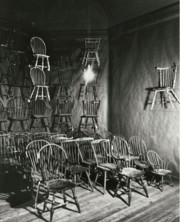
Ice Box.jpg Installation of Windsor chairs, from "Raid the Icebox With Andy Warhol," exhibition at the Museum of Art, Rhode Island School of Design, April 23 - June 30, 1970

Andy's Icebox

Beth Lipman's After You've Gone reminded me of "Raid the Icebox With Andy Warhol," which I saw at Rice University in Houston in 1969. It was Andy at his best: a gigantic readymade consisting of old shoes amassed, chairs on the floor and chairs in the air; everything and nothing. Things broken, things that were fixed, real things and things that were fakes. Everything had been selected from RISD's collection of "decorative arts."

"Decorative arts"? This is a too-fancy and misleading category that some of us prefer to call material culture so that it may include the humble as well as emblems of wealth -- and not exclude meanings, both formal and social. Chairs and guitars, porridge bowls, hat boxes, and chamber pots often have more meanings and tell better stories than ruby-red goblets or paintings.

Hot Glass Comes in Out of the Cold
80_3_12_st.jpg

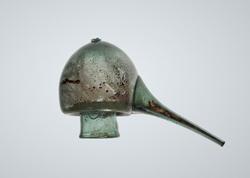
Alembic. Europe. 18th century? Corning Museum of Glass

There is something ghostly about glass. Something both scientific and weird. A smidgeon of research will turn up too many details about the alchemical pursuit of crystal clarity. I was entertained by "Glass of the Alchemist" at Corning, mentioned above. I learned that alchemy, might be seen as merely the mother of chemistry rather than as an occult discipline of personal/universal transformation. I learned how crystal-clear glass, ruby-red glass (achieved by a smidgeon of gold added to the "metal"), and milk glass were invented in the West; how glass discoveries spread throughout Europe and even to China and Jamestown in the New World. I confess I truly hated the profusion of ruby-glass goblets, but loved the few examples of alchemy instruments - an alembic, two retorts, and what is identified as an oil separator. And then there's the little matter of the glob of gold that was supposedly created by alchemist Johann Bottger in Dresden on March 20, 1713, in the presence of King Augustus II of Poland. Now that's exhibition gold!

As partial closure, here's a quote from the sumptuous catalog:

And hence the most ancient Commentators upon the Sacred Writings have told us, that the whole World, when it shall be destroyed by Fire at the general conflagration, will be turned into Glass." -- Herman Boerhaave, London, 1735.

Glass Today
stilllifesized.jpg

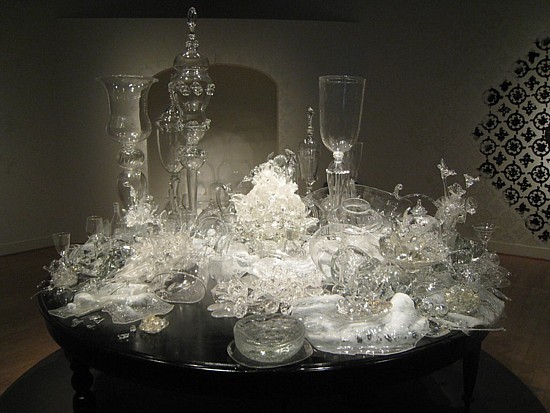
Beth Lipman: Laid Table (Still Life With Metal Pitcher) from 2007. Centerpiece of After You're Gone, 2008.
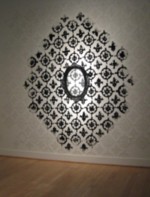
wallpapersized.jpgBeth Lipman's installation (through Jan. 18, at RISD Museum of Art) is primarily made up of clear glass -- blown and/or hot-sculpted with some monochromatic black and white glass here and there. Lipman is known for her blown-glass still lifes, usually inspired by or echoing real-life paintings. Returning the glassware in the paintings to their three-dimensional, glittery glory, paradoxically makes them less real, but also faintly scary.

Lipman: Wallpaper, blown, lampworked and kiln-formed glass. 2008

Glass like gold has an easy beauty, an unearned beauty. But Lipman transforms the glass act into a class act, offerings meanings as well as glitz.

Prediction: Lipman will be the next artist to leap from the glass world to the art world, like the very clever storyteller Josiah McElheny. Like McElheny, Lipman has not shielded herself from the curse of glass (as many have) by hiring artisans to make her work. The blown glass and instances of cast glass are all her own efforts, but they are in service of concepts far more complicated than what is usually found in glass art coming from the studio-craft movement. In any case, some now claim that Post-World War II phenomenon is over and done with.

Corning curator Tina Oldknow, in her catalog essay for her "Contemporary Glass Sculptures and Panels in The Corning Museum of Glass" has this to say:

In the 2000s glass has increasingly been used as a material for sculpture by artists from outside the glass world as well as by artists form whom glass is a primary material. Glass is intersecting with the world of design and contemporary art in multiple directions, and the American Studio Glass movement as it was defined from the 1960s through the 1980s no longer exists..

These statements, on top of rechristening the American Craft Museum the Museum of Arts and Design --do not bode well for art-world alternatives. But now that pricing will drop across the board for all artworks will there be any need for craft to turn its back on crafts? The craft cult will merely be further purified - having been purged of far too many High Art wannabees - and go underground, again.

In the meantime, we gotta have art, in no matter what form. Even if it is made of glass or grass or linoleum or body fluids. Or marble. Or even paint on canvas.

Beth Lipman's fresh work is a case in point.
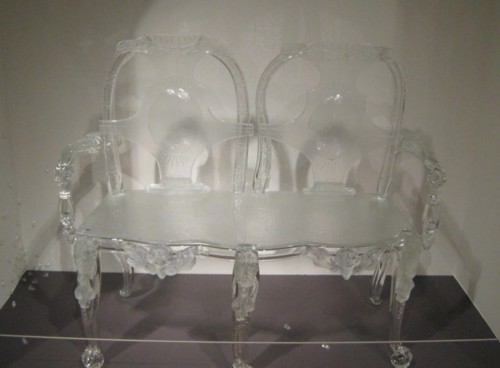
setteesized.jpg

Lipman: Settee (After Grinling Gibbons), 2008

.

Who's Going to Miss You?

The centerpiece of Lipman's installation, "After You've Gone," is Laid Table (Still Life With Metal Pitcher) from 2007, which is a profusion of vessels all made of blown glass including the "metal pitcher" of the title. But Lipman has added a jumping squirrel, a sitting squirrel, and lampworked snails on the periphery of vision. But then there are creations inspired directly by the RISD collection and made on site in the school hot-shop, beginning with glass wallpaper. I kid you not. And a glass settee. Meanings proliferate. The spectacular and dangerous double-chair-back settee is based on an early-20th century copy of a 19th-century reproduction of an 18th-century chair that collector/patron Mr. Charles Pendelton thought until his death was "the greatest 18th century English chair in this country."

Still-life paintings are often memento mori. In this case, a whole room is a memento mori. Lipman's After You've Gone is about what we leave behind: piles of drinking glasses, wallpaper, empty picture frames. Art! Ghosts! Glass is usually perceived as glitzy and celebratory; Lipman uncovers the emotions attached to loss and fragility. And of fakery, too.

Like Warhol's surprisingly forlorn "Raid the Icebox" so many decades ago, Lipman's installation points out the stuff - sometimes loveable, sometimes vulgar, always telling - that clutters up the world with fascinating but mostly unintended messages and meanings. Can we see through materialism, or are we possessed by our possessions and afterwards haunted by them? Are we determined by our decor? Isn't there a strange beauty in how we grasp for stability? And how we remember?"


Perreault, J. "Beth Lipman, smart glass and various time warps." Artopia: John Perreault's art diary. exact posting date unknown, 2008. accessed June 17, 2009. http://www.artsjournal.com/artopia/2008/12/beth_lipman_smart_glass_and_va.html


2008 National Endowment for the Arts:


"Pilchuck Glass School
Seattle, WA
$10,000
To support a summer artist residency program. Artists will be provided with resources, facilities, and technical assistance to experiment with new work in glass.


Wheaton Arts and Cultural Center, Inc. (on behalf of Creative Glass Center of America)
Millville, NJ
$20,000
To support a residency program for emerging and mid-career glass artists at the Creative Glass Center of America. Artists will be provided with housing, a stipend, studio facilities, and technical assistance to work in glass."


National Endowment for the Arts FY 2008 Visual Arts Grants. website accessed June 19, 2009. http://www.nea.gov/grants/recent/disciplines/Visualarts/08visual.php?CAT=Access%20to%20Artistic%20Excellence&DIS=Visual%20Arts&TABLE=1


Monday, April 27, 2009

Chrysler Museum of Art: Contemporary Glass Among the Classics opens April 26, 2009

From the Chrysler Museum of Art website:

"Contemporary Glass Among the Classics
opens at the Chrysler Museum of Art on April 26, 2009.
The exhibition continues through July 19, 2009.

The Chrysler will feature awe-inspiring glass installations from four contemporary artists: Katherine Gray, Stephen Knapp, Karen LaMonte, and Beth Lipman. The exhibition will present new works from each artist, focusing on each artist’s approach to the versatile material of glass, as they continue to explore centuries-old techniques and themes in art.

“We’ve chosen artists for this exhibition who have something to say,” says Kelly Conway, Curator of Glass at the Chrysler Museum of Art. “They use glass as a means of commenting on their own beliefs and how they see the world. The themes that resonate in their work are very relevant because they elicit a reaction. People will find some part of this exhibition and it will touch them—we hope it will make them more curious about the world and give them a fresh approach to art in the Museum’s permanent collection.”"

Chrysler Museum of Art website. Accessed April 27, 2009. http://www.chrysler.org/press/contemporary_glass.asp

Monday, March 30, 2009

2001

In this time line I pull quotes to illustrate a thread in popular and scholarly writing and criticism about glass. Here we will see current glass artists defending their art against the accusations and separating themselves from these stereotypes and, hopefully, find out how and where the now-common opinion was born. Fundamentally, the general thesis seems to be born of the question, What Is Art? This question I will leave to others to answer, here I am only documenting the written history of a popular way of thinking and a popular taste.

2001 Sylva Petrova:

“It appears that means (craftsmanship and technology) themselves become the goals and therefore many glassworks lose one aspect that everyone pretends to include in them: artistic expression… It may be this fact that makes some of modern art’s world renowned personalities convinced that glass as a whole does not deserve their attention.”

Petrova, S. Czech Glass. Gallery Prague, 2001.

2001 Sheila Farr:

"Tacoma is building a $63 million Museum of Glass, scheduled to open next summer, and with a name like that, you'd expect the first show to be, well - glass, right?

To that director Josi Callan has a prompt reply: "Don't forget the colon."

That colon precedes the rest of the museum's title: International Center for Contemporary Art.

And one of the museum's opening exhibits will have nothing at all to do with glass. Expect that kind of programing to continue.

At a walk-through of the site yesterday, Callan and architect Arthur Erickson unveiled a glimpse at a bold structure that will offer more than a place to display and create glass art. It's evolving as a wide-ranging institution that could offer strong competition to other regional museums, including the nearby Tacoma Art Museum.

It's a long way from the seven-year-old original concept as The Chihuly Center for Glass, Callan said.

"We don't use the words `glass art' or `glass artist' here," she insisted yesterday. "We feel that it marginalizes the artists." Although glass impresario Dale Chihuly was associated with the original idea, he plays no role in the museum now. "He's just a good buddy, a good friend," Callan insisted."

Farr, Sheila. "Museum on the rise Tacoma building has art of glass ... and more. " The Seattle Times (Seattle, WA). (Sept 7, 2001): B1. General OneFile. Gale. Seattle Public Library. 1 Apr. 2009. Gale Document Number:CJ78021210

2001 Matthew Kangas:

"Two artists of differing styles and materials, Hank Murta Adams at Elliott Brown Gallery and John Moilanen at Two Bells Tavern, offer their versions of representational art. Both condense and abbreviate recognizable imagery, but with distinct results.

Adams, 45, lives in Troy, N.Y., but has long ties to Seattle and the Pilchuck Glass School, where he studied in 1981 after graduating from Tennessee Tech in Cookeville, Tenn. He also spent significant time (1988-1994) as head designer at Blenko Glass Co. in Milton, W.Va., and has had solo exhibits of his cast-glass sculptures in New York City, San Francisco and Vienna.

Adams' status as a major American glass artist has a lot to do with how he handles a perplexing problem: how to bring up the size and scale of work that tends to be diminutive due to technical details such as the size of glass-furnace openings. Unlike Pilchuck artists Dale Chihuly or William Morris, Adams is not a glassblower but a glass-caster. In his new work, he attempts once again to complicate people's expectations of what glass can be. He does so, this time for his fourth Seattle show since 1986, by combining cast-glass elements with cast-plaster ones, and assembling them all with copper staples and wires.

Although all the new works share this material combination, there is no sense of the usual unending series approach, where glass artists do the same piece over and over. Instead, some of the works are wall-mounted, some pedestal size. Some employ found objects for which molds have been made before the glass or plaster is poured. Not wholly original, Adams is borrowing his found-object idea from better-known glass artists like Howard Ben Tré, Richard Posner and, above all, the late Italo Scanga, but he brings to the process his own identity.

In a few of the wall pieces, such as "Isolate," "Block Trinity" and "Knuckles," black and white glass and plaster shapes are in symmetrical compositions closer to design than abstract art.

The pedestal pieces fare better, mixing references to antique American glass bottles, ornamental Jell-O molds, animal decoys and even perhaps a well-known Swedish vodka bottle. In these, the Philadelphia native faces a bigger challenge for sculptors — how to make the front and back of the sculpture equally interesting. Despite silhouettes reinforced by black and white colors, Adams falls short of fully addressing this crucial problem. "Podsticksweetie Cluster" and "Spindlecluster" overcome it, however, and pass the 360-degree, walk-around test: Everything looks good from every angle.

Even better, "Bombcluster" and "Can Call" transcend the arbitrary look of many of the assemblages and suggest, respectively, spent nuclear-waste storage containers and a pile of ominous, portable explosives. If Adams could make his art more issue-oriented — a big order for business-as-usual decorative glass — and build on the strengths of "Bombcluster," the evidence of technical fabrication could be outweighed by deeper meaning."

Kangas, M. "Painter, glass artist break out new works." Friday, November 2, 2001. The Seattle Times.Accessed April 22, 2009. http://community.seattletimes.nwsource.com/archive/?date=20011102&slug=visart02

2001 James Yood:

"Many art media concern themselves with color and light, but at the end of the day these are the trump cards of glass. In no other medium do color and light so suggestively interweave, shifting, changing and endlessly cross-pollinating. Among the most nuanced seekers after the eternally sensual and elusive mysteries of light and color in glass is Stephen Rolfe Powell, whose upbeat vessels for more than a decade have bubbled, blistered and erupted in fugues of chromatic suggestion. He can be seen as an accomplished color-field painter, though he neither paints nor makes color-fields. Instead, his world provides globular prismatic bursts, an irrepressible ebullience of hue and a tintinnabulation of tincture that maintains, as Van Gogh put it, that "color expresses something by itself."

But what's the point of color without form? The pointillist play of Powell's blots of pure color is tremendously energized and reinforced by the very shapes they come to sheathe and define. He makes vessels, round and bulbous, curvaceous and ribald, replete with generous Intimations of the sensuality of the human body. Their lobes and swellings inevitably suggest buttocks or breasts or testicles, the soft and vulnerable zones of sexuality, in a warm eroticism heightened by the fantastic color scheme. The weight of these lobes, the sense of their being pulled down by gravity, is countered by the exquisite tension of Powell's attenuated and elongated necks, which strain upward in some Parmigianino rhythm, as if these vessels were simultaneously bulb and sprout. Through these forms Powell makes color volumetric, enhancing its possibilities[...]

[...]There have been subtle shifts in his work, as Powell tries to push the edges of his process and explore new strategies. The necks of his vessels, which a decade ago were modestly tapered, have recently been stretched close to breaking point and often are as long as the bodies they surmount. He has tried to create larger murrine to ease the transition from neck to body, to have the color of the neck ooze into the body in some handsome attenuation. And his color too is intensifying, as he shifts from translucency to opacity within the same piece.

His titles exude the "keep-on-truckin"' amiability that is at the core of his work. Usually three words long, these curious names-Tangerine Cheeks Smith, Piranha Gasp Johnson, Purple Zippy Mania, Naive Laughing Cheeks, Undulating Groan Jones, Purple Aloof Cleavage, Pyronic Marilyn Monroe- are important to Powell for their free-and-easy patter. A word or two in a title does describe some aspect of the piece-a shape or color or feeling-but the total effect recalls the 1970s sensibility in which this artist was formed.

Things are good for Powell-his work is successful in the marketplace, he enjoys teaching and lives with his wife and two sons on a 44-acre farm outside Danville. He recently co produced a documentary on the Muranese glass master Lino Tagliapietra's visit to Kentucky and is looking forward to an exhibition of his own work at Galleria Rossella Junck in Venice next year. There is not an iota of fatigue or closure in his commitment to his quest, to have color sing again, to create in glass some vestige of the pursuits he sees in artists such as Mark Rothko, Claude Monet, Morris Louis, Kenneth Noland, and Georges Seurat. Colorists, it is sometimes observed, are born not made Their pursuit of subtlety and beauty, their search for the optical exhilaration that begins where language ends and taste begins, certainly stretches as far as Stephen Rolfe Powell's cooling pools of breathtaking color in Kentucky."

Yood, J. "Stephen Rolfe Powell." American Craft. June/July 2001. http://www.stephenrolfepowell.com/articles/amercraft/index.html
Accessed April 23, 2009.


2001 Robin Rice:

""The end result is what I aim for -- not the perfection of 'Wow, what an amazing technical feat!' " explains Beth Lipman, a fall, 2001 Fellow at the Creative Glass Center of America. Nevertheless, Lipman undeniably wows viewers with the glittering virtuosity of her three-dimensional recreations of 17th and 18th century still life paintings, each incorporating 50 to 100 pieces of glass.

Much of Lipman's earlier work dealt with abundance and excess and, especially, food, which she values as a "universal known thing." An early collaboration with a fellow student combined real food like melted sugar and jelly beans with glass images of lobsters, bread loaves, and fish. The paintings which serve as models for Lipman's current series, "The Still Life Revisited," are rich with meaning and sensuous surfaces. On one level, still life painting traditionally pays homage to the bounty of nature, God's gift to humanity. More superficially but inescapably, these paintings recorded the affluent circumstances of the artist or patron who commissioned them: fine linens, crystal and fresh, abundant food, the stuff of life. Countering this show of vanity, many historic still lifes were vanitas paintings, reminders of the brevity of life, which emphasized fleeting material pleasure as a contrast to infinite, ineffable spiritual joy.

Representations of decadence, decay and waste are reminders of mortality. They include tipped-over wine glasses, insects and the damage caused by them, as well as broken stems and bruises. Split melons in John F. Francis' Still Life with Fruit, one of the works Lipman is recreating at CGCA, seem almost eviscerated, while cascading grapes hang like bloody gobbets. Just as the bloom on a peach fades, so does youth and life. These paintings remind us that though life may be pleasant at the moment and possessions plentiful, "You can't take it with you." Yet, paradoxically, although the subjects of the paintings, their owners, and authors are dust today, the represented scene remains vivid and fresh for our contemplation.

At a third remove from the original living fruit, Lipman's glass versions are even more ambiguous. Glass is solid and almost imperishable, though fragile by definition. Moreover, representing painted objects in clear glass, as she does in her reconstruction of the Francis painting, perversely dissolves solidity in an optically challenging maze of reflections and transparencies. "It's about the essence of the lusciousness of what's going on," Lipman says.

She chose the Francis piece because, John Francis (1808-1886), the most famous American still life painter of his day, lived and worked in Philadelphia where Lipman plans to show this sculpture at the Mangel Gallery in early 2002. For this show, she's also basing sculptures on works by another important Philadelphia still life artist Raphaelle Peale (1774-1825).

The subject of still life attracted Lipman in part because it has always been considered a secondary or lower form of painting -- not as elite, challenging or content-driven as portraiture or "history painting," for example. Glass and fiber (Lipman's other primary medium), are often considered second-class materials for fine arts; so she sees them as akin to still life.

Furthermore, Lipman explains, "I'm a woman working in a material (glass) that 30 years ago a woman wasn't allowed to touch." Her observation reminds us that for centuries aspiring women painters were not allowed to work from the nude (to protect their "modesty"), but still life was considered a suitably ladylike subject and one which was not overly challenging.

Nevertheless, Lipman's glass still lives are challenging and labor intensive. Transcending the pejorative "crafts" label, she presents her work as a consummate complete sculpture. In the hot shop, Lipman works almost expressionistically, knifing a gather of soft solid glass on the end of a metal rod into rugged facets to suggest rather than represent individual, life-size grapes and turning out dozens of peaches in short order. "I'm striving for drawing in glass, not an academic rendition but a translation of objects in my voice and my material." She is not bound to functional perfection when making the props like baskets, spoons and sugar bowls. Lids lack flanges, baskets lack symmetry and slumped spoons are a little flat. In the finished work, they will not be handled. The carefully calculated arrangements of glass objects are permanently mounted on tables built by woodworker Richard McCoy to Lipman's specifications.

An admirer of outsider art, Lipman describes herself as a "craft child," who frequently helped her mother with tole painting and other similar projects. At one time, she disdained the decorative "country" craft aesthetic, but now she respects "the humility of making utilitarian decorative objects" and freely borrows useful techniques. For example, she painted crosshatch tole stokes in fire-on enamels to give a basket in the Francis work a sense of texture.

The most ambitious piece she began at CGCA was a version of Wolfgang Heimbach's Table Still Life with Maid behind a Window. "This piece will be a summary of how I feel about the viewer interacting with the work," she explains. The glass fruit in the McCoy's wooden shadow box will again be clear. In the painting, a maid behind a cracked window eyes the fruit, perhaps covetously. In Lipman's version, the window will be a mirror reflecting the viewer's contemplation of her three-dimensional banquet, a frozen ghostly array of glittering overabundance in which food and consumption have political and social implications. Though it has plenty of intellectual content, Lipman's sculpture is powerfully seductive. When the viewer is literally part of the picture, it is complete and instantly contemporary."

Rice, Robin. "Beth Lipman" Wheaton Arts, NJ. Creative Glass Center of America. 2001. website accessed May 2, 2009. http://www.wheatonarts.org/creativeglasscenteramerica/criticresidency/robinrice/lipmanbeth