Showing posts with label museum of northwest art. Show all posts

Friday, June 4, 2010

Resonances in Glass @ MoNA (review)

Photo Credit: ABJ
The Museum of Northwest Art is in La Conner, Washington.  The lamp-worked glass show currently on is a continuation of the entire museum's theme right now, "Resonances: Contemporary Echoes Modern," in which a modern artist was paired with a contemporary inspired by their work.  What makes the glass show featuring three contemporary artists, Ginny Ruffner, Masami Koda, and James Minson, in Benaroya Glass Gallery a part of the overall theme?  Kathleen Moles, Curator of Exhibitions, says in her notes to the show that Minson and Koda "both remember being struck in particular by Ginny's work" when it was featured at Tama Art University in Tokyo in 1988 where they were students.  As such, her work from the 1980s and 90s is shown in the middle of the room between Minson, whose displayed pieces are dated 2007, and Koda, whose pieces are from 2009.

With the exception of Koda's work on loan from Traver Gallery, most of the show is owned by Anne Gould Hauberg.  "The Queen of Everything" glass-jeweled crown which Ruffner made for the founder of Pilchuck is shown.  It's restrained, a child coloring within the lines.  It's different from "The Juggler of my Heart in Person" or "Balance Series: A Balanced Diet."  In these, her exploding crayola box of harlequin, checkered, and gilded symbols (cats, hearts, bones, tropical fish, wings) may have inspired Koda and Minson, but these two younger artists have what can only be described as a cooler contemporary feel compared to Ruffner's warm and open work.  Alki vs. Freemont.  Or, it's as if a way-out-there mom who baked pot brownies raised two children and they rebelled by being part of the mainstream.

Minson is pulled in two directions.  On one hand there are the very literal underwater scenes of anemone and coral, and on the other, the abstract 22 panels of black wood crawling with clear squiggles and the perfectly arranged green, orange and white mobile.  The mobile made of glass rods is amazing and well-balanced. 

Koda's "Still Life" (2009) is the best piece in the show.  Though it doesn't employ her beautiful silver and glass bead/berry technique found on "Red Dew 6" and "Spring Blow," and it does have the delicate cage look of a lot of lamp-worked pieces now, it contains the most perfect squared-off taper at the top of the bell-jar.  You'll can view it on Traver's website. 

I would have taken a picture, but there were no photos allowed.  (I did draw it, but my sketch is ugly.  There was a fascinating article somewhere recently about photography permission in museums, I'll try and find it.)  So here are a few photos of other things in and around La Conner instead.  La Conner is fun, the museum is only $2 for students $5 for adults, and Clayton Beach is not far away (from Seattle)...it's worth the trip.

Photo Credit: ABJ
Ries Niemi's Fish Bridge, the artist who once said "Glass art makes me wish for earthquakes."
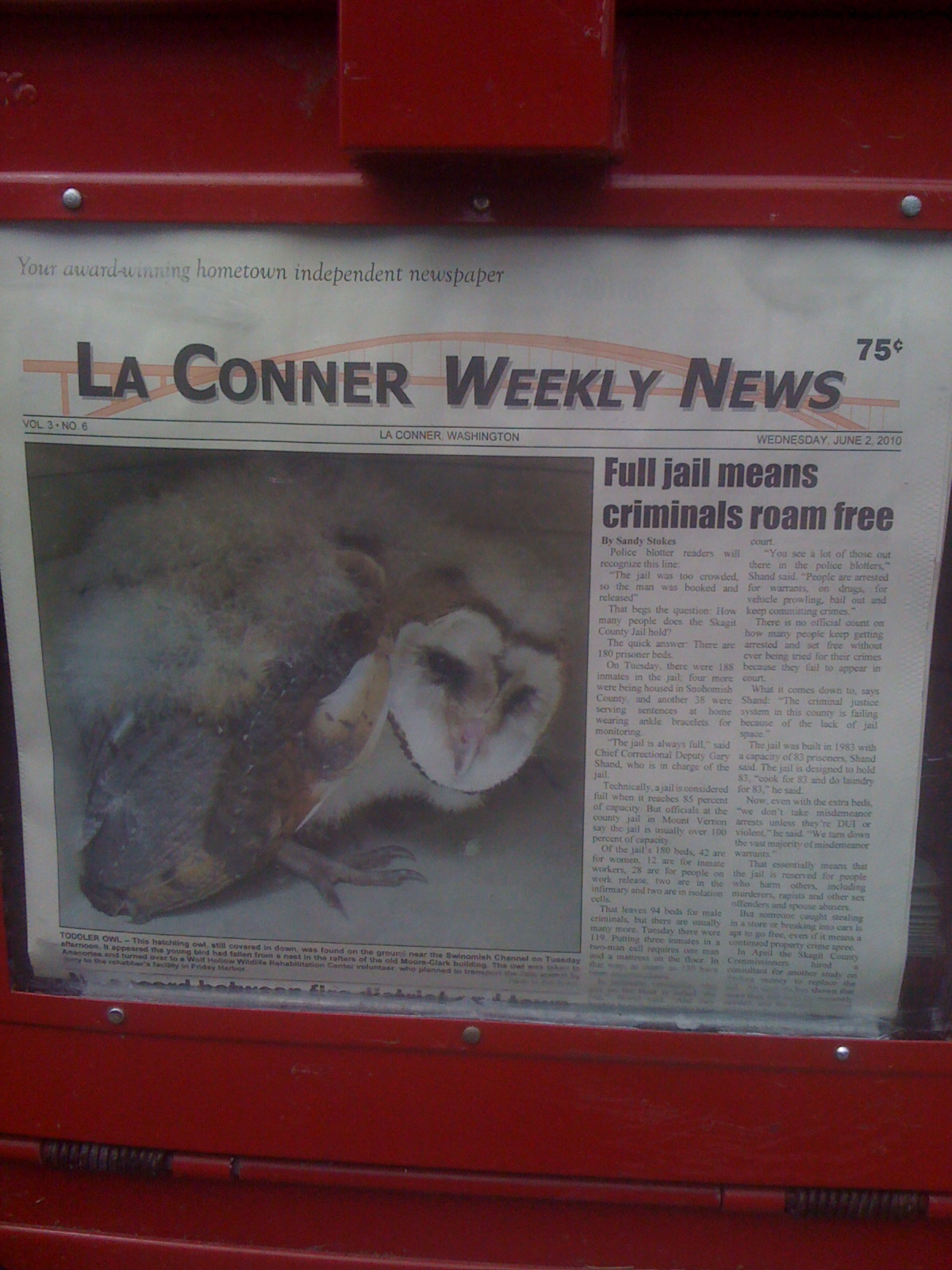
Photo Credit: ABJ
La Conner Weekly News: "Full Jail Means Criminals (like this bad bad baby owl) Roam Free."
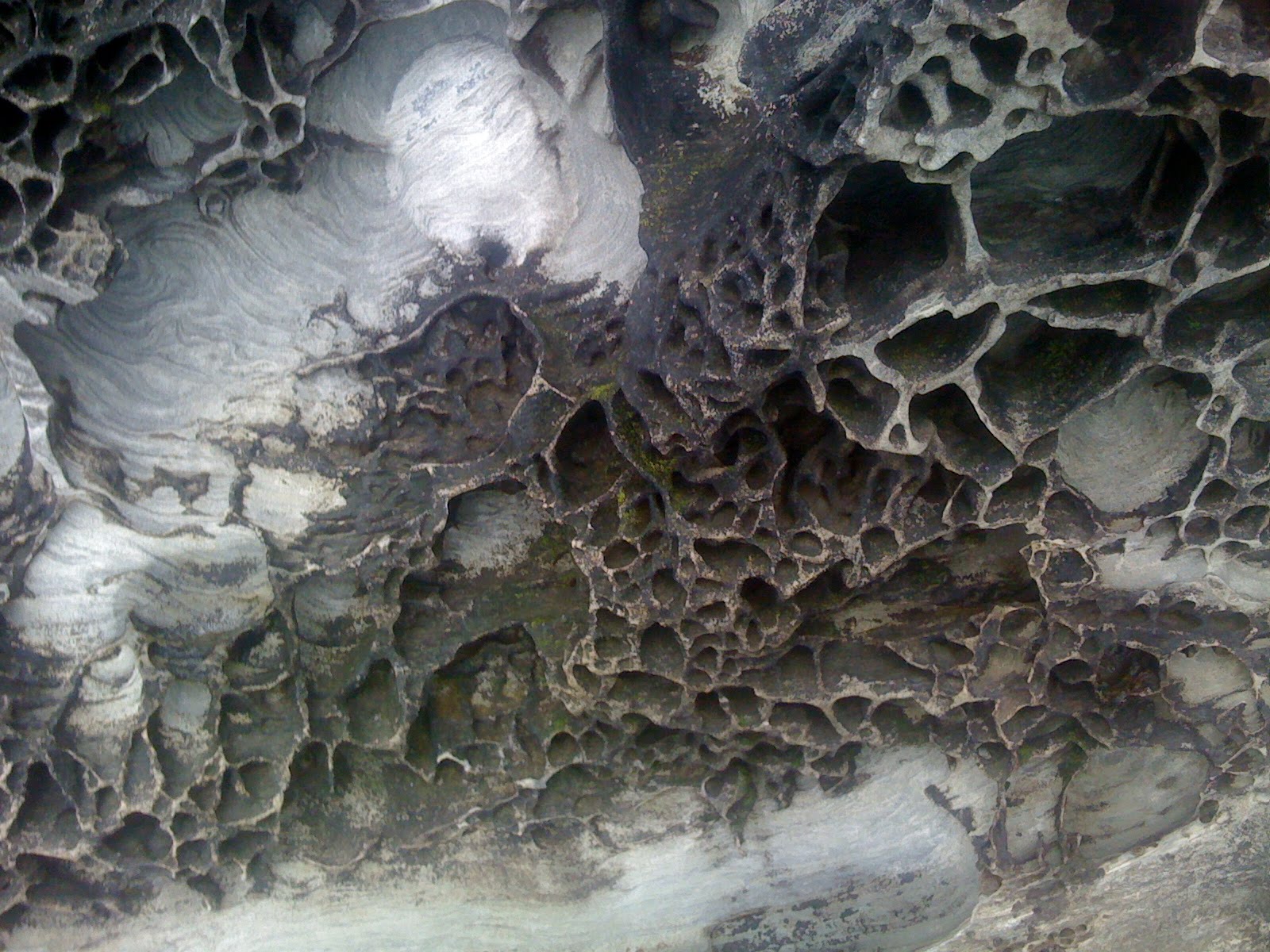
 Photo Credit: ABJ
close up of a Sandstone Boulder, Clayton Beach

Friday, March 5, 2010

like being inside a Tobey painting?

2002 Delores Tarzan Ament:

"...a shimmering light that reflects the idea of mist still permeates much of [Northwest] art, regardless of style. And symbols--birds, the moon, a hail of strokes reminiscent of Mark Tobey's 'white writing'--make regular appearances. Most prominent are references to water--particularly rain.

The Northwest School has left an indelible imprint on the region's art. Its themes and techniques have jumped to new media--a step that had already begun in the 1970s when Doris Chase moved into producing films and video. In the nearly fifty years since Tobey and Graves left the Northwest, and others of their circle have dispersed or died, far more Northwest art has moved into three dimensions, and many more women artists have emerged, particularly as sculptors. Norie Sato and Nancy Mee layer clear glass in ways that build transparency into substance, much as fog over Northwest water transforms Northwest air. Julie Spiedel's totemic bronzes and Steve Jensen's wooden poles carved with formalized patterns of water are contemporary echoes of the symbolic carved totem poles traditional to some Northwest tribes. Gerard Tsutakawa continues the tradition of his father, using classical Japanese forms as departures for bronze sculpture.

[...] Nothing reflects the change in Northwest art more dramatically than the phenomenon of Dale Chihuly, who was designated in 1992 as America's first Living National Treasure. Chihuly entered the art scene unremarkably in the early 1970s, at Seattle's Foster/White Gallery, with a show of simple glass tumblers featuring embedded patterns that harked back to the weaving of Northwest Indian baskets. Year by year, he expanded the scope of art glass to audacious new applications, with a genius for promotion that soon had even his coworkers calling him simply Chihuly, like a rock-star phenomenon. He became the greatest impresario of art promotion since Salvador Dali, with his own publishing company to document his work. He even founded a glass museum in Tacoma, where he had grown up unremarkably as the son of a butcher.

The difference between Chihuly's style and the understated, often reclusive nature of earlier Northwest artists can be understood in part if we recall that while painting is a solitary and contemplative activity, glass is blown in a team context, surrounded by noise and fire, with the necessity for constant awareness of the dangers attendant to molten glass and sharp broken shards. Glass work is intense. Physical exertion is significant; appetites are hearty.

No one could be oblivious to glass art after Chihuly hit the headlines. Every art gallery in the greater Northwest, it seems, represents at least one glass artist. Most have more than one. Because he has made glass art the trendiest, most collectible art in the world, all glass artists--including some more gifted than he--receive more recognition and higher prices for their work.

At first glance, nothing might seem more radically different from the whisper-soft imagery of Northwest art fifty years ago than massive installations such as Chihuly's feat of suspending glass chandeliers that resemble gaudy, multi-breasted fetishes over the Grand Canal of Venice. Lost again. Glass is entirely about light. Chihuly calls it 'the light of the future and past.'

Chihuly rejects the idea of symbolism in his work and he denies narrative content. Yet he speaks movingly of glass as a magical material made of sand and breath, and of the marvel of human breathe giving life to fragile matter. And he has chosen such forms such as the mountain and the moon, which have a long history in Northwest art. Not to mention connections with water such as Seaforms, the ruffling seashell shapes with which he scored his first major success.

[...] In a dozen individual pieces [at the Citadel], Chihuly reiterated Northwest themes in three light-chomping dimensions. The largest Crystal Mountain [...], was formed of rebar welded in random cross slashes, embedded with chunks of the pink glassy plastic Chihuly calls Polyvitro. The mountain rose as a web of crystals 33 feet high, emanating the recorded prayers of three religions. Anyone who entered its interior was bathed in sparkling pink light. From that vantage, looking up in any direction yielded the sensation of being inside a Mark Tobey painting, with the famous slashes of white writing having become black, as if one had walked through the looking glass and found the world reversed.

[...] The Northwest School--the school that never really existed--is not only alive and well in art today, it is making appearances around the world. Each of the artists who helped to define the look of Northwest art half a century ago had a markedly individual style. Yet the more personal their imagery and symbolism, the more universal it appeared in affirming the unity of all life."

Arment, D.T. "Now" in Irridescent Light: The Emergence of Northwest Art. U of W press, Seattle and London, Museum of Northwest Art, La Conner. 2002.

Sunday, November 1, 2009

Boyd Sugiki in The Seattle Times

Boyd Sugiki, a Museum of Glass Artist in Residence this year, also has a show at the Museum of Northwest Art in La Conner.

2009 Nacy Worssam:

"La Conner's Museum of Northwest Art has mounted an impressive show where abstraction combines with representational art to satisfy the intellect as well as the aesthetic sense. Featured are five highly regarded local painters and one glass artist, most of whom have a unique take on traditional landscape art.[...]

Complementing the painted landscapes are three-dimensional cityscapes by West Seattle glass artist Boyd Sugiki. Most powerful are his deep-blue or black groupings inspired by the skyline of Istanbul. Though delicate and elegant, they evoke the vitality and continuity of urban life. Be sure to pay attention to the cutouts he uses to test his designs before blowing the glass."

Worssam, N. "Review: Abstract, representational combine in satisfying show in La Conner" The Seattle Times. October 30, 2009. accessed November 1, 2009. http://seattletimes.nwsource.com/html/thearts/2010163740_abstract30.html