Showing posts with label harvey littleton. Show all posts

Monday, October 5, 2009

2009 Michael Taylor

2009 Luke Strosnider:

"Without a doubt the most renowned glass artist of our time is Dale Chihuly, the enterprising Seattleite whose squiggly chandeliers, delicate floating orbs, and walk-through installations are the most familiar examples of "glass art." His work is ubiquitous, and love it or loath it (it's sometimes a challenge to appreciate an artist whose work is perceived as the sole representative of an entire medium), his pieces eloquently celebrate glass's dazzlingly colorful luminosity and beautiful rendering of organic form.

But there is far more to glass art than Chihuly's hegemony would have us believe, and Michael Taylor has done much to promote that point. Taylor, a pioneer of the medium and the former chair of the glass program at Rochester Institute of Technology, is the subject of Memorial Art Gallery's current exhibition, "A Unity of Opposites: Recent Work by Michael Taylor." On view are several pieces, the majority of which Taylor created within the last five months. What separates his recent work from what most of us would envision as glass art are drastic contrasts in both form and concept.

The formal differences are a matter of how the sculptures are made: unlike most well-known glass art, Taylor's work is not completed in a blazing hot furnace. Rather, he employs a technique known as "cold working," in which hunks of clear and colored glass are cut, ground, and polished. Taylor then joins the pieces with adhesive to create the final works. There are no sea creature-esque shapes here, no swirling flows of frozen liquid. Instead, Taylor's sculptures are assemblages of hard-edged polygons, still quite colorful and beautiful, but displaying an appreciation of geometric design and precision.

Most of the artworks in "A Unity of Opposites" sit calmly on tables and none feature moving parts, but the overwhelming sensation is one of rotation, turning, and movement through space. Despite its comparably diminutive size and lack of color, Taylor's sculpture "Wave" goes far to illuminate his conceptual practice. Shards of clear glass, held together with invisible glue, ever so vaguely attest to a human shape and bear a strong resemblance to the figure depicted in Marcel Duchamp's seminal painting "Nude Descending a Staircase (No. 2)." All of Taylor's work appears to depict serial movement via a motionless media, as if he began with geometric shapes, flung them through the air, photographed them, la Eadweard Muybridge, and then created his own sculptural interpretation of that process. Taylor's "Escalating Spiral" uses clear glass wedges with turquoise highlighting to give form to a swinging, swaying, barrel-roll motion, while "Candidate Sequences for CJ" presents us with a clear half-circle, outlined in citrus orange and heavy red, careening off into space and time.

Director of Exhibitions Marie Via's wall text alludes to Taylor's polymathic tendencies, stating "He's as interested in quantum physics as he is in beauty, as fascinated by the possibility of alternative universes as by engineering." We see this not only in Taylor's aesthetic, but also in the relationship of the sculptures to their titles. Moving around his "Helix or Boring a Conical Hole in the Darkness," the object shimmers: several wedges of clear glass fan out, resembling the motion of a corkscrew's burrowing. Vibrant red highlights glow where the glass wedges meet and, depending upon where you stand, the work's shape and color change completely. It's nearly flat when viewed from head-on; a crimson-ringed aperture made by three-dimensional triangles. But step to the side and it becomes an undulating, jagged form with slashes of hot color. Our visual sense delights, and - recalling the title - our mind considers the illuminating power of scientific knowledge.

Movement through the gallery animates the work, but there are a few pieces you can't circle completely; as such, they're less satisfying. "Meditative Algorithms" and "Entanglement Preservation in a Slow Medium" are mounted high on a wall, and both remain true to Taylor's stop-motion style and expressive use of color. They're pretty, pointy, shambolic tangles of pink, tangerine, yellow, and blue glass. But given that we can't walk around them, they're less responsive to our eyes. Stainless steel armature holds the rose, indigo, and multi-colored striped glass of the tall "Objective to Subjective." Strongly lit, its colors pleasantly grace nearby surfaces. Unfortunately the sculpture stands quite close to the wall, denying us a 360 degree interaction. Taylor's tabletop pieces invite us to play; limiting our perspective is like gifting a shiny new toy but insisting it remain in its box.

Talented glass artisans are many, and their output charms us with its mix of beauty and functionality. "Glass Wear," the gallery's accompanying exhibit of wearable and sculptural glass jewelry, proves that conclusively. But glass artists - those whose work explores heady concepts while simultaneously celebrating the uniqueness and beauty of materials - seem a much smaller group. Taylor's work is a long leap in a much different direction than that of popular preconceptions, and the results are just as fascinating visually, and even more thrilling intellectually.

A Unity of Opposites: Recent Work by Michael Taylor

Through June 28

Memorial Art Gallery, 500 University Ave.

Wed-Sun 11 a.m.-5 p.m.; Tue until 9 p.m. | $4-$10 | 276-8900"

Strosnider, L. "ART REVIEW: a unity of opposites: new work by Michael Taylor, through a glass brightly." City Newspaper. Rochester, . May 6, 2009. accessed October 5, 2009. http://www.rochestercitynewspaper.com/entertainment/art/2009/05/ART-REVIEW-A-Unity-of-Opposites/


2009 Shirley Dawson

"

Ref. to the Michael Taylor art review, I fear your writer misses some interesting points on the history of glass art in America and his dismissal of Dale Chihuly and his (reviewer's quotes)"glass art" is certainly a slap in Mr. Chihuly's less than deserving face!

The reviewer probably knows that Harvey Littleton was the singular "Johnny Appleseed" of the contemporary studio glass movement, traveling from college campus to college campus throughout the U.S. (early 1970's) illustrating how glass could be worked without the huge factory facilities considered up to that time to be a necessity. Harvey came to RIT and left behind a collection of primitive (by today's standards) glass pieces and sure enough, a few practitioners in his wake.
(An interesting aside, several of those young men - and at that time they were almost always male - hightailed it across the U.S.-Canadian border to escape being sent to Viet Nam and they became the teaching backbone of college art programs throughout Canada.)
But it was Dale Chihuly who "sold glass art." Any student who spent time at Pilchuck, the school he established in Seattle, will tell you that Chihuly spent hours nearly every day working the telephones, using every shred of charm and coercion he possessed to sell the IDEA of glass art to collectors, museum curators and gallery owners. Whether you like his art pieces or not - and many of us who snobbishly consider ourselves "critics", turn our noses up at the sometimes Las Vegas approach Chihuly brings to his art - must give him credit for the unbelievable job he's continued to do in the field. He not only sold the idea of collecting glass, but he is unbelievably generous sharing his expertise with students - an asset sometimes missing from teaching staff with less secure egos. He is directly responsible for the strong branding of Seattle as a glass art city - an association that brings thousands of visitors and millions of tourism dollars into that city every year.
These are not small accomplishments."

Dawson, S. May 9, 2009. Comment to above article.

Saturday, June 6, 2009

1964

Before anyone was a 'glass artist' there were only artists learning to 'exploit' the material of glass.

The Tricky and Fascinating Four, where are they today?

1.
Marvin Lipofsky--One of the most well-known glass artists today, presented with a Lifetime Achievement Award from GAS
2. Monona Rossol--The best voice in safety for artists in all materials, she's an author, stage performer, ceramics and glass artist and industrial hygienist, too.
3. Samuel Herman-- Mark Hill, author of Miller's Collectible Price Guide, and expert on Antiques Roadshow says he's "Arguably the greatest name in British studio glass - and pretty darned important in the global studio glass movement too. Unfairly in my mind at least, few recognise his incredible vision, abilities and importance. Without him, studio glass techniques would not and could not have spread to the UK and beyond."
4. Rodger Lang--ceramicist and teacher at Metropolitan State College in Denver, CO. Passed away in 2000.


1964 Wisconson State Journal:

"Four Madison artists who have been experimenting in the tricky and fascinating art of glass-blowing under the tutelage of Prof. Harvey Littleton, of the University of Wisconsin, will be showing their work Monday at the Madison Art Association’s Downtown Sidewalk Art Fair in Capitol Park.

They are Samuel Herman, Marvin Lipofsky, Rodger Lang, and Monona Rossol, all U.W. graduate students or former graduate students specializing in ceramics and sculpture.
They pursue their interest in creating beauty in glass at 52 Randall ave. in a new workshop that formerly served as a warehouse for pleasure boats.

This unpretentious tin building called the “glass lab” is a mecca for students and teachers of the ancient art of glass-blowing, who are attracted by the skill and creativeness of Littleton, well-known for many years as a potter and now achieving new laurels for his artistry in glass.

One of Littleton’s vases is currently on display in the New York Museum of Modern Art’s good design exhibit, and four pieces are included in the 13th International Design Triennale in Milan, Italy.

Littleton is also the only glass artist now exhibiting at New York’s Museum of Contemporary Crafts.

Grants Built Lab

His personal interest in glass as an art form is responsible for the glass lab, which was set up a year ago in several grants prompted by an original gift of $1,000 from the Johns-Manville glass fibers division.

To Littleton’s knowledge, the grant was the first from an industrial or private source ever
received by the U.W. art department for practicing arts.

It has already reaped rewards. A class of eight graduate students worked under Littleton there the past 10 months, achieving results which the talented teacher modestly lauds as ‘better than I managed in several years working alone at the furnace I have at my farm.”

Among them are the four young people who will be exhibiting at the art fair. Lang, a native of Chicago and graduate of Cornell College was sent to Littleton by a former Littleton student who know teaches at Iowa college.

Herman is the blass lab [sic] assistant for the summer, and will have a sculpture assistantship [sic] this fall as he continues work on his master’s degree.

Won Show Award
Miss Rossol holds a degree in chemistry from the university as well as a master’s degree in art and a M.F.A. She won an award for her glass last fall in the Wisconsin Designer-Craftsman show.

Marvin Lipofsky, who received his M.F.A. in sculpture in June, is the first disciple to spread the Littleton influence to another campus. He goes in the fall to the University of California at Berkeley, to start a program in glass at the undergraduate level in the department of decorative arts.

The University of Iowa and the Haystack School in Maine currently have summer workshops in this medium, but LIpofsky’s venture comprises the first regularly scheduled program in free-blown glass at the university level other than here at Wisconsin.
Spreading of interest and know how to other campuses is one of Littleton’s objectives, for he sees as long-overdue the re-adoption of glass as a medium of creative expression.

“The creative artist and the craftsman have been separated. We believe that the artist’s heart, hand, and head should all be used together and simultaneously to express the idea that originates within him. Glass can be many things. You’re out not to re-discover but to exploit as an artist some of the things of the past, he says.

To this end the glass furnace at 52 N. Randall glows [..?..] day, giving off a loud humming that immediately attracts the passerby. It was built by students, as was the annealing oven and other equipment.

4-Week Class Held
To this end to, Littleton has set up a four-week class this summer for specialists and instructors from all over the country who were invited to the university to learn and to share their knowledge of free-blown glass.

From Munich, Germany, has come Erwin Eisch, painter, sculptor, co-owner of a Bavarian glass factory, and one of the few individual glass artists in the world today.

Dr. Robert Fritz, assistant professor of ceramics at San Jose State College, and Russell Day, a well-known glass artists who is head of the art department at Everett Junior College [sic] in Washington, have come from the West Coast to observe, experiment, and learn.

An industrial engineer, Carl H. Betz of Philadelphia, whose work in glass-blowing has been extensive in the scientific instrument filed, is discovering new joys in free-blown glass.
Other invited ‘students’ are Don Wallace, sculptor and ceramist from Toronto; Frank Kulasjewicz, a doctoral candidate in art education at Teacher’s College, Columbia University; Robert C. Florian, a prominent art educator from Franklin Park, Ill.; and Mrs. Gail Griggs, a graduate student associated with the Art Institute of Chicago.”


['Artists Experiment With Glassblowing' from Wisconsin State Journal], 1964 July 12 / Wisconsin State Journal. Clipping : 1 p. ; 38 x 24 cm. Harvey K. Littleton papers, 1946-1975. Archives of American Art.website accessed June 6, 2009 and transcribed by ABJ. http://www.aaa.si.edu/collections/searchimages/images/image_201_168.htm

Tuesday, May 26, 2009

1974

In this time line I pull quotes to illustrate a thread in popular and scholarly writing and criticism about glass. Here we will see current glass artists defending their art against the accusations and separating themselves from these stereotypes and, hopefully, find out how and where the now-common opinion was born. Fundamentally, the general thesis seems to be born of the question, What Is Art? This question I will leave to others to answer, here I am only documenting the written history of a popular way of thinking and a popular taste.

1974 Heinz Spielmann:

The well-wooded border area between Bavaria, Austria and Bohemia, a center of European glass production since the Middle Ages, is still of great scientific importance today…

Eisch, who has a reputation as a loner in Germany, has his friends in England and the United States. Together with them he strives to overcome the narrow view of glass as only a material for functional containers.

Erwin Eisch: “I have worked as an industrial designer myself, but I could not find either satisfaction or pleasure in approaching matter intellectually. Designing technical gadgets ought to be left to technicians and business people. Industrial design is largely based on mercantile principles; consequently on the belief that the so-called simple form is most adequate to a technical object may soon be refuted by the changing taste of purchasers. Let us leave the designers to their own devices. We invite them to come with us, of course!

Whenever I am forced to design glasses for industrial purposes my soul is distorted and reduced to a miserable little thing. Nobody who knows of the infinite possibilities offered by glass, nobody who has ever felt how this material responds to his breath and his intentions as a craftsman will ever sit down at a drawing-board and try to plan and form glass exclusively by designing. ‘I do not regret,’ an industrial designer recently told me, ‘that the handicraft of glassblowing is no longer appreciated or of any importance today.’ in his opinion the glassblower has been replaced by designers and by those who make the moulds corresponding to their designs. The activity of the glassblower, he feels, has been replaced by automation, by machines.

Only a man who does not know the delight and the pride that the craftsman takes in every perfect piece of glass he has shaped can hold this opinion.

Spielmann, H. "Erwin Eisch" GlassArt Magazine, June 1974.

1974 Harvey Littleton and Erwin Eisch:


Photo Citation: [Harvey Littleton and Erwin Eisch], 1974 Apr / Herbert Wolf, photographer. Photographic print : 1 item : b&w ; 14 x 18 cm. Harvey K. Littleton papers, 1946-1975. Archives of American Art. http://www.aaa.si.edu/collections/searchimages/images/item_238.htm

1973

The Central Seattle Public Library is one of my favorite places. It makes me soo claustrophobic--it's a total labyrinth--and once a guy threw up next to me. Anywhere you sit you can see someone watching porn with their bookbags stacked up around the computer like shields. The city should invest in those screen covers that let you only see from one angle. But, there's a great periodical section with hardbound books of every topic under the sun. And you can request materials from the Rakow Library at the Corning Museum of Glass in NY.

There is a collection of GlassArt Magazines, it looks like it was published by glass artists, but I don't have too much history on it. Here's some of the 1973 publication. One interesting point is made by Harvey Littleton about artists joining arts organizations because they do the promotion of your art and your material and artists writing for the 'straight' newspapers to promote their art as well.

(This is also the start of the Technique vs. Concept debate-- a subset of which was artists purposfully disfiguring the beauty of glass because it was too easy-- which came before the Art vs. Craft debate.)

1973 GlassArt Magazine:Glass Art magazine. January-February 1973.

John Bennett has been collaborating with Robert Coleman in a series of works involving hand-blown glass and poetry. “Coleman does the glass,” he says, “and I write the poetry for it and apply it to the glass.” Mr. Bennett has published poetry in a number of literary magazines…He has also completed two books of poetry, one of which, Found Objects, will very shortly be published by The New Rivers Press in New York. Robert Coleman’s work has been widely exhibited throughout the United States….Mr. Coleman is currently teaching assistant in the MFA program at Kent State Univeristy, Ohio."

My dog is barking in me
My eyes in teeth in passage through
The air biting me this hot cold
It is so difficult to speak to my wife
To my hand or tongue or shoelace
This is a fiction,
The one I want to speak to isn’t,
As if he were no one hiding in the closet
Around the bend of stirs
The dog barking in the next block
The distant freeway a coffin rushing back again
Tehe air hissing through its teeth which never move
I am speeding paralyzed toward a
Greater motion of ice in mirrors
Of frozen wind in sworls like brain like glass
Like breathing a peace a balance a terror….

Citation: GlassArt Magazine. Jan-Feb, 1973.


1973 Jerald Pilcher:

“Why should an art department or an art teacher want to have a glass blowing facility for a high school? It’s not a normal medium that all students should have a chance to work in, but then maybe that’s a good reason why one could be beneficial. Glass blowing is a good incentive medium because it is so different and so interesting that it makes good all-around students of some people who otherwise would have to interest in art or school in general….”

Pilcher, J. "Valdosta High: Blowin’ glass, insteada class” GlassArt Magazine. April 1973.


1973 Mike Cohn:

Michael makes unfat glass. He manipulates the medium to bring forth cool, serene forms which fit together in interlocking patterns. He admits that he was originally turned on by the seductive qualities of glass, but it is precisely because he finds it so inherently beautiful that he turned in another direction. ‘Glass,’ he says, ‘is so beautiful you can just pile it on the floor. It has a lot more going for it than, say, ceramics, where you start with a lump of clay.’ he sees the exploitation of this organic quality as, ‘sort of a riff, like in music.’ so he reacted against this, tried to force the medium out of its natural path. His glass began evolving into machine forms.

Mike no longer sees this as forcing the glass into a path it doesn’t want to take. The images he is producing are ‘Natural to what’s in my head’, and he is comfortable enough with the medium to not feel guilty about exploiting all of its potential. He sees glass as an animated and energetic medium which is perfect for the forms he is producing, both machine-like and organic.

Unlike many people working in glass today, Michael did not come to the medium from ceramics, but rather from sculpture. He is understandable concerned with producing art with a capital A, and is almost apologetic about his functional creations. He says he tries to think of them merely as small sculptural statements, and is, in fact, actively involved in the fragmentation of these forms.

Citation: GlassArt Magazine. August, 1973.


1973 Joel Weinstein and Harvey Littleton:

…The modern scientist really, I think, has tuned himself in much more to the artist and really understands that his directions are creative in the same sense that the artist’s are. He regards the experimental data and so on to prove his creative thoughts, his creative ideas, but he basic concepts come in the same way that an artist conceives and realizes his individual concepts. It’s a very direct, almost subconscious kind of thing.

Q: Last night, you said at one point that you were more interested in questions of impact rather than questions of technique.”

A: Well, impact; impact is perhaps a bad word. Concept; much more I’m interested in concept than technique. Why you do it, what it is, how it fits in, who you are as an artist…I don’t really think of art as communication. I think that it’s more expository, if you want to draw a parallel to speech, rather communication. The artist doesn’t really give a damn if anybody likes lit or understands it, if he’s really into it. You know, he does it because he has to do it. There’s a compulsion, as in compulsive talk. It’s not communication.

[…]

Q: Someone suggested that many buyers were unable to distinguish well-crafted wares from schlock at art fairs, for example.

A: Who is it who develops consumer consciousness? What is the public relations of the artists? The public relations of the artists are, among other things, organizations of artists. How many of those people belong to organizations of artists? To the American Crafts Council? They want public relations, they want to be able to sell, but will they join the outfits that’re promoting them?

How about museum support?…Newspapers…how many people are drumming up articles for the newspapers so that there’s a weekly column on the scene? They’ll write for the underground papers, but will they write for the straight papers? They’ve got to put energy into it if they’re going to get anything out….

Q: Assuming you can get people to buy your stuff, what kinds of things do you expect to be going on in their heads? Why would they buy your stuff, for example?

A: In my opinion, the artist’s concern is to get rid of the stuff so he can make more, and when he’s finished with a piece, he should be finished with it….And his concern is to be able to live and to be able to work, make more…

Q: So it really doesn’t matter what kind of effect…

A: No, it’s not your business. If they identify with a piece and they want it, it’s their concept of how they’re going to live with that thing. You’ve got to five them the chance to see something in your stuff…

Q: Why do you deserve to continue? Why should people support you?

A: Well, that’s the test that everybody has to make. You produce a piece, is anyone interested in it?"

Weinstein, J. "A Conversation with Harvey Littleton." GlassArt Magazine. August 1973.


1973 Antone Gasparetto:

“In a word, all the trends of modern art--from distant cubism, futurism, figurative expressionism and action printing, to op art and multiple ‘vasareliani’--are today present in the non-utilitarian form of glass sculpture.

...in conclusion, we can say that having overcome the distinction between industrially-produced items (wherein a series of objects for everyday use is created by industrial designers) and of pure works of fine art (those non-useful objects created by artists directly, by means of a ‘translator’, or alongside a great craftsman), modern criticism acknowledges any creative process that is truly autonomous whether or not an object is purely expressive. It must only reflect the dignity of art. Consequently, between utilitarian sculpture in glass (useful glassware) and non-utilitarian sculpture int glass (the so-called glass artworks) one cannot establish a hierarchy. There are perfect works of art in the first type as well as in the second. If a negative limit is applied to the art in the first instance regarding its expression of content, of the function on the form , then in the second case (nonutilitarian) the negative limit may be is sensualist, estheticism of material, its technique and resulting effects, or of the free form itself.

Accompanied by photos of Salvador Dali/Jacques Daum “Bande de Moebius, 1970
Jack A. Schmidt “Game Board 25” 1973
Joel Philip Myers “In My Garden” 1973
Jean Cocteau “Face (reality)" 1966

Gasparetto, A. [the director of the Instituto Veneto per il Lavoro] "The Tendency of Modern Glass Sculpture”. GlassArt Magazine. October 1973

Bonhams 20th Century Decorative Arts. New York, 17 Dec 2008

After seeing the glass-only auction results from Bonhams May sale, I wanted to see how glass did at Bonhams last year. Certain artists like Littleton were sold at the 20th Century Decorative Arts sale last December in New York and weren't in the Contemporary Glass sale this year. I also wanted to see what prices were doing, even though it's only been 5 months since this 2008 sale.
Lot No: 4360
A pair of Murano glass leaf-form sconces
1950s
unsigned
height 17in (43.2cm)
Sold for $2,160 inclusive of Buyer's Premium
Lot No: 4425
Jaroslav Svoboda (Czecholslovakia, born 1938)
Sculpture, 1983
glass,
inscribed 83.
height 11½in 29.2cm); diameter 5½in (14cm)
Estimate: $1,000 - 1,500 Lot No: 4422
Concetta Mason (American, born 1950)
Spun Violet, 1988
blown, cut and polished, sandblasted and enameled glass,
inscribed 1988 SE 2984 SPUN VIOLET.
dimensions 16½in x 9½in x 9½in (41.9cm x 24.1cm x 24.1cm)
Sold for $1,680 inclusive of Buyer's Premium

Lot No: 4448
Maurice Heaton (American, born Switzerland, 1900-1989)
Three Untitled Platters, 1964-1967
blown and enameled glass,
each monogrammed MH.
lengths 12¼in and 8in (31.1cm and 20.3cm); diameter 8½in (21.6cm)
Estimate: $800 - 1,200 (unsold)
Lot No: 4445
Pavel Hlava (Czechoslovakian, born 1924)
Vase
blown glass
inscribed P. Hlava / Czechoslovakia.
height 6 1/8in (15.5cm); width 7 7/8in (20cm)
Sold for $1,920 inclusive of Buyer's Premium
Lot No: 4456
Dana Zàmecnikovà (Czechoslovakian, born 1945)
Lovers
painted, etched and engraved laminated glass.
height 16¾in (42.5cm); length 18¼in (46.4cm); depth 7¾in (19.7cm)
Sold for $4,800 inclusive of Buyer's Premium
Lot No: 4469
Dominic Labino (American, 1910-1987)
Two Vessels, 1970-1975
blown and internally decorated glass, each inscribed Labino one dated 8-1970 the other 8-1975.
heights 6½in and 4½in (16.5cm and 11.5cm)
`
Estimate: $3,000 - 5,000 (unsold)
Lot No: 4478
Harvey K. Littleton (American, born 1922)
Optic Glass #6, 1979
blown glass,
base inscribed Harvey K. Littleton, 1979.
height 12in (30.5cm); length 21½in (54.5cm); depth 7¾in (19.7cm)
Sold for $9,600 inclusive of Buyer's Premium
Lot No: 4477
Harvey K. Littleton (American, born 1922)
Amber Loop, 1972
cast glass,
inscribed Harvey K. Littleton 1972 131/150
originally purchased with a signed and witnessed certificate of authenticity.
height 5½in (14cm)
Sold for $1,200 inclusive of Buyer's Premium

Lot No: 4481
Harvey K. Littleton (American, born 1922)
Three Glass Arches, 1975
blown glass,
each inscribed Harvey K. Littleton 1975.
dimensions range from 5¼in x 6in to 9½in x 8in (13.3cm x 15.2cm to 24.1cm x 20.4cm)
Sold for $3,600 inclusive of Buyer's Premium
Lot No: 4500
Pino Signoretto (Italian, born 1944)
Embrace
internally decorated glass,
inscribed Pino Signoretto and Made for Julia.
height 46½in (118.1cm)
Sold for $3,300 inclusive of Buyer's Premium
Lot No: 4508
Mary Shaffer (American, born 1947)
Fired Twice, 1995
slumped, cast glass and metal.
height 5in (12.7cm); width 8in (20.3cm)
Sold for $1,200 inclusive of Buyer's Premium
Lot No: 4502
A Lino Tagliapietra Saturneo Plate and Bowl
circa 1988
blown glass,
each inscribed Taglipietra Angelin Effetre International / Murano Italy 1988 and numbered 59/100 and 52/100 respectively.
diameter of plate 9½in (49.5cm); height of bowl 8½in (21.6cm)
Sold for $4,800 inclusive of Buyer's Premium
Lot No: 4515
Mary Schaffer (American, born 1947)
Double, 1999
glass, metal.
height 19in (48.2cm); width 5in (12.7cm); depth 11in (27.9cm)
Estimate: $6,000 - 9,000 (unsold)
Lot No: 4516
Dale Chihuly (American, born 1941)
White eight-piece Seaform with black lip wrap
blown glass
inscribed Chihuly.
dimensions of largest. 15in x 10in x 6in (38.1cm x 25.4cm x 15.2cm)
Sold for $6,600 inclusive of Buyer's Premium
Lot No: 4518
William Morris (American, born 1957)
Rython: Etruscan Horse, 1999
cast glass,
inscribed William Morris 1999.
height 15in (38.1cm); width 12in (30.5cm); depth 5½in (14cm)
Sold for $21,600 inclusive of Buyer's Premium
Lot No: 4514
Mary Ann (Toots) Zynsky (American, born 1951)
Vase
fused glass threads,
monogrammed Z
height 11½in (29.3cm); length 20½in (52.1cm); depth 13in (33cm)
Estimate: $4,000 - 6,000 (unsold)
Lot No: 4511
Harvey K. Littleton (American, born 1922)
Double Arch, 1986
internally decorated, blown, cased, cut and polished glass
each inscribed Harvey K. Littleton 4 -1986.
dimensions 9in x 14in and 6½in x 16in (22.9cm x 35.5cm and 16.5cm x 40.6cm)
Estimate: $7,000 - 10,000 (unsold)

Lot No: 4540
Stanislav Libensky (Czechoslovakian, 1921-2002) and Jaroslava Brychtova (Czechoslovakian, born 1924)
Taking Off, 1998-2000
cast glass
inscribed LIBINSKY-BRYCHTOVA 1998-00
height 16in (40.6cm); width 33in (83.8cm); depth 22in (55.9cm)
Sold for $57,000 inclusive of Buyer's Premium Lot No: 4531
Dale Chihuly (American, born 1941)
Yellow five-piece Seaform, 1996
blown glass,
inscribed Chihuly 96.
dimensions of largest 6½in x 12in x 8in (16.5cm x 30.5cm x 8in 20.3cm)
Sold for $6,600 inclusive of Buyer's Premium

Sale 16154. Bonhams 20th Century Decorative Arts. website accessed May 26, 2009. http://www.bonhams.com/cgi-bin/public.sh/pubweb/publicSite.r?sContinent=USA&screen=Catalogue&iSaleNo=16154

Sunday, May 10, 2009

Art Alliance for Contemporary Glass Awards

2009 From the AACG website:

"The AACG Annual Award

Each year the AACG selects an organization to be honored for its contributions to the contemporary glass movement. This organization receives an unrestricted grant from the Alliance, and is invited to present a public program at SOFA Chicago in conjunction with the AACG Annual Meeting. The Honorees have been:
  • 1991: Rhode Island School of Design
  • 1992: Penland School of Arts and Crafts
  • 1994: Urban Glass
  • 1995: Pilchuck Glass School
  • 1996: Glass Art Society
  • 1997: Bullseye Connection
  • 1998: Glass Program of University of Illinois
  • 1999: The Studio of the Corning Museum of Glass
  • 2000: Glass Program of California College of the Arts (formerly California College of Arts and Crafts)
  • 2001: Creative Glass Center of America (at Wheaton Arts and Cultural Center, Millville NJ)
  • 2002: Mint Museum of Craft + Design
  • 2003: Renwick Gallery of the Smithsonian American Art Museum
  • 2004: Corning Museum's Mobile Hot Shop
  • 2005: The Museum of American Glass at Wheaton Arts and Cultural Center
  • 2006: The Glass Program of the University of Miami
  • 2007: The National Liberty Museum
  • 2008 (to be presented November 8, 2009 at SOFA Chicago): Museum of Glass, Tacoma.

AACG Honors

In 2001, the AACG began a new program of recognizing individuals of outstanding accomplishment in the field of contemporary glass art. Honorees may be artists, collectors, curators, critics, teachers, authors, gallery owners and directors,and any others whose contributions have been significant and important in the field. Recipients are introduced at the AACG Annual Meeting at SOFA-Chicago. These awards have been given to:

  • 2001:
    • Harvey Littleton, Artist
    • Stanislav Libenský and Jaroslava Brychtová, Artists
    • Hilbert (posthumous) and Jean Sosin, Collectors
  • 2002
    • George and Dorothy Saxe, Collectors
    • Joel Philip Myers, Artist
  • 2003
    • Ferdinand Hampson and Doug Heller (joint award), Gallery Owners
    • Jack Pelisek (posthumous), Collector
    • Paul Stankard, Artist
  • 2004
    • Tina Oldknow, Curator
    • Myrna and Sheldon Palley, Collectors
    • Mark Peiser, Artist.
  • 2005
    • Marvin Lipofsky, Artist
    • William Warmus, Critic, Curator
  • 2006
    • Richard Marquis, Artist
    • Natalie and Ben Heineman, Collectors
  • 2007
    On the occasion of the 20th anniversary of the founding of AACG, to the founders of the organization:
  • Madeline Baer (posthumous)
  • Wally Baer (posthumous)
  • Mike Belkin
  • Irvin Borowsky
  • Gloria Kamm
  • Sonny Kamm
  • Elmerina Parkman
  • Paul Parkman
  • Bobbi Raphael (posthumous)
  • Jerry Raphael (posthumous)
  • Dorothy Saxe
  • George Saxe
  • Hilbert Sosin (posthumous)
  • Jean Sosin
  • Paul Stankard
  • Laurie Wagman
  • 2008 (to be presented November 8, 2008 at SOFA Chicago)

    • Simona and Jerome Chazen, collectors
    • Bonnie Marx and Ken Saunders, gallerists"
AACG. "Awards of the Art Alliance for Contemporary Glass". Website list last updated June 5, 2008. Website accessed May 10, 2009. http://www.contempglass.org/activities/awards.html

Heineman Collection at CMOG

Artdaily.org (March 4, 2009):

"CORNING, NY.-
A new survey of one of the largest and finest collections of contemporary studio glass in the United States will open at The Corning Museum of Glass on May 16, 2009. Part of a year-long series of contemporary glass exhibitions and programming at the Museum, Voices of Contemporary Glass: The Heineman Collection, will present 240 works in glass by 87 international artists.

Voices of Contemporary Glass will showcase the collection donated to the Museum in 2006 by Ben W. Heineman, Sr. and his wife, Natalie G. Heineman. Mr. Heineman collected with a discerning eye, thoughtfully assembling a grouping of works that represents the full breadth of a defining period in contemporary glassmaking. He was intrigued by the extraordinary potential of the material to take on a broad range of expressions and forms. Although interested in all kinds of art in glass, he was drawn primarily to works that explored abstraction and color.

The exhibition at the Corning Museum features video interviews with a selection of artists represented in the Heineman Collection, exploring their individual ideas, or “voices,” in glass. This multitude of voices and perspectives celebrates the infinite possibilities of glass as a medium for contemporary vessels and sculpture, and documents the ongoing process of discovery and innovation that has shaped the story of the Studio Glass movement.

“The Heineman Collection reflects the remarkable achievements made in studio glass over the past 35 years,” said David Whitehouse, the Corning Museum’s executive director. “The collection is distinguished by its in-depth focus on a key group of individuals whose work has been influential to artists working in glass worldwide. The exhibition explores the appeal of glass and its essence as a creative medium for artists of all backgrounds. At the Museum, visitors can always experience the energy of artists at work but, this year, the artists will be even more present.”

[...]

This extensive collection allows us to present the story of studio glassmaking, and to examine the variety of ways in which artists have used glass to find their artistic voices,” said Tina Oldknow, curator of modern glass and of the exhibition. “The exceptional compilation of objects displayed in the exhibition documents a remarkable material and a deeply introspective process of working that helps to explain the often indefinable, but always captivating, allure of glass.”

The Heineman Collection nearly completely documents the chronology of the American Studio Glass movement, with objects dating from 1969 to 2005, and it presents the work of several artists over the course of their careers. Highlights of the exhibition include:

• Architectonic sculptures by Thomas Patti, who pioneered the exploration of industrial and architectural glass as a sculptural medium.

• Blown vessels by Lino Tagliapietra, considered to be the world’s foremost glassblower and one whose influence has had a lasting impact on American studio glass.

• Glass sculptures evoking elements of architecture and industry by Howard Ben Tré, who led the way in the use of cast glass as a sculptural medium in the United States.

• A rare group of “Navajo Blanket” cylinders blown in the mid-1970s by the internationally recognized artist, Dale Chihuly.

• Iconic sculptures by the acknowledged “fathers” of American studio glass, Harvey K. Littleton and Dominick Labino, who, in 1962, introduced the first studio-sized glass furnace that enabled glassworking to move outside of a factory environment, launching the American Studio Glass movement.

Voices of Contemporary Glass, which runs through January 3, 2010, will be accompanied by a fully illustrated catalog of the collection by Tina Oldknow. As part of a year-long celebration of contemporary glass at the Museum, it is complemented by the exhibitions, Favorites from the Contemporary Glass Collection (March 1, 2009 – January 3, 2010), and Masters of Studio Glass: Richard Craig Meitner (April 4 – October 18, 2009).

The installation, designed by Paul and Barbara Haigh, is inspired by the Heinemans’ Chicago residence in which the collection was originally displayed. The exhibition design transforms the large and open spaces of the Museum into a more intimate setting, reminiscent of domestic interiors, with the objects arranged primarily by artist, rather than by artistic theme, chronology, or technique.

The Corning Museum of Glass has historically taken the lead in disseminating information about contemporary glass. This year marks the 50th anniversary of the Museum’s landmark show, Glass 1959, one of the first significant surveys of mid-20th-century glass design. Workshops introducing studio artists to hot glass, held three years later, in 1962, at The Toledo Museum of Art, Toledo, Ohio, launched the American Studio Glass movement, which is explored in-depth in Voices of Contemporary Glass."

Artdaily.org [edited and published by Ignacio Villarreal, Jr.] March 4, 2009. "Corning Museum of Glass Announces Radiant Survey of Studio Glass." website accessed May 10, 2009. http://www.artdaily.com/index.asp?int_sec=11&int_new=29394&int_modo=1

Friday, May 1, 2009

Habatat Masterworks Auction Results

On April 23, 2009 Habatat Galleries in Michigan held "Masterworks: A Contemporary Glass Auction". Here is a list of the pieces sold that also have the selling price available online. Others may have sold, but the price is not posted online (instead of price there is written, "Call Habatat").
Shown above is
Kyohei Fujita "Red Leaves" circa 1994 (mold blown glass box and cover with gold and platinum leafing) estimate $3,200-$3,600/sold for $3,450. The pieces that sold within the price range which Habatat estimated beforehand will appear in bold red, as Fujita's does above. On average, the successful pieces (with prices posted online) sold at 86% of their lowest estimate price.
Dale Chihuly. "Basket Cylinder Series" 1980 (blown glass vessel with shards) estimate $6,000-$8,000/sold for $4,312.
Harvey Littleton "Eye Form" (blown cut and polished glass sculpture) estimate $10,000-$12,000/sold for $12,075.
John Littleton and Kate Vogel. "Acro Bag" 1995 (blown and hot worked sculpture) estimate $2,800-$3,200/sold for $2,588.
Mark Peiser. "Skyscape" 1991. (cast glass sculpture) estimate $10,000-$12,000/sold for $12,075.
William Morris "Untitled #111" (blown glass vessel) estimate $9,000-$12,000/sold for $6,900.
Bohumil Elias "Space" circa 1992 (blown and plate glass sculpture with mixed media and fired enamels) estimate $12,000-$15,000/ sold for $6,038.
Dale Chihuly. "Seaform Group" 1990. (blown glass sculpture) estimate $14,000-$20,000/sold for $12,075.
Michael Pavlik "Dual Gate" 1985. (cut polished and laminated glass sculpture) estimate $14,000-$20,000/sold for $11,788.
Lino Tagliapeitra. From the "Batman Series" 1990. (blown and carved glass sculpture) estimate $24,000-$28,000/sold for $16,100.
Bertil Vallien "Sand Blown Vessel" 1983 (mold blown and sand blasted vessel) estimate $6,000-$9,000/sold for$4,313.
Keke Cribbs "Ibis Waltz" 1985 (blown, carved and painted glass vessel with beads) estimate $3,500-$5,000/sold for $4,025.
Dan Dailey "Le Vin: Cristallerie Daum (The Wine)" 1993. (cast glass sculpture-Edition of 125) estimate $25,000-$35,000/sold for $21,850.
Robin Grebe "Untitled" circa 1995. (pate de verre and mixed media wall sculpture) estimate $7,000-$9,000/sold for $6,612.
Howard Ben Tre "Wrapped Form #21" 2007. (cast glass sculpture with silver leafing) estimate $50,000-$64,000/sold for $34,500.
John Kuhn "OST 199" 1999. (cut, polished, and laminated crystal sculpture with stainless steel base) estimate $10,000-$12,000/sold for $11,500.
Joel Philip Myers "Contiguous Fragment Series" 1979 (hot worked glass vessel) estimate $8,000-$12,000/sold for $7,475.
Martin Rosol "Duet XIV" 2002. (cut polished and laminated glass sculpture) estimate $10,000-$12,000/sold for $6,000.
Richard Ritter "Untitled" 1980. (blown glass vessel with murinni) estimate $7,000-$9,000/sold for $3,738.
Mark Peiser "Summer Cattails" 1978 (hot worked glass vessel) estimate $14,000-$18,000/sold for $11,213.
Flora Mace and Joey Kirkpatrick "Dancers Cylinder" 1983. (blown and fused glass vessel with wire drawings) estimate $22,000-$28,000/sold for $18,400
Stanislav Libensky and Jaroslava Brychtova "Free Through II" 1992-01. (cast glass sculpture) estimate $100,000-$120,000/sold for $89,125
Richard Marquis "Murrini Teapot" 1985 (blown glass teapot with murrini) estimate $9,000-$11,000/sold for $10,350.
Martin Blank "Gold Ruby Duet" 2002 (hot sculpted glass sculpture) estimate $17,000 to $22,000/sold for $11,213.

Habatat Masterworks

Sunday, April 19, 2009

2008 PART TWO

In this time line I pull quotes to illustrate a thread in popular and scholarly writing and criticism about glass. Here we will see current glass artists defending their art against the accusations and separating themselves from these stereotypes and, hopefully, find out how and where the now-common opinion was born. Fundamentally, the general thesis seems to be born of the question, What Is Art? This question I will leave to others to answer, here I am only documenting the written history of a popular way of thinking and a popular taste. The years are not in chronological order, there are posts from 1886 to 2009, you may search by year, i.e. "1981" in the search box.

2008 Larry Reid:

"...Oh, and the term “artist-architect” should be immediately consigned to the gallery of oxymorons that includes “military intelligence,” “jumbo shrimp,” and “glass art.”

XO, Larry Reid"

Reid, L. The Stranger Slog (blog) February 27, 2008 "Letter of the Day". Accessed April 27, 2009. http://slog.thestranger.com/2008/02/letter_of_the_day_55

2008 Alessandra Ilari:

"Think of Venetian glass, and the image that probably comes to mind is a cheerful knickknack in swirling hues of red and blue. But take one look at the work of rising Milan-based glass artist Franco Deboni, and that image quickly goes to pieces. “I wanted to do something that hadn’t been done before,” says Deboni, whose distinctively dark, earthy vases are catching on among collectors of contemporary glass. With their craterlike surfaces and saturated, metallic-flecked hues—from charcoal gray to ruby red—his pieces exploit the possibilities of shape, color and texture. “I like mixing minuscule quantities of different particles and oxides because the end result hardly looks like glass,” he says.

Deboni’s glass vases.

According to Tina Oldknow, modern glass curator at New York’s Corning Museum of Glass, Deboni is “among the few contemporary artists to have broken out of the rather ossified Italian glass scene.” Along with higher-profile glass artists Laura de Santillana and Yoichi Ohira, Deboni, says Oldknow, is “showing us new directions.”

Sitting in his all-white living room in Milan’s artsy Brera district, the elegant, soft-spoken 57-year-old looks little like an up-and-coming artist, though that’s more or less what he is. In fact, it was just a decade ago that Deboni was known only as a glass expert and collector. After a brief stint in his 20s learning the glassmaking craft under Albino Carrara, a Venetian glassmaker who had worked with Picasso and Cocteau, he turned to scholarship, eventually writing the definitive work about Paolo Venini, the fabled glassmaker whose embrace of innovative design helped arouse international interest in Venetian glass. Over the years, Deboni also amassed an authoritative collection of art glass by such masters as Venini, Archimede Seguso, Aureliano Toso and Giacomo Cappellin, a portion of which he sold at Christie’s in 2000. But in 1996, says Deboni, whose pieces are sold at the Rossella Junck Gallery in Venice, “after having studied glass of all kinds, I wanted to do something for myself.”

These days, in his workshop, Deboni operates mostly on instinct. Because of his pieces’ rich hues and textures, he favors “simple” shapes and never makes sketches, preferring a spontaneous approach. Smiling, he says, “I like to act on a whim.”"

Ilari, A. "Through a Glass Darkly: Franco Deboni makes glass pieces that are anything but transparent." W Magazine. April 2008. Accessed April 19, 2008. http://www.wmagazine.com/artdesign/2008/04/franco_deboni

2008 ArtKnowledgeNews.com:


"PITTSBURGH, PA.-
Carnegie Museum of Art’s permanent collection has been bolstered by the acquisition of several significant works of art in line with its collecting strategies. Included in these plans are the purchase of art from and related to the Carnegie International; adding to areas of strength, such as contemporary art, photography, regional art, and art after 1985; and acquiring works of art that contribute to the museum’s exhibition program.
[...]
Department of Decorative Arts
[...]
Harvey K. Littleton
American (b. 1922)
Blue/Lemon Sliced Descending Form, 1989
Glass
13 1/4 x 12 1/2 x 5 in.
5 x 5 x 3 1/2 in.
Bequest of Maxine H. Block

Harvey K. Littleton is considered the father of the American Studio Glass movement. This is the first work in the museum’s collection by Littleton. Since 1996, William and Maxine Block have given or bequeathed 93 contemporary glass objects to Carnegie Museum of Art, including this work; their gifts comprise nearly half of the contemporary glass collection for which the museum is nationally recognized."

Author unknown on ArtKnowledgeNews.com. "Carnegie Museum announces Recent Acquisition of Works to the Collection." December 9, 2008. website accessed May 10, 2009. http://artknowledgenews.com/Carnegie_Museum_of_Art_Recent_Acquisition.html

2008 Greg Stacy:

""An Indian and an Irishman Walk Into a Bar," the title of a new exhibit of work by Eoin Breadon and Jason Chakravarty at @Space Gallery, is obviously the start of a joke. It sets you up to think that this show is going to be something goofy and satirical about ethnic tensions. The exhibit's poster reinforces all of this, with its crude cocktail-napkin drawing of a stick figure with a shamrock on its belly standing beside another stick figure with a dot on its forehead.

But then you get there, and the show doesn't seem to have much of anything to do with Breadon being Irish or Chakravarty being Indian. This weird, wonderful art could've been made by two guys from Beijing, two girls from Berlin, or a pair of conjoined twins from Nome.

So what's up with the goofy, provocative and misleading title? Maybe Breadon and Chakravarty were brainstorming names for the show, and one of them did the doodle on a cocktail napkin, and they were just buzzed enough to think the whole thing was hilarious. I guess the joke is on us—the joke being that there is no joke.

If we can put that title aside (and please, just let it go, already), we must admit that the work itself is gorgeous stuff. Breadon makes things out of glass that look like relics from a civilization of the future that has long since collapsed. Hang on while we try to untangle that sentence: It's as if you travelled 2 million years into the future; Breadon's art looks like the few artifacts that would survive from the legendary Golden Age just before the Android Uprising of A.D. 5525.

Breadon specializes in shiny, humanoid heads covered with colorful patterns that simultaneously look like tribal tattoos and glowing circuitry. They're stunning, even putting aside the fact they're made out of goddamn glass. You ever see somebody try to sculpt with glass? Making anything nice out of glass is impressive, but making stuff like this out of glass is impressive to the point of being . . . not right. One can only conclude that Breadon actually is a time traveller from 5525, and he's using some sort of stolen, android technology to create these eerily beautiful glass sculptures as a grim warning of things to come. But in so doing, has he prevented the Android Uprising from ever happening? Or has he doomed us all?!?

There's nothing sci-fi about Chakravarty's art. He's not from the future, just a modern guy . . . who consorts with ghosts. His work features little glass domes with weird, vexingly enigmatic objects in them—tiny toilets, statues of Abraham Lincoln, stuff like that. As if the jars themselves weren't already creepy enough, they also happen to be full of crackling lightning. The real deal, apparently accomplished with xenon and other toxic gases. Done poorly, the effect could come across as very Spencer's Gifts. But the reality is very . . . unreal. Obviously, Chakravarty's art is haunted. He has somehow trapped the souls of the damned in these little domes, and his horrible, EC Comics-esque retribution is bound to hit any day now.

"An Indian and an Irishman Walk Into a Bar: Eoin Breadon/Jason Chakravarty" at @Space Gallery, 2202 N. Main St., Santa Ana, (714) 835-3730; www.atspacegallery.com. Open Sun. & Wed.-Thurs., 11 a.m.-4 p.m.; Fri.-Sat., 11 a.m.-8 p.m. Through Wed. Lee Price's "Recent Works" at Sarah Bain Gallery, 411 W. Broadway, Ste. C, Anaheim, (714) 758-0545; www.sarahbaingallery.com. Open Tues.-Sat., 11 a.m.-7 p.m. Call to check availability."

Stacy, G. "Eoin Breadon and Jason Chakravarty Haunt @Space Gallery. Also: Lee Price at Sarah Bain Gallery" April 30, 2008. OC Weekly, Orange County, CA. website accessed May 12, 2009.http://www.ocweekly.com/2008-05-01/culture/certain-doom/

2008 Lisa Fondo:

"Glass and metal art are not the first mediums that come to mind when considering an art gallery's offerings. However, many galleries have round that carrying these niche mediums has been a profitable investment that bas diversified their sales and overall clientele.

Although glass and metal art are sometimes considered crafts, and its practitioners craftsman, the work by the fine artists in this article certainly challenges the generalization.

Craft Vs. Fine Art

The debate continues among many gallery owners and artists as to the distinction between craftsman and artist. "We straddle the line of art and craft, engineering and design," says Angelique Jackson of Jancik Arts International. "Craft is round in the shop drawings and glass and metal frame fabrications while art is found in the interpretations and results."

Livia V. Garson of Glass Place Gallery in Jackson Hole, Wyo., has been specializing in glass art sculptures since the 1980s when artists working behind the Iron Curtain were able to introduce their work to American galleries and collectors. She is of the opinion that glass art offers a myriad of possibilities for an artist and gallery. "The glass medium gives infinite possibilities to be played with; the tire of life is given the chance by artists to create new and unique pieces each day, from classic to contemporary shapes."

Dale Chihuly is arguably the best known, living glass artist in the world. He is an interior designer, ceramic artist and painter, but it is his work in the medium of glass that has garnered the most acclaim. Chihuly offered the following advice to anyone considering a career as a glass artist in the fine-art realm. "I would tell them to figure out what they want to do," he says. "Do they want to be an artist, designer, or do they want to be a craftsman? Naturally, the hardest thing to be is an artist."

The Transition to Fine Art

Initially a student of interior design and architecture, Chihuly realized he wanted to concentrate instead on glass. Chihuly enrolled in the University of Wisconsin's hot glass program--the first of its kind in the United States--established by Harvey K. Littleton, founder of the Studio Glass Movement. After receiving a degree in sculpture, Chihuly enrolled in the ceramics department at Rhode Island School of Design (RISD) and later established the renowned glass program at RISD.

"Back when I first started, I wanted to get a job as a professor, which I got at RISD, so that allowed me to have a glass shop and earn an income and be able to do my own work," he explains. "Some professors can do that, but some can't; it is not an easy thing to do."

Artist Max Gold, known as "The Father of Fusion Art," began his career as a glass artist for a more pragmatic reason. "I ran out of canvas, and there were some sheets of glass in the apartment building I was living in; I loved the way the reverse painting looked," Gold says.

The process then evolved into something different--sculptures that merge digital art and original reverse glass paintings. "My first glass sculptures came about a few years later when I would layer multiple sheets of painted glass; I only painted about 20 percent of each sheet, negative space was as important as the painted part."

Metal artist Jason Mernick started his career working in glass but made the transition to metal. "I like the element of tire in my creative process--there's no hesitation," he says. "I have been given credit in the industry for developing 'torch painting;' that is, I use tire the way painters use paint."

From Concept to Finished Works

Working in hard metals and glass can prove challenging, at times, for fine artists.

Mernick works with stainless steel, aluminum and copper at his studio in Lake Mathews, Calif. The designs he produces are free flowing and spontaneous. "I just begin, and the process takes me," he explains. "One thing leads to another. The keys are knowing when to stop and how one works with spontaneous developments."

Chihuly works with hand-picked teams in his Seattle studio to create works of art that vary in scale from small free-flowing pieces to large-scale installations that require serious planning.

Jancik Arts International provides large pieces for corporate and private clients. Known for its stained-glass domes, most pieces require strict specifications. "The right and left sides of our brains need to work together in order to create a work with structural integrity; we must use calculus to determine the surface area of a curved dome," Jackson says.

Brad Lorang, a metal sculptor from Oregon, incorporates various techniques, including engraving and heat-applied patinas, to create textural and reflective effects on the metal.

"The work I am now doing has really been more than a 30-year process of adapting techniques I learned along the way for my own specific purposes; each new corner I turned has taken my work a little further off the beaten path," Lorang says.

Defining Form and Function

Las Vegas-based artist Dale Mathis creates high-relief wall sculptures that challenge and defy many physical and artistic boundaries. A typical Mathis artwork is mechanical with hand-carved, moving gears and neon-lit areas. Weighing 80 pounds or more, the metallic mixed-media sculptures are created with what the artist has dubbed a Steampunk style.

"Steampunk is a mixture of old and new, Victorian era meets today," Mathis explains. "It's a blending of different forms and ideas, materials and function. I'm an artist and an engineer."

Artist Henry Jerome has also taken a unique approach to the functionality of his work. He has made a townhouse his personal gallery, allowing potential clients to view his glass and granite works in a home setting.

Works by many fine glass and metal artists can be found in private collections while corporate collections, museums and sculpture gardens hold pieces of monumental scale.

Translation to Sales

Maggie Munro, owner of Munro Gallery in San Diego, uses the glass art she features in her display window as a way to attract a diverse clientele into her store. She came across some fine-art glass and jewelry at an industry trade show a few years back and began carrying it in her gallery as a way to pick up some additional income and diversify her clientele. The initiative took off, bringing her an increase in holiday buyers and purchases from homeowners, corporations and interior designers.

Kelly's Fine Art Gallery in Joseph, Ore., has been offering hand-blown glass and metal art, in addition to bronze sculpture and paintings, for the past 10 years. Owner Kelly Wick began offering the two niche mediums as a way to add more color and variety to her offerings. She says glass and metal art appeal to collectors with contemporary and more rustic home settings and offers the following advice when selling these genres.

"For glass, proper lighting is very important," she explains. "I recently purchased a well-lit display case for some of my glass, and my sales went up significantly. Selling glass and metal require a personalized sales approach, like any other type of art. I stay in tune to what the client is interested in, tell them why I love the artwork and get excited about it with them.""

Fondo, L. "Glass & metal art: in a time when new business is paramount, these niche mediums offer glaring possibilities." Art Business News. November, 1, 2008.

2008 Gather gallery and Erich Woll:

"A quick peak at the work in Erich Woll's exhibition entitled, "It Takes 10 Squirrels To Make A Squirrel Pie".

IT TAKES 10 SQUIRRELS TO MAKE A SQUIRREL PIE
(Blown glass and shot gun shells)
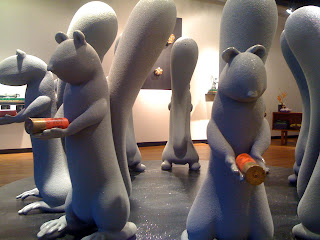
IT TAKES 10 SQUIRRELS TO MAKE A SQUIRREL PIE
(Blown glass and shot gun shells)

ABSINTHE MAKES MY EXTREMITIES FEEL HEAVY
(Blown glass)
Sold

IT'S BETTER TO REGET SOMETHING YOU HAVE DONE
THEN TO REGRET SOMETHING YOU HAVN'T DONE
(Blown and sand casted glass)"

[All Photos by Gather.]

Gather Blog. Gather Gallery [closed April 10, 2009] owner Jenn Jones, post: Thursday, June 19, 2008. website accessed June 4, 2009. http://gatherseattle.blogspot.com/2008/06/quick-peak-at-work-in-erich-wolls_3046.html